Triggering Care Plan Updates From Incident Report Findings
Federal rules require incident findings to trigger care-plan reviews within a strict timeline.
Every incident report filed inside a skilled nursing facility starts a clock. Federal regulation treats detection, assessment, and care plan revision as one continuous chain of tasks, handled on the same timeline by the same people. Facilities that build operations around that chain, rather than around its individual links, hold up under survey scrutiny. Facilities that treat each step as its own isolated task generate citations, penalties, and the resident harm that follows when a change in condition goes unaddressed. That distinction matters more now than it did five years ago, because surveyors have gotten sharper about finding the seams.
The chain has a name for its trigger mechanism: the Significant Change in Status Assessment, or SCSA. A significant change is a major decline or improvement that won't resolve on its own, touches more than one area of a resident's health status, and requires the interdisciplinary team to revise the care plan or, at minimum, formally review it. A rash that clears up in three days is not a significant change. A hip fracture is. The line between those two isn't always obvious. The decision belongs to a team and not to whichever nurse is charting that shift.
The determination is a clinical judgment made collectively, not one staff member's read of a chart, and treating it as an individual call is the first mistake most facilities make. Federal regulation names who sits on the interdisciplinary team: the attending physician, who confirms medical significance; the registered nurse, who coordinates the assessment and documents clinical status; the nurse aide, whose day-to-day observation often reveals the pattern first because of sustained direct contact with the resident; food and nutrition staff, who weigh in on dietary impact; and the resident, or the resident's representative, who participates in the process instead of getting notified after the decision is already made.
Many facilities loop in the physician or medical director specifically to judge whether a change looks temporary or lasting. That's common practice, not a fixed federal requirement, and it reflects how genuinely hard the underlying judgment is. A urinary tract infection that resolves in a week or two is generally self-limiting and unlikely to qualify. A stroke, a hip fracture, or a sustained weight-loss pattern is far more likely to cross the threshold. But the incident type is only a signal. The IDT still has to weigh it against the resident's overall clinical picture, case by case.
Missing or incomplete paperwork is where this turns into a compliance failure, and it's the single most avoidable one in the whole chain. The 14-day clock for completing the SCSA starts the moment the IDT determines a significant change occurred, so that moment needs a date the facility can point to under questioning. The common failure mode is informal consensus: staff generally agree something has changed, care shifts accordingly, and nobody writes down when the determination happened. Without that date, the 14-day window is unauditable. A surveyor who can't find a start date assumes there wasn't one, and that assumption is usually correct.
The specific incident categories that most reliably trigger the chain
Falls are at the top of the list, both in volume and in surveyor attention. A fall resulting in major injury or hospitalization is about as clean a trigger as this framework produces. Pressure injuries follow close behind: a new wound, or a stage progression in an existing one, is a textbook significant-change event.
Behavioral changes count too, when they're new or escalating and touch more than one area of functioning: agitation, refusal of care, sudden withdrawal. Medication errors trigger the chain when there's an observable clinical consequence layered on top of the administrative discrepancy on the med pass record. Hydration and nutrition patterns matter when weight loss or dehydration is sustained and doesn't self-correct. Hospitalization itself is a common trigger point on return, since a resident's baseline may have shifted during the admission in ways the facility hasn't assessed yet.
The underlying test never changes across these categories: does the event touch more than one MDS area, and will it persist without intervention? The category is the starting signal. The analysis that follows is the actual answer, and facilities that stop at the category are the ones that miscode the chain from the first step. These facilities treat "fall" or "UTI" as self-explanatory.
Incidents that don't clear the bar individually still deserve tracking. A string of near-miss falls spread across a few quarters might never produce one dramatic event, but stacked together they can add up to a significant change the facility should have caught sooner.
Where the incident-to-care-plan chain most commonly breaks down in practice
Surveyors are looking for one thing above everything else: follow-through. Notification, monitoring, intervention, care planning. A break anywhere in that sequence creates citation exposure, even when the break looks minor on its own.
The most visible failure is documentation that's incomplete or written after the fact. Surveyors don't read incident reports in isolation; they pull care plans, MDS assessments, nursing notes, and incident logs together and hunt for gaps between them. A handful of breakdown points recur across surveys. Sometimes the incident gets reported, but the IDT never formally decides it rises to a significant change, so the chain never technically starts. Sometimes the SCSA gets initiated, but not every triggered Care Area Assessment gets completed inside the 14-day window. Sometimes the assessment finishes on time, but the care plan revision slips past the 7-day follow-on deadline. And sometimes the revision happens on schedule but reads like boilerplate, generic language standing in for the specific findings the SCSA actually produced, so the aides delivering care never learn what changed.
These failures compound. A surveyor who finds one broken link in one resident's chart doesn't stop there. The natural next move is checking whether the same gap appears in other residents' charts, which widens both the scope and the severity of whatever gets cited.
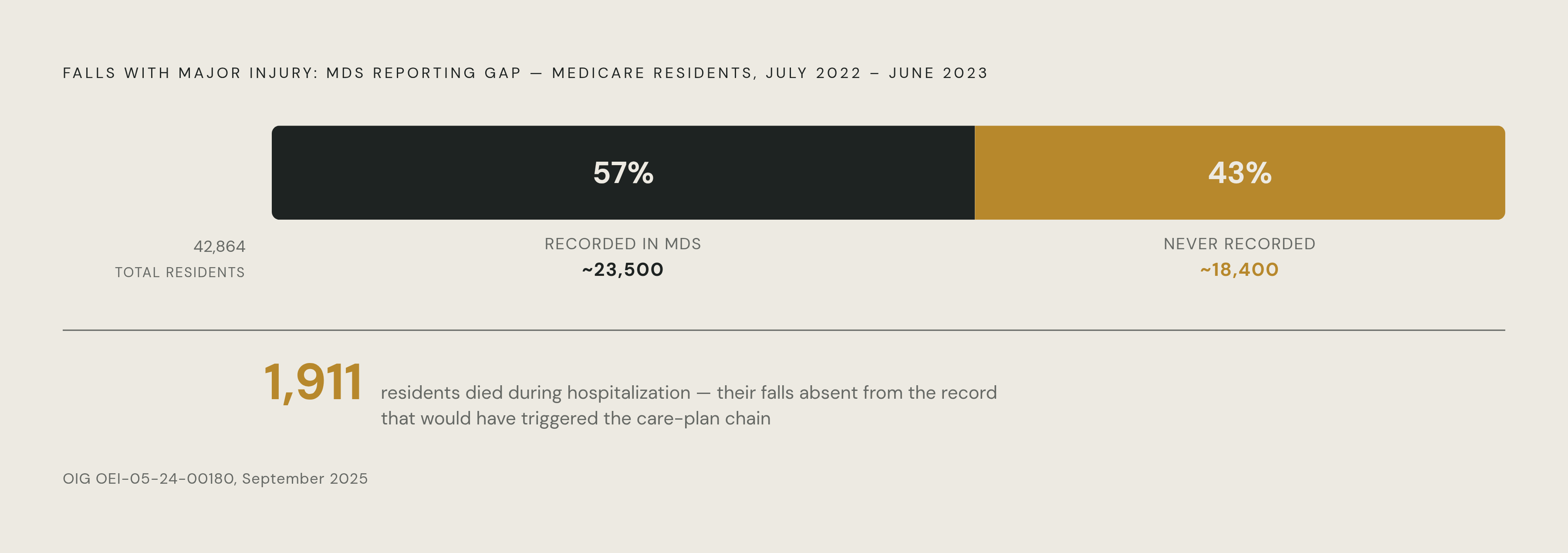
A September 2025 OIG report (OEI-05-24-00180), covering July 2022 through June 2023, found that 43% of falls with major injury and hospitalization among Medicare-enrolled residents never made it into MDS assessments at all, leaving nearly 18,400 of roughly 42,000 qualifying falls unrecorded. That's nearly 18,400 of roughly 42,000 qualifying falls. For every one of those residents, the SCSA trigger never got pulled, because the underlying incident never reached the record that would have prompted it. When an incident goes untracked, the care plan never updates, the next shift never learns what to watch for, and the resident who needed new precautions goes without them. The clinical harm and the compliance failure are the same failure here, seen from two different desks. They're the same failure, seen from two different desks.
How surveyors now investigate the chain, cross-checking each link
Surveyors have moved away from evaluating incidents as standalone events. The current approach triangulates: care plans against MDS assessments against nursing notes against incident reports, checking that each stage of care was actually assessed, planned, and delivered in a way the paper trail can prove.
Since April 2025, updated Long-Term Care Survey Process (LTCSP) guidelines have tightened how surveyors investigate MDS accuracy, psychotropic medication documentation, care planning, and documentation gaps generally. A further update, QSO-26-03-NH, takes effect March 30, 2026, revising Chapters 5 and 7 of the State Operations Manual to sharpen how surveyors investigate those gaps and how facilities are expected to respond once deficiencies surface.
Two F-tags carry most of the weight when the incident-to-care-plan chain breaks. F641 covers MDS accuracy and gets cited when the MDS coding doesn't match what the clinical record shows, a mismatch that carries both a compliance consequence and a PDPM reimbursement consequence, since payment classification depends on the MDS being right. F684, quality of care, gets cited more broadly whenever care falls short of professional standards, including a facility's failure to identify, assess, and respond to a resident's changing needs.
What sharpens the environment further is the cross-checking method itself. Surveyors increasingly compare self-reported MDS data against fall logs, hospital transfer records, and Medicare claims, essentially replicating the matching method the OIG used in its own review. That review found underreporting rates that swung wildly by location, from 21% in South Dakota to 64% in Washington, DC. Patterns like that don't stay contained to a routine survey citation once flagged. Repeated or serious underreporting elevates the nature of the exposure well beyond a routine survey citation. Readiness and quality reinforce each other in both directions, and there's no version of this where a facility gets to claim one without the other.
The financial consequences of chain failures in the current enforcement environment
Civil monetary penalties remain a central enforcement tool, and the FY 2025 final rule's broader quality and payment changes reinforce that compliance failures carry real financial consequences. That reality alone should change how facilities budget for compliance risk.
Separate from CMPs, non-compliance with a related quality-reporting program carries its own bite: a 2% reduction to the annual payment update for facilities that miss reporting requirements. The FY 2025 final rule also raised the payment adjustment tied to quality performance under another program from 2% to 3%, so facilities that underperform on quality measures now lose more of their payment than they used to.
Falls and pressure ulcers, the same two categories where the incident-to-care-plan chain breaks most often, are among the clinical risk areas the FY 2025 final rule places under tightened quality reporting requirements. The categories most prone to documentation failure being now the categories most tightly tied to payment is a deliberate alignment of enforcement with clinical risk. It's a deliberate alignment of enforcement with clinical risk, and the categories most prone to documentation failure are now the categories most tightly tied to payment.
Reimbursement exposure runs parallel to compliance exposure, not apart from it. An F641 citation for MDS inaccuracy hits PDPM classification directly: an unrecorded fall that should have triggered an SCSA can also mean the facility gets paid as though it's managing a lower level of care complexity than it actually is. For facilities carrying elevated underreporting rates, the combined exposure, citations, CMPs, QRP reductions, VBP adjustments, and PDPM miscoding, adds up to a liability that's substantial and almost entirely self-inflicted.
What a reliable incident-to-care-plan process looks like operationally
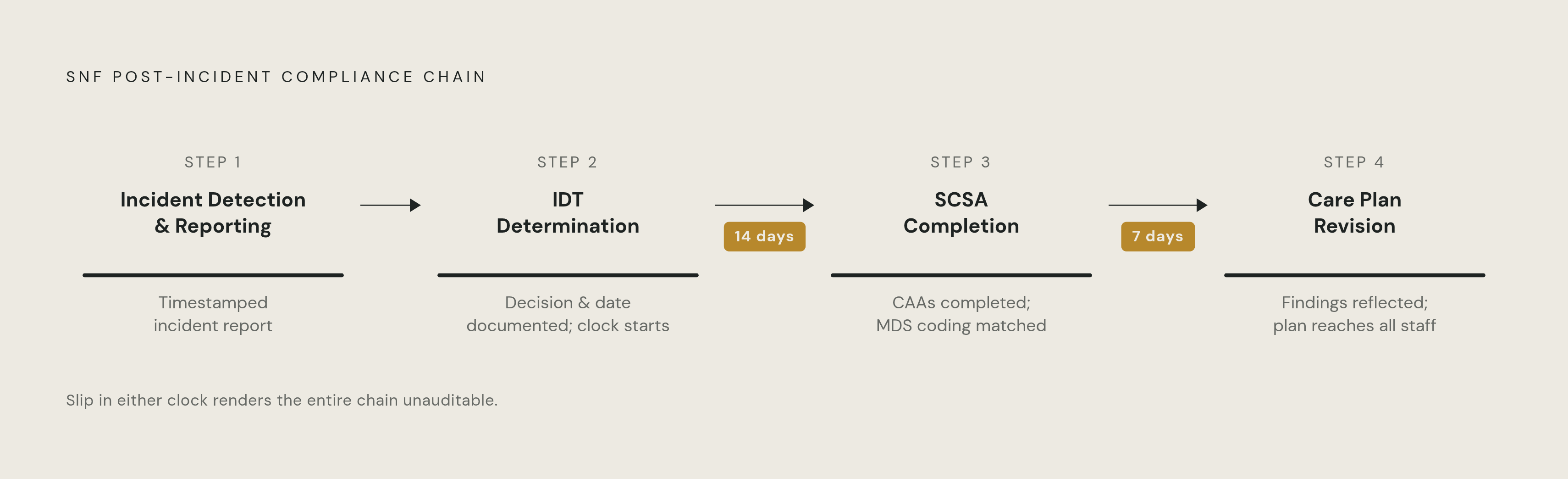
A dependable process breaks into four steps, and each one needs a documented handoff to the next. Skip the handoff and the step might as well not have happened, at least as far as a surveyor can tell.
Incident detection and reporting make up step one: the incident report has to be complete, timestamped, and detailed enough to inform the significant-change determination that follows. The IDT's determination itself is step two, where the team convenes, documents both its decision and the date of that decision, and either starts the SCSA clock or records specifically why the threshold wasn't met. Step three is SCSA completion within 14 days, covering every Care Area Assessment the SCSA triggers, with MDS coding that actually matches the clinical record instead of drifting from it. Step four is care plan revision within 7 days of SCSA completion, and that revision has to reflect the SCSA's specific findings rather than falling back on generic language, with the updated plan reaching every staff member actually delivering care.
Tracking runs alongside this chain, in parallel with it. Incidents that don't individually cross the significant-change threshold still need logging and periodic review, because a pattern, a series of near-miss falls, say, can justify an SCSA even when no single event in the series would on its own. Quarterly reviews, required at least once every 90 days, serve as the backstop for slower-moving changes in weight, mobility, or cognition that never trip the significant-change wire alone.
The resident and resident representative belong inside this process as full participants, with a role in shaping the decision itself. Federal regulation calls for meaningful participation by the resident and resident representative in the care planning process. None of this holds up without documentation discipline, though: the IDT determination date, the SCSA completion date, and the care plan revision date all need to be independently verifiable, because a process that lives only in staff memory is a process no surveyor can confirm.
The baseline care plan for a new admission runs on its own clock, due within 48 hours of admission, distinct from the SCSA-triggered revisions described above. Completing an SCSA resets more than the care plan. It resets the assessment schedule downstream, with the next quarterly assessment due within 92 days of the SCSA's assessment reference date and the next annual comprehensive assessment due within 366 days of that same date. MDS coordinators sometimes miss this scheduling consequence entirely, treating the SCSA as a one-time event instead of a reset point for everything that follows, which is exactly backwards.
Some of the clinical signal that should trigger this chain already sits inside the notes nursing staff write every shift, just not in a form anyone reviews systematically. Tools that read existing, unstructured clinical documentation and identify incident patterns in it can catch what a manual chart review misses, without asking nursing staff to document anything new. That's the operational logic behind the current push toward AI-assisted compliance monitoring in skilled nursing: not a new documentation burden, but a sharper read of documentation that's already there.
Continuous monitoring of the chain versus survey-cycle preparation
Surveys arrive unannounced. That single fact means the incident-to-care-plan chain has to be auditable at any given moment, including in the weeks leading up to a scheduled visit. Facilities that treat readiness as a seasonal project, something to tighten up before an expected window, are unready most of the year by definition, and the unannounced nature of surveys is precisely what exposes that.
Under the CMS risk-based survey pilot, facilities that can show documented, consistent follow-through qualify for a lighter, more focused survey process, while facilities with repeated gaps face escalating scrutiny going forward. The OIG's own data makes plain what's actually at stake here. Of the roughly 42,864 residents whose falls resulted in major injury and hospitalization, 1,911 died during that hospitalization. That's the clearest evidence available that incident underreporting is a clinical safety failure hiding behind clinical language. It's a clinical safety failure with a mortality count attached to it.
Facilities that treat this chain reactively, pulling records together only after a surveyor walks in or after a serious event forces the issue, are already behind before the review even starts. The documentation gaps that create exposure don't form during a survey. They form in real time, one unrecorded incident at a time, on an ordinary Tuesday when nobody in the building was thinking about a survey at all.
Continuous readiness means the IDT determination step never goes informal, the 14-day and 7-day clocks never slip because nobody started them, and trending data flags risk before it hardens into a serious incident. The information a facility needs is almost always sitting in the chart already: in nursing notes, in incident logs, in MDS records. Making that information visible and actionable early enough to intervene is the real challenge, rather than discovering the gap only once a surveyor points directly at it.
Facilities that run this chain reliably gain more than a clean survey. They cut down on the resident harm the whole framework exists to prevent, they free up nursing management time that would otherwise go to reactive scrambling, and they build the documented quality history that decides how lightly, or how heavily, the next survey treats them.