Charting Falls to Satisfy F689 Requirements
Documentation gaps in fall charting, not falls themselves, trigger F689 citations.

F689 is the most frequently cited deficiency in nursing homes, and the reason is rarely what facilities assume. It isn't that falls happen. It's that the chart fails to prove the facility did what the regulation requires before, during, and after the fall. Satisfying F689 is a documentation discipline, and the chart is the compliance record surveyors actually evaluate.
What F689 Actually Requires Facilities to Prove
The regulatory basis is straightforward. 42 CFR § 483.25(d) requires each facility to keep its environment as free of accident hazards as possible and to provide each resident adequate supervision and assistive devices to prevent accidents. That standard does not reference outcomes. It references the conditions a facility maintains and the steps it takes.
CMS Appendix PP turns that requirement into an operational loop with four steps: identify hazards and risks, evaluate and analyze them, implement interventions, and monitor whether those interventions work, modifying the care plan when they don't. The citation attaches when the loop is broken somewhere between recognition and follow-through. They evaluate a documentary record. That makes the chart the primary evidence base at survey, and it means every gap in the chart is a potential gap in compliance.
Why F689 Is Cited So Often Despite Widespread Fall Policies
Nearly every skilled nursing facility has a fall prevention policy. That is precisely the problem. What generates F689 citations is the failure to close the loop from risk recognition to individualized intervention to documented follow-through.
Workflow analysis of F689 deficiencies identifies five recurring breakdowns. Risk identification comes late, often only after a first fall. Care-plan updates never reach the floor where care actually happens. The gap is execution, and the execution record is what surveyors read.
The Four Charting Gaps That Convert Falls Into F689 Citations
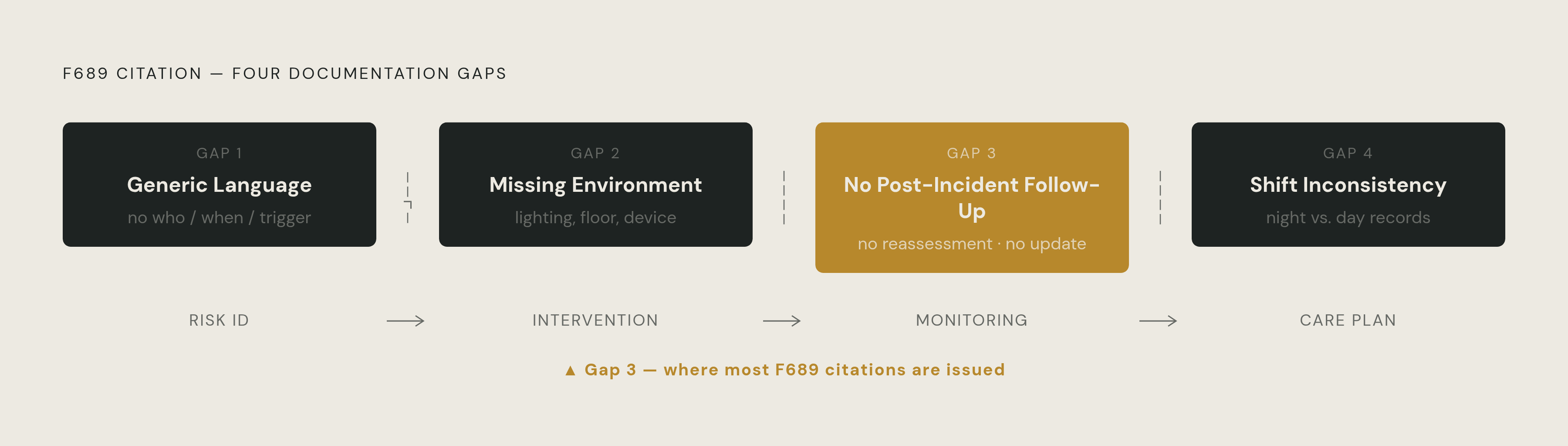
Most F689 citations trace back to one of four documentation failures. Each represents a severed link in the risk-identification-to-monitoring loop, and each is fixable within the charting workflow itself. The first gap is generic intervention language. "Fall precautions in place" tells a surveyor nothing about who does what, when, and under what clinical trigger. It applies equally to every resident, which means it individualizes care for none of them. Surveyors cannot evaluate whether an intervention was appropriate for a particular resident when the language in the chart would fit any resident in the building. The distinction that matters is between a supervision step that actually reaches the floor and one that lives only in the care plan binder.
The second gap is missing environmental documentation. Facilities frequently note that a fall occurred but omit the surrounding context: lighting conditions, floor surface, assistive device placement, call-light accessibility. That context is exactly what surveyors need to determine whether the environment was adequately safe. Without it, the facility has no documentary basis to argue that the accident was unavoidable under the circumstances.
The third gap is thin or absent post-incident follow-up. The incident appears in the record, but there is no documented monitoring schedule, no post-incident assessment, and no evidence the care plan was reviewed or updated afterward. This is where many facilities are actually cited. A pattern of incidents without subsequent risk reassessment is itself a deficiency, because surveyors look specifically for evidence that the first event changed the system in any measurable way.
The fourth gap is shift-level inconsistency. Night-shift incidents get two sentences. Surveyors notice that pattern, and it raises questions about the documentation system and the quality of oversight rather than about any individual nurse's diligence. The inconsistency itself becomes the finding.
What a Real F689 Citation Looks Like When Charting Breaks Down Across Shifts
The abstract gaps become concrete quickly when charting failures compound over weeks. A single resident's fall series can produce a Scope/Severity G citation, the level that reaches actual harm findings, even at a facility that had a care plan in place. The July 2025 South Dakota Department of Health survey of United Living Community in Brookings shows the mechanism with unusual clarity.
The facility was cited at Scope/Severity G for failing to communicate with staff and implement fall prevention interventions. One resident experienced at least six falls between February and July 2025, four resulting in injuries. The care plan existed. What broke down was the transmission of that plan to the people responsible for executing it. Pocket care plans in the facility's care plan binder listed residents who were no longer on the unit and omitted seven current residents. Updated interventions never reached the staff carrying them out. Each subsequent fall in that series became evidence not simply that a resident was at risk, but that the earlier documentation had not been acted upon. That compounding dynamic is what transforms a fall into a G-level F689 citation.
How the Regulatory Environment Just Raised the Documentation Stakes
Since late 2025, three overlapping regulatory changes have made complete and accurate fall documentation a condition of a facility's standing in the system, not merely a component of its survey score. The most operationally urgent is the expanded MDS reporting standard. CMS revised its definition of falls under MDS item J1900 to include external forces and intercepted falls, and it revised the definitions of major injury and injury except major. The MDS 3.0 RAI User's Manual version 1.20.1, effective October 1, 2025, brought these changes as a major revision to the section governing fall coding. A facility's reported fall numbers may rise without any change in actual incidents, simply because the definitions are broader and the documentation requirement is stricter.
The second change is Special Focus Facility designation. In January 2026, CMS made falls data a direct factor in SFF selection for the first time, a departure from the agency's previous reliance on staffing metrics. SFF status triggers intensive, semi-annual survey cycles and can accelerate toward termination from Medicare and Medicaid. Falls documentation now bears directly on a facility's operating license. The third change is financial: CMS is tying bonus payments to fall rates beginning in FY 2027 under the SNF Value-Based Purchasing Program, so documentation gaps that inflate or obscure fall rates carry direct revenue consequences.
The Underreporting Problem and What MDS Accuracy Now Means for Survey Exposure
Accurate fall charting is no longer just a survey preference. It is a legal obligation with federal program exclusion risk attached, and facilities that treat low reported fall rates as a shield are operating on a false assumption. Federal watchdogs have documented that low rates on Care Compare are more likely to reflect underreporting than actual safety.
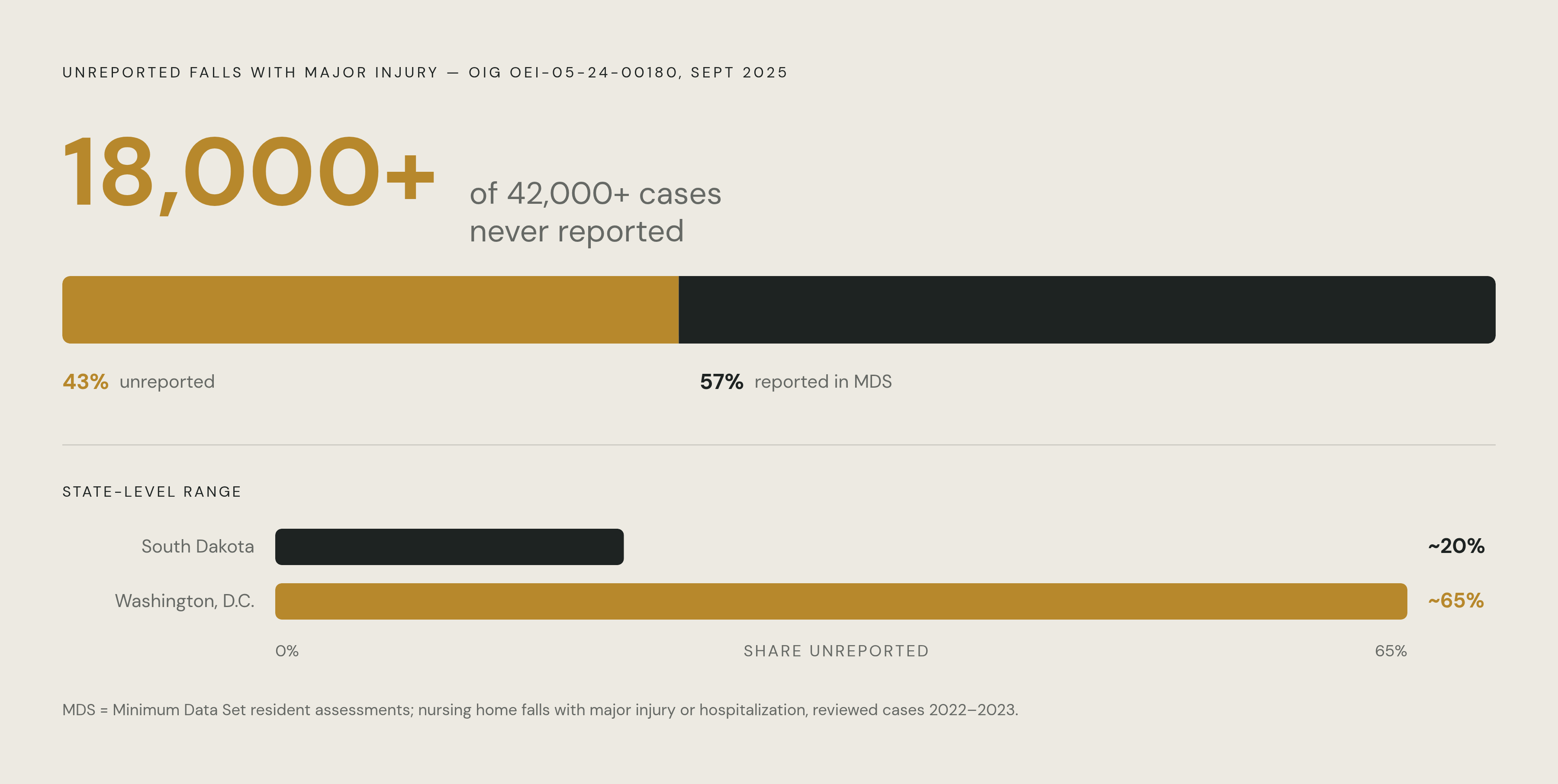
The September 2025 OIG report (OEI-05-24-00180) quantified the problem. Nursing homes failed to report nearly half of falls with major injury and hospitalization in MDS resident assessments. Out of more than 42,000 cases reviewed, more than 18,000 were never reported. Reporting rates varied widely by state, from roughly one-fifth unreported in South Dakota to nearly two-thirds unreported in Washington, D.C. And the legal exposure is explicit. Facilities that knowingly or willfully submit false MDS data may face exclusion from federal programs under 42 U.S.C. § 1320a-7(b)(7). The charting implication follows directly: MDS coding follows the clinical record, so gaps or minimization in nursing notes flow into MDS underreporting, which is now an active OIG and CMS audit target.
What Surveyors Look For When They Read a Fall-Related Chart Entry
A complete post-fall chart entry is not a narrative summary. It is a documentary record that answers the specific questions a surveyor must resolve to determine whether the facility met its F689 obligations. Six elements must appear in a defensible incident record. First, time and circumstances: when the fall happened, what the resident was doing, and what the environmental conditions were. Second, immediate interventions: what staff did in the moment, whether the resident was assessed for injury, and whether a physician was notified. Third, witness information: who discovered or witnessed the incident and whether another staff member was present. Fourth, resident response: the condition immediately following the incident. Fifth, follow-up actions: the monitoring initiated, the care plan update, family notification, and risk reassessment. Sixth, root cause analysis: contributing factors assessed and environmental or care plan changes made in response.
A note that reads "resident was found on the floor" fails every criterion. The care-plan review element carries particular weight. A pattern of incidents without reassessment is, by itself, a basis for citation.
Why the Charting Burden Itself Creates F689 Risk
The gaps that generate F689 citations are partly a knowledge problem but mostly a workflow problem. Nurses working SNF caseloads cannot produce complete, timely incident records through effort alone, and any compliance strategy that depends on individual diligence will fail. The documentation volume is high: nurses in EHR-based systems document hundreds of discrete data points per twelve-hour shift, and charting competes directly with direct care time. Delayed end-of-shift or next-day documentation is similarly structural: detail fades, timing becomes approximate, and the record no longer reflects the urgency with which the incident was actually handled.
The responses that work address the structure rather than the training. Immediate documentation at the point of care, supported by tools that let nurses capture a record by voice while walking away from the incident, makes completeness practical rather than aspirational. And systems that surface unstructured clinical notes already being entered, flagging charting gaps before they become survey findings, close the loop without requiring new data entry.
How Risk Stratification From Clinical Notes Supports the Ongoing Monitoring Obligation
The hardest part of F689 compliance isn't documenting falls that happened. It is demonstrating that the facility was monitoring risk between incidents and adjusting interventions before the next event. Traditional fall risk scoring tools are often inaccurate and burdensome, and the clinical context that matters most, mobility impairment, balance difficulties, confusion, situational observations like "patient unsteady on feet," lives in unstructured nursing notes rather than structured fields.
The evidence that this context can be surfaced is substantial. A study applying large language models with retrieval-augmented generation to unstructured EHR nursing notes in an aged care setting found the method significantly improved risk factor extraction from free-text documentation. A long-term care machine learning study using EHR data from Juniper Communities predicted three-month fall risk across senior care facilities including SNFs, drawing on retrospective data from nearly 2,800 individuals. The consistent limitation across these studies is equally instructive: models relying exclusively on structured EHR data miss important clinical context, and incorporating unstructured data materially improves predictive accuracy.
For F689 purposes, a risk stratification system that surfaces residents whose nursing-note language indicates rising fall risk before a fall occurs provides the documentation trail showing that the facility was monitoring effectiveness and responding. That is precisely what surveyors look for to distinguish avoidable from unavoidable accidents. The tools for meeting it from existing notes are.
Building a Documentation System That Holds Up at Survey
A facility that satisfies F689 at survey is not one that prevented every fall. It is one that can produce, for any resident and any incident, a closed documentary loop from initial risk identification through intervention assignment, shift-level execution, post-incident follow-up, and monitoring-driven reassessment. Five operational elements make that loop defensible. Resident-specific risk language in the care plan, not "fall precautions in place" but who does what, when, and under which clinical trigger, so any surveyor can read the plan and know exactly what was supposed to happen. Environmental documentation at every incident, lighting, floor surface, assistive device status, call-light placement, captured immediately rather than reconstructed later. A discrete follow-up step with its own workflow trigger: monitoring plan, post-incident assessment, care plan review, and family notification documented before end of shift, every time. Consistent documentation quality across shifts, achieved not by demanding more from night staff but through structured templates or AI-assisted tools that produce the same required elements regardless of who is charting or when. And continuous monitoring that generates a visible record between incidents, resident risk scores surfaced from existing clinical notes with a documented response when risk signals change, so that if a fall does occur, the chart already shows the facility was watching and acting.
Qsource's F689 prevention framework states the underlying principle: safety must be embedded in daily work, not just in survey preparation. The documentation system is the evidence that it is. The chart is the compliance record, and surveyors cannot evaluate what was not written. Facilities that treat charting as a workflow outcome, something their systems produce continuously and consistently, will have a materially different survey experience than those that treat it as a response to incidents.