Physician Notification Documentation After Resident Status Changes
Notification requires four documented elements, not just a phone call.
Physician notification after a resident's condition changes is a federal obligation with four distinct parts, and a facility that treats it as a single phone call misunderstands what the regulation demands. F580, codified at 42 CFR § 483.10(g)(14), requires a facility to immediately inform the resident, consult with the attending physician, and notify the resident's representative when a significant change occurs, when an accident involves injury with the potential for physician intervention, when a treatment must be significantly altered, or when a decision is made to transfer or discharge the resident. The triggering conditions run wider than most nursing staff assume. They include deterioration in physical, mental, or psychosocial status, whether that deterioration is life-threatening or a lesser clinical complication, and they include the discontinuation of a treatment because of adverse consequences as well as the initiation of a new one.
The obligation does not end once someone picks up the phone. The facility must also ensure that all pertinent clinical information specified in § 483.15(c)(2) is available and provided to the physician on request. The clinical picture conveyed during that call has to be documented with the same rigor as the fact of the call itself. A notification that happened but left no record of what was actually communicated satisfies the letter of the regulation in name only.
Four documentation elements follow directly from this structure: who was notified, when the notification occurred, what clinical information was conveyed, and what orders or decisions resulted from the conversation. The absence of any single one of these four elements is the exact gap a surveyor will exploit when building a citation. This four-part framework is the spine against which every subsequent argument in this piece is measured, because surveyors now use it to measure a facility's chart.
Where F580 sits in the survey tag structure
F580 does not exist as an isolated administrative requirement. CMS places it within the resident rights section of the federal tag structure, alongside F552 (informed decision-making), F553 (care planning participation), and F551 (rights exercised by representative), and this cluster of tags, when cited together at certain severity levels, can rise to the level of Substandard Quality of Care. A missed notification exposes a pattern that surveyors are trained to read as evidence of a broader failure in how the facility identifies, tracks, and responds to resident risk.
The survey record bears this out. At Waters of Martinsville, a 103-bed skilled nursing facility, surveyed April 15-16, 2025, the CMS-2567 Statement of Deficiencies shows F580 cited alongside F655 (Baseline Care Plan) and F689 (Accident Hazards/Supervision), confirming that surveyors treat a notification gap as evidence of a broader care-planning and safety failure. Surveyors did not treat the notification gap as a standalone clerical lapse. They treated it as one symptom of a facility that was not tracking resident risk consistently across care planning, supervision, and communication.
The enforcement record carries the same lesson with sharper consequences. In the Highland Pines case (CR6922), summarized by Kairos Health Systems in a September 2026 legal update of an underlying HHS DAB ALJ decision, required foot and skin assessments were not performed or accurately documented, delaying recognition of spreading gangrene. An administrative law judge upheld a civil monetary penalty of $22,584, and the ruling turned specifically on whether contemporaneous records proved that required care had actually been delivered. The clinical outcome mattered to the case, but the deciding factor was documentation: whether the chart could prove, after the fact, that the required steps occurred when they were supposed to occur. A missing entry did not just weaken the facility's defense. It became the entire basis for liability.
That lesson lands differently now than it would have two years ago, because the survey environment in which these citations are assessed has itself shifted substantially in 2025 and 2026.
What the Risk-Based Survey rollout means for F580 exposure
CMS issued QSO-26-14-NH, implementing the Nursing Home Risk-Based Survey nationwide for eligible facilities beginning September 8, 2026. The RBS is a streamlined recertification process: fewer surveyors, a smaller resident sample, and roughly half the time of a traditional survey. Eligibility requires no Actual Harm, Immediate Jeopardy, or Substandard Quality of Care citation during the facility's last survey cycle, the exact severity levels an F580 citation can reach once co-cited with harm-related tags.
The incentive structure this creates is new, and it changes what a notification gap actually costs a facility. A facility that qualifies for RBS status earns a "High Performing Facility" icon on Nursing Home Care Compare beginning September 30, 2026, and losing that icon because of a pattern F580 citation is a setback that shows up in admissions and marketing, not only in a compliance file. A facility that once absorbed an F580 finding as a line item in a plan of correction now risks losing a visible public designation that drives referral decisions.
RBS eligibility is not a shield once a survey begins. If surveyors identify resident-safety concerns during an RBS, the survey expands on the spot, and a facility that enters a streamlined survey with undocumented notification gaps becomes more exposed than it would have been under the traditional process once those gaps surface mid-survey. The smaller sample size and shorter survey window do not mean a lighter standard. A facility has fewer opportunities to demonstrate, across a broader resident population, that its documentation habits are consistent, so any gap that does surface carries more weight per instance.
Compounding this, the July 2026 recalibration of the star ratings raised thresholds across star levels two through five, so a facility's star rating can decline even when its underlying quality scores have not moved. The margin for error on documentation-driven deficiency patterns has narrowed at the exact moment the reward for staying clean of them has grown more valuable. Notification documentation has stopped being a purely clinical or compliance matter and become a strategic one, tied directly to a facility's public standing and its exposure under a faster, less forgiving survey model.
Where the documentation chain breaks in practice
Most failures trace back to workflow rather than a missing policy. Most facilities have a notification policy that reads correctly on paper. The failure sits in daily workflow, where responsibility for monitoring residents and flagging high-risk changes falls to nursing staff working under time pressure, and a missed notification is as often a workflow failure as it is a knowledge gap about what F580 requires.
Split documentation systems make this worse structurally. A nurse can make the call, relay the clinical picture accurately, and receive an order, and still leave no defensible trace of any of it if the systems on either end of that conversation do not talk to each other.
Unstructured clinical notes deepen the problem. Progress notes are a key data source for identifying a status change, but most skilled nursing EHRs do not systematically extract that narrative text to generate a notification trigger. The clinical signal that a resident's condition has shifted often exists somewhere in the chart well before anyone acts on it. It just does not automatically produce the documented response the regulation requires.
CMS has effectively acknowledged this. CMS acknowledged in the FY 2026 SNF QRP final rule that some licensed healthcare professionals have limited data capture in EHR systems, and that limitation can cause their contributions to care quality and outcomes to be overlooked, a federal concession that the documentation infrastructure itself is part of the problem. That is a federal admission that the infrastructure clinicians work within is part of the compliance problem, not simply the people using it.
The documentation universe is also expanding. The CMS final rule known as CMS-1843-F, issued in July 2026, will require MDS data submission on all SNF residents receiving covered skilled care regardless of payer, phased in starting with residents admitted on October 1, 2029, for the FY 2031 SNF QRP. As that requirement phases in, the set of records that must stay internally consistent with physician notification documentation grows larger, and inconsistencies between MDS data and notification records become easier for a surveyor to spot.
The facility must produce a timestamped, physician-consulted, representative-notified record that a surveyor will accept as proof that the four required steps happened when they were supposed to happen. Knowing and proving are two different capabilities, and the gap between them is where most F580 citations originate.
What complete notification documentation looks like, element by element
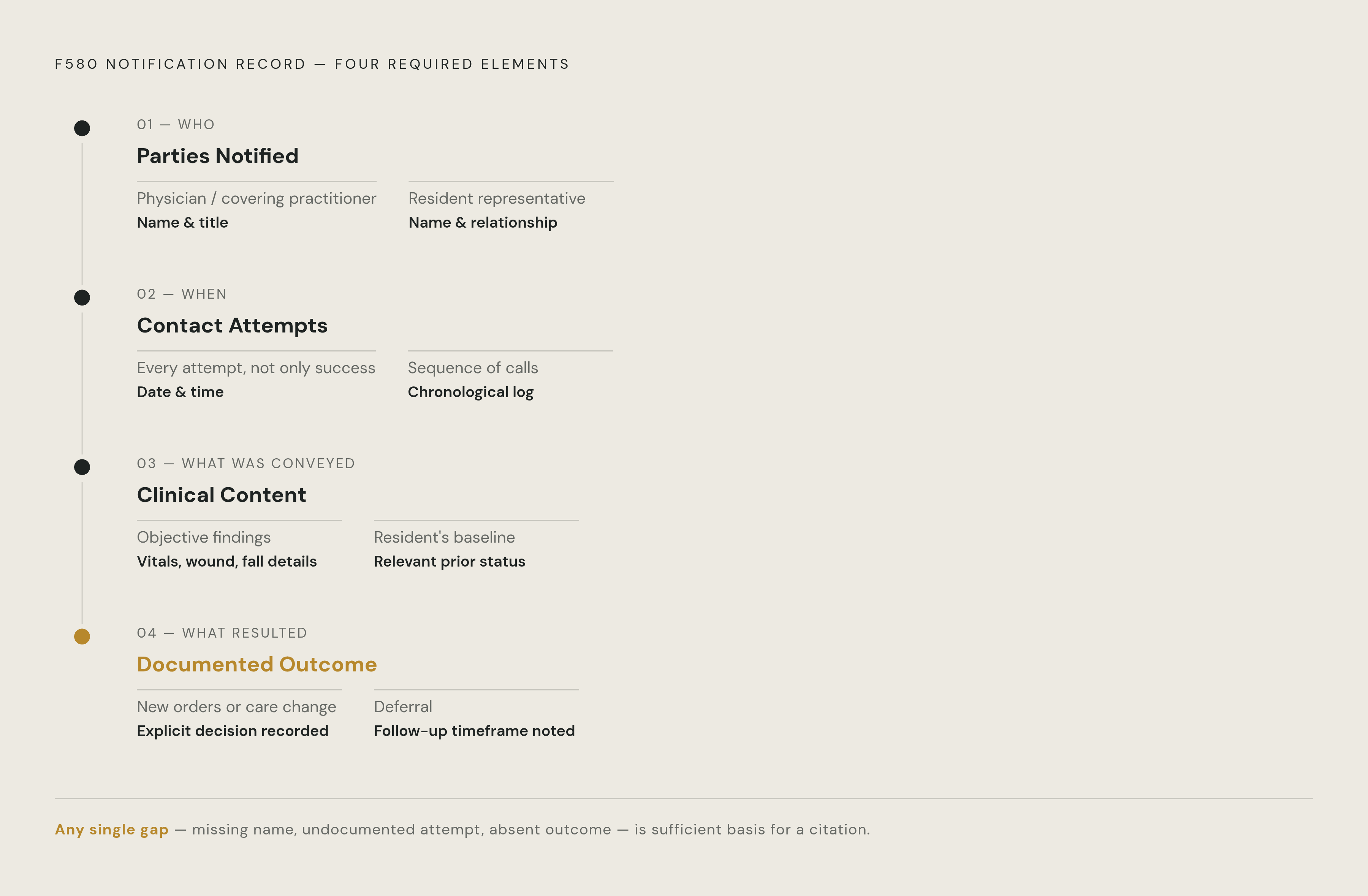
A defensible F580 record is a structured entry that closes each of the four accountability loops named earlier: who was notified, when, what was conveyed, and what resulted. Each element maps to a specific piece of the regulatory text, and each one needs its own discrete entry rather than a single narrative paragraph summarizing the whole event.
The chart needs the name and title of the physician or covering practitioner actually contacted, and if a non-physician practitioner responded first, the record should show the chain of contact that eventually reaches the attending. It also needs the name of the resident representative notified and that person's relationship to the resident. If notification of the representative was delayed or waived, the reason has to be written down. An unexplained absence of that notation is itself something a surveyor will flag.
The record should show the date and time of every contact attempt, not only the one that succeeded. A log showing two unanswered attempts before a third successful call demonstrates diligence in a way a single timestamped entry cannot. F580's requirement that notification happen "immediately" is not tied to a fixed clock time; surveyors instead assess how quickly notification followed the identification of the change, so the chart has to make that sequence of events legible on its own. The interval between when a status change was first observed or charted and when the physician was actually notified is the single detail a surveyor is most likely to scrutinize.
This section of the record needs the specific, objective findings: vital signs, observed behavior, wound appearance, or the circumstances of a fall, rather than a vague characterization like "resident declined." The pertinent information required under § 483.15(c)(2) has to be documented as having actually been provided to the physician, and this is the provision most often assumed rather than recorded. The record should also note the resident's relevant baseline, what was normal for that individual, so the current presentation reads as a documented departure rather than an isolated observation.
Any new orders, changes to existing orders, or an explicit clinical decision to continue the current treatment plan all belong in the record, and a decision to make no change is itself an outcome that needs to be written down as one. If the physician deferred a decision or asked for a follow-up assessment, the expected timeframe and the monitoring put in place in the meantime should be documented. If the notification led to a transfer or discharge decision, that triggers its own separate documentation chain under F627 and F628, and the F580 record needs to cross-reference it rather than stand alone.
Updated regulatory guidance and surveyor training
Surveyors are not evaluating notification records against a static standard. CMS's January 2025 memo, QSO-25-12-NH, announced revisions to Appendix PP of the State Operations Manual that took effect on April 28, 2025, and those revisions specifically covered how F580 and other resident rights tags are evaluated. Constellation Quality Health's analysis of these updates noted that surveyors are now applying a data-driven approach to identifying areas for closer review. Citation patterns across a facility inform how deeply a surveyor digs into notification documentation rather than each incident being assessed in isolation.
CMS also revised Chapters 5 and 7 of the State Operations Manual effective March 30, 2026, changing how complaints get prioritized, and facilities with complaint-driven F580 findings are now more likely to face focused follow-up under the RBS framework. A single complaint about a delayed notification can now trigger a level of scrutiny that extends well beyond the incident that prompted it.
Surveyors are trained to trace a notification chain backward from an outcome, a pressure injury, a hospitalization, a fall, to the moment of first clinical observation, and to check whether every required step along that chain was recorded as it happened. A chart that reconstructs the sequence accurately after the fact is far more vulnerable to citation than one where each entry carries its own timestamp from the moment it was created. The four-element framework described above is a requirement, not a best practice offered as a suggestion. It is a direct answer to how surveyors are now trained to read a chart.
Continuous monitoring of clinical notes and the F580 documentation record
The gap identified earlier, that clinical signals sit in unstructured notes without automatically producing a timestamped, attributed notification record, is exactly the gap that continuous monitoring of the EHR is built to close. Rather than relying on a nurse to notice a change, flag it manually, and then separately document the notification that follows, continuous monitoring tools read the clinical narrative as it is written and surface the moment a documented trigger appears.
Field evidence supports the underlying mechanism. A study tracking 94 skilled nursing communities using an AI-enhanced EHR against a comparison group without that capability found that 16 of 18 quality measures showed statistically greater improvement in the AI-enabled group, and the mechanism behind that improvement was software surfacing early deterioration signals that anchor the notification chain before a status change becomes a surveyor-visible event. A predictive model used SNF EHR data, including vital signs, diagnoses, laboratory results, food intake, and clinical notes including progress notes, to predict hospitalization or death within seven days, demonstrating that the data needed to trigger physician notification earlier already exists in the chart. Maryland's Real Time program, where a majority of participating nursing homes had signed business associate agreements as of the first quarter of 2025, shows that structured analytics built on existing EHR data can perform this monitoring function without adding a new documentation task to a nurse's workload.
For a facility running its clinical documentation on an existing platform, the practical path forward is a monitoring layer that reads nursing notes as they are written, identifies the clinical triggers that meet F580's definition of a significant change, surfaces them to nursing managers in real time, and generates a timestamped record of when that alert was produced. That timestamped alert becomes the anchor for the four-element documentation chain: it marks the moment the change was identified, against which every subsequent notification, consultation, and order can be measured.
Technology alone does not guarantee the cultural discipline required to act on an alert once it appears. A monitoring system can surface a trigger accurately and still leave the outcome to the judgment and follow-through of the staff who receive it. The documentation framework and the monitoring mechanism have to work together rather than as substitutes for one another.
Sources
- DEPARTMENT OF HEALTH & HUMAN SERVICES Centers for Medicare & Medicaid Services
- eCFR :: 42 CFR Part 483 -- Requirements for States and Long Term Care Facilities
- Federal Regulatory Groups for Long Term Care
- Navigating the 2025 CMS Updates: Key Changes for Long-Term Care Facilities - Constellation Quality Health
- 2026 Long Term Care Provider State and Federal Legal Update
- State Operations Manual Appendix PP - Guidance to Surveyors for