CMS F-Tag Categories That Most Often Cite SNF Documentation
Five F-tags account for most nursing home citations, driven by documentation gaps.

Every deficiency cited in a skilled nursing facility survey is assigned a specific F-tag, a code that ties the finding to a requirement in 42 CFR Part 483. That code follows the facility through enforcement, public reporting, and the Five-Star Quality Rating system, which means a survey finding is never a closed matter. It becomes a durable part of the facility's regulatory record, and its weight persists long after the survey team walks out the door.
Each F-tag maps to a section of the Code of Federal Regulations. Citations appear on Form CMS-2567, the Statement of Deficiencies and Plan of Correction, and from there they enter the public record. The Five-Star health inspection rating is built directly from these findings, so a citation is simultaneously an enforcement action and a reputational marker that prospective residents and their families can see.
Scope and severity combine into a letter grade from A to L. A D-level citation, representing more than minimal harm to an isolated resident, is worth 4 points. The severity of a citation, not its raw frequency, is what drives star-rating damage.
The health inspection star is built from the two most recent standard surveys plus complaint and focused infection-control surveys over the preceding 36 months, with the most recent standard survey cycle weighted more heavily. Documentation gaps compound across cycles rather than resetting when a new survey begins. Standard surveys are unannounced and must occur no later than 15 months after the previous one, while complaint investigations and focused infection-control surveys can add further F-tags at any point, and those findings count toward the rating as well. The F-tag system itself was renumbered in 2017 as part of the revised Requirements of Participation that took effect November 28, 2017. Any accurate reading of survey data depends on understanding that current numbering system.
Which F-tag categories are cited most often nationally
A consistent set of categories accounts for a disproportionate share of all citations nationally, and the same names appear at the top of every recent CMS data release. The pattern has remained stable across years, which itself signals something about the underlying drivers. These are not random or idiosyncratic findings. They are structural.
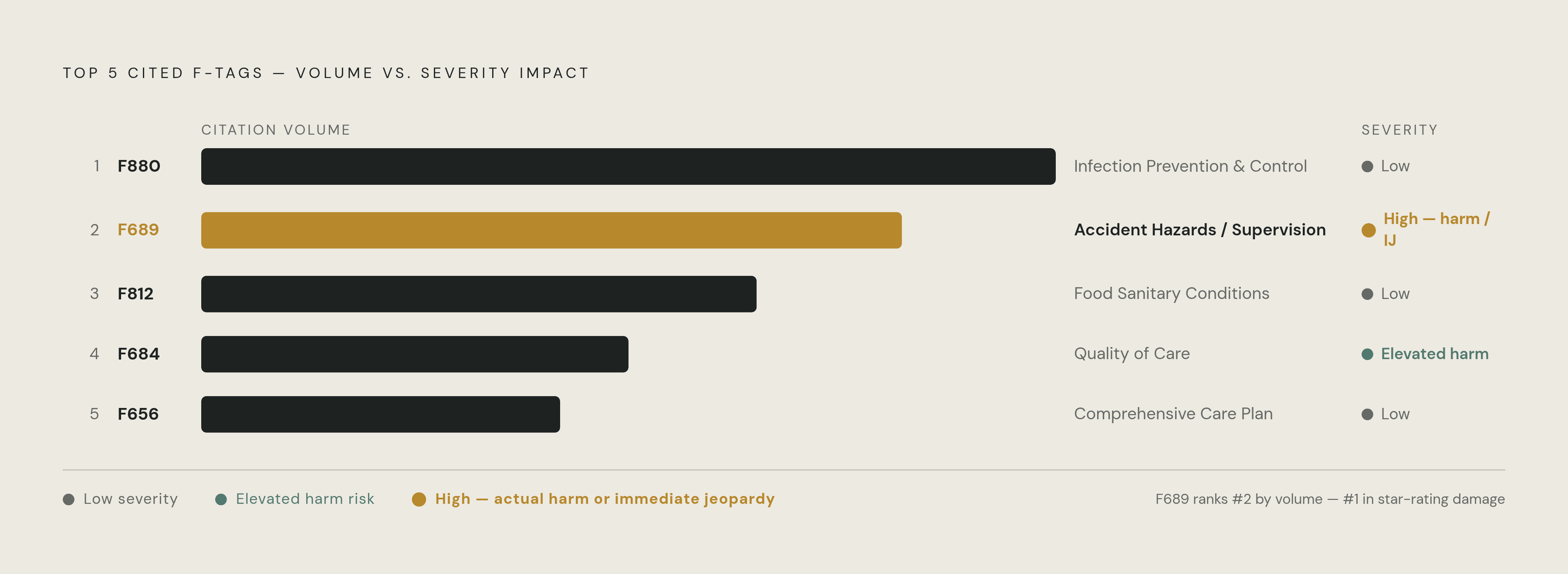
F880, Infection Prevention and Control, is the single most-cited tag nationally, appearing at the vast majority of nursing homes. It covers the infection prevention and control program, antibiotic stewardship, and the IPCP coordinator requirement. F689, Free of Accident Hazards and Adequate Supervision, sits consistently second. Its distinguishing feature is not its volume but its severity profile: a large share of its citations involve actual harm or immediate jeopardy, the most serious finding levels, which gives it an outsized impact on star ratings relative to its rank by raw count. F812, Food Procurement, Preparation, Storage, and Service Under Sanitary Conditions, appears among the top three by volume in recent CMS data, covering how nursing homes obtain, store, prepare, and serve food.
F684, Quality of Care, requires facilities to provide care and services that help each resident attain or maintain their highest practicable physical, mental, and psychosocial well-being. It is cited frequently when staff fail to notify a physician of a change in a resident's condition, or when a failure to act results in a decline in well-being. F656, Develop and Implement a Comprehensive Care Plan, is cited for missing or inadequate individualized care planning documentation. It sits within the broader Care Planning category, which also encompasses MDS comprehensive assessments and discharge planning. These five categories cluster in 42 CFR Part 483 Subpart B, the portion of the regulations covering resident rights, quality of care, infection control, and food and nutrition services. That clustering is significant: the most-cited categories are not scattered across unrelated domains but concentrated in the areas where ongoing, individualized care delivery must be continuously translated into documentation.
Why the most-cited categories are overwhelmingly documentation-driven
The categories that dominate national citation reports are not primarily about facilities delivering bad care. They are about facilities failing to make good care visible to a surveyor through adequate documentation. The survey team reviews the records, interviews staff, and observes practice, but the evidentiary foundation is what the facility can produce. If the documentation does not exist, the care cannot be credited.
Infection control makes the point concretely. F880 is frequently cited not because facilities lack policies but because those policies are not always followed or monitored consistently, and because the monitoring itself is not documented in a way a surveyor can verify. What the surveyor needs to see is evidence that the program is operating continuously across every shift, that deviations are caught and corrected, and that staff competency is maintained. When that evidence is episodic or absent, the citation follows from the documentation gap rather than from any demonstrable infection event.
Food safety shows the same pattern. F812 deficiencies often reflect lapses in kitchen documentation or training records rather than actual foodborne illness incidents. Five recurring failure patterns appear across Statements of Deficiency: early detection failures, communication failures, failures to follow policy and procedure, inaccurate documentation, and staff performance failures tied to lack of familiarity with nursing home operations. Each of these is fundamentally a documentation failure, not a care delivery failure. Documentation is both the detection mechanism and the compliance defense.
F656 and the care planning cluster: where documentation gaps are most structurally exposed
The Care Planning tag cluster, spanning F636 through F660 and anchored by F656, F657, and F658, is the place where a single documentation gap most reliably generates multiple simultaneous citations. The mechanics of this cluster explain why. Each tag describes essentially the same gap from a different regulatory angle, so when the underlying documentation fails, the surveyor can apply several tags at once. F656 requires facilities to develop and implement a comprehensive, person-centered care plan for each resident, and it is cited frequently for care plans that are missing, generic, or not updated to reflect changes in the resident's condition. F657, which governs care plan timing and revision, and F658, which requires services to be provided by qualified persons, are routinely cited alongside F656. A single missing or outdated care plan can simultaneously trigger all three.
The structural exposure runs deeper. The MDS 3.0 comprehensive assessment, governed by §483.20, is the input that care plans are built from. When MDS coding is incomplete or inconsistent with narrative nursing notes, the care plan built on that assessment is by definition deficient. One upstream documentation gap propagates downstream into multiple tags. The pharmacist consultation illustrates how quickly this compounds. Unsigned orders, late progress notes, and missing physician notification records sit at the same exposure point, and F842 citations trace each one back to its source. A periodic internal audit of these items, conducted by chart rather than by event, catches them before a surveyor does.
F689 and F684: how documentation failures turn clinical events into harm citations
F689 and F684 are the tags most likely to generate harm-level or immediate-jeopardy findings, which makes them structurally different from the high-volume monitoring tags. When a fall or a decline in condition occurs, the surveyor does not simply evaluate the event itself. The surveyor evaluates the record of what the facility knew and did. If that record is incomplete, the event becomes a harm citation.
F689, rooted in §483.25(d), requires the facility to keep the resident environment as free of accident hazards as possible and to provide adequate supervision and assistive devices. A large share of F689 citations involve actual harm or immediate jeopardy. For fall-related findings, the surveyor expects to find a complete documentation chain: an initial fall-risk assessment, an updated care plan reflecting that risk, documented staff response to each incident, and evidence that the care plan was revised after each fall. A gap at any link in that chain becomes a citation point. A fall that was responded to appropriately but not documented in the incident record, and not reflected in a revised care plan, is from the surveyor's perspective a fall that was not responded to at all.
F684, under §483.25, is among the broadest quality-of-care standards, and it is most often cited in two specific situations: when staff do not notify the resident's physician of a change in medical condition, and when a failure to provide needed care results in a decline. The surveyor sees two different facilities because the documentation chain is the clinical story the surveyor reads. When that chain is broken, the facility has no narrative to offer in its defense.
F880 and F812: high-volume, low-severity tags that signal systemic monitoring failures
F880 and F812 generate the highest raw citation volumes for a reason that is distinct from the severity-driven risk of F689 and F684. These tags need continuous, documented monitoring, and most facilities struggle to sustain it across every shift and every department. F880, under §483.80, encompasses the infection prevention and control program, antibiotic stewardship, and the IPCP coordinator requirement. It is cited most often not because facilities lack policies but because consistent implementation and monitoring across all staff and all shifts is not documented in a way that survives scrutiny. Every patient encounter, every shift, every time a staff member follows or fails to follow a protocol is potentially within scope, and a documentation system that captures compliance episodically will always produce gaps a surveyor can cite.
F812 shows the same mechanism in the dietary department. Deficiencies frequently reflect lapses in kitchen-level documentation, temperature logs, storage records, or training files, rather than actual foodborne illness events. The aggregate effect of these high-volume, lower-severity citations matters in ways that individual severity profiles do not capture. Because the Five-Star health inspection rating accumulates points across all citations in a survey window, a facility with many D-level F880 and F812 findings can absorb significant star-rating damage even without a single harm-level citation. High-volume tags are a slow bleed, not a sharp wound.
How the documentation burden distributes across nursing staff and why it accumulates into gaps
The documentation failures behind the top-cited F-tags are not failures of effort or knowledge. A nurse documents a large number of unique data points across multiple flowsheets and forms on a shift, so little capacity is left for the narrative clinical notes that carry the compliance signal surveyors actually evaluate. The irony is that the narrative notes are precisely where the most meaningful compliance information lives, and precisely where the gap originates.
The large majority of data in an EHR is unstructured: clinical notes, shift summaries, and patient narratives written in the nurse's own words. No one systematically cross-checks those narrative notes against coded MDS fields, so a nurse can document a fall in a shift note, complete the note accurately, and move on to the next resident, while the formal incident assessment is never initiated, the MDS fall-coding field never reflects the event, and the care plan never gets revised. All three omissions remain invisible until a surveyor traces the chain backward and finds the break. The system that was supposed to connect that documentation to the required follow-up simply did not exist.
Many facilities respond to these gaps by adding more documentation steps, but poorly structured processes create their own risks. Staff burnout rises, decision-making slows, and new inconsistencies appear between fields that did not previously exist. Without that loop, every additional training session adds knowledge without closing the gap.
What a proactive documentation strategy looks like for each major citation category
Closing the documentation gaps behind the top-cited tags requires category-specific strategies tied to the regulatory trigger each tag responds to. A single blanket documentation improvement effort will not work, because the failure modes are distinct. For the Care Planning cluster, the core requirement is that every change in a resident's clinical status, a new fall, a medication change, a wound development, triggers a documented care plan revision within the regulatory window. The facility's process for initiating that revision, not just the revision itself, must be auditable. Drug regimen review findings from the consultant pharmacist must be documented as integrated into the care plan rather than filed separately. Unsigned orders, late progress notes, and missing physician notification records need periodic internal audit by chart rather than by event.
For F689 and falls, the documentation chain from initial risk assessment through care plan revision after each incident must be producible for every high-risk resident. Every link has to exist. For F684, the two most common citation triggers, failure to notify a physician of a change in condition and failure to provide needed care resulting in decline, are both traceable to specific documentation events: a timestamped notification entry and a care response note. These should be treated as mandatory structured documentation fields, not optional narrative additions. Tracking resident health trends forward, not just documenting discrete events, is what allows a facility to show that it detected and acted on a developing pattern before it became a decline.
For F880, the documentation target is evidence of ongoing monitoring: shift-level compliance logs, staff competency records, and IPCP coordinator activity records, not just the policy document itself. For F812, maintain temperature logs, storage inspection records, and dietary staff training documentation continuously rather than reconstructing them before a survey. Across all categories, the common structural solution is identical. A system that reads what nurses already document and cross-checks it in real time against what the regulatory requirement demands surfaces the gap at the moment it opens, not at the moment a surveyor finds it. Tools that extract compliance signal from existing EHR documentation, reading unstructured clinical notes against coded fields and flagging inconsistencies, address the root cause rather than adding new documentation burdens to already stretched nursing staff.