Family Goal Integration in Care Plans Without Duplicating the Social Work Record
One-directional workflows from social work records into care plans eliminate duplication.
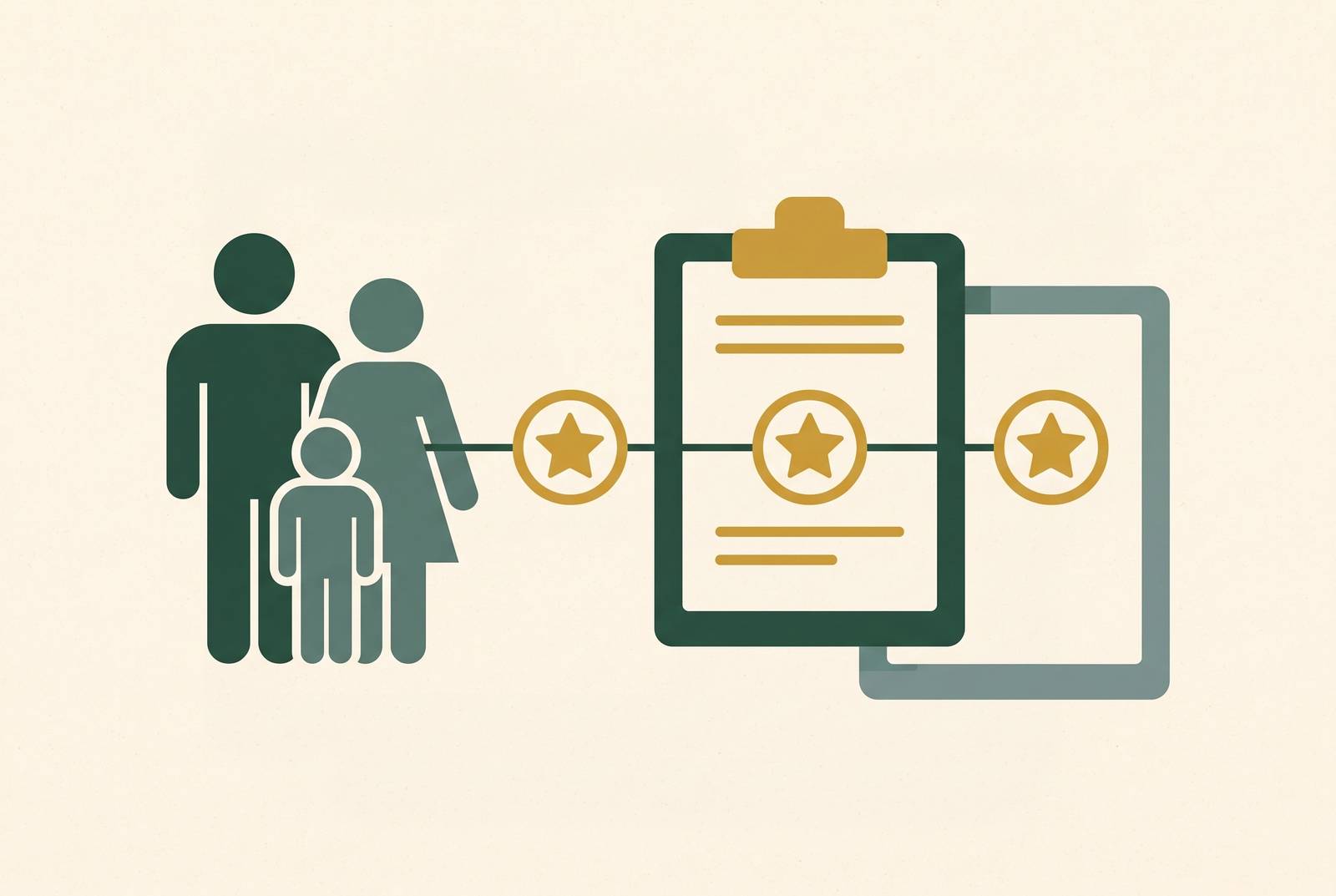
Integrating family goals into SNF care plans requires a one-directional workflow that treats the social work record as the authoritative source and carries its content into interdisciplinary planning. This approach preserves the purpose of both documents while reducing conflicting entries, protecting staff time, and making family goals usable in clinical care.
Why family goals keep getting entered twice in SNF care plans
A social worker documents a family’s goal in a meeting summary, and a nurse re-enters a version of it into the care plan module the next day. The information was already available, but the workflow required another entry. The second author may use different wording, even when both disciplines understand the goal in the same way. Once the entries exist separately, each can change without the other changing. The problem begins with how information moves.
Most social work documentation is made up of psychosocial histories, family meeting summaries, and preference conversations. These narrative records sit in a part of the EHR that care plan modules often cannot draw from automatically. MDS assessments are also frequently completed in stand-alone software separate from the facility EHR, requiring staff to re-key relevant information. Poor interfaces and structured forms that do not capture all relevant domains compound this separation. As a result, “prefers morning showers” may appear in a social work note, an MDS Section F response, and a nursing care plan entry, with each version entered independently.
What federal regulation actually requires, and where duplication enters the picture
Under 42 CFR 483.21, a baseline care plan that includes social services must be in place within 48 hours of admission. It also requires a comprehensive care plan within seven days after completion of the comprehensive assessment. The interdisciplinary team preparing that plan must include the attending physician, the registered nurse responsible for the resident, a nurse aide, and food and nutrition staff. The resident and their representative must participate to the extent practicable. These requirements bring family-goal information into several documents and involve several people in its use.
The plan must then be reviewed and revised by the interdisciplinary team after each assessment. CMS’s RAI Manual version 1.20.1, effective October 1, 2025, requires a Significant Change in Status Assessment, including every triggered Care Area Assessment, within 14 calendar days after a significant change in condition is determined. The care plan must then be revised within 7 more days after that assessment. Admission, quarterly reassessment, and significant change therefore create successive points at which preferences and goals must be considered. Without a source to draw from, the person filling out each document may enter the family goal again.
Why duplicated entries are a survey citation risk, not just an efficiency problem
Separate entries create a compliance risk when their meanings diverge. Medical records must “tell the resident's story,” showing how decisions relate to the resident’s condition, goals, and changing needs. A preference recorded by social work but absent from the care plan leaves that relationship incomplete. A contradictory nursing entry makes it harder to establish which preference guided care. CMS’s State Operations Manual, Appendix PP, directs surveyors under F553 to evaluate whether resident preferences actually shaped the plan’s goals.
The assessment deadlines make this a time-bound responsibility rather than a general expectation of good documentation. If a changed goal is recorded only in the social work record, the revised plan may still be incomplete when the SCSA assessment and care plan windows have passed. QAPI reviewers can find these gaps by checking whether Section F preferences appear in care plan goals and whether the record explains why it was not practicable for the resident to take part.
CMS announced that a new Risk-Based Survey process for nursing homes that qualify will begin nationwide on September 8, 2026. The process is designed to let State Survey Agencies redirect resources toward facilities where residents face greater risk of harm. In that environment, a coherent, person-centered record remains important evidence of how care is planned. Duplicate entries weaken that evidence when they leave competing accounts of the resident’s goals.
What person-centered care planning actually requires from the social work record
Person-centered planning begins with the resident’s goals, including family input when the resident cannot speak for themselves. In that circumstance, the care team must discuss with families what they think the person’s goals would be. If family is also unavailable, staff determine as best they can what those goals might be. Social work is the natural first point of contact and documentation owner for these conversations. When resident participation is not practicable, the medical record must explain the reason.
The care plan has a different function from the account of that conversation. Strong goals specify function, measurement method, assist level, conditions, and timeframe. A narrative family goal therefore needs translation into a measurable care plan goal. The social work record preserves the originating information, while the care plan states how the team will apply it.
The physician, RN, nurse aide, nutrition staff, social services, and resident or representative contribute to the plan through review and validation. Their participation does not require each discipline to write a separate account of the same family conversation. Treating social work as the authoritative source is a workflow design for meeting the person-centered standard.
How to build a one-directional flow from the social work record into the care plan
The first step is for social work to capture the family goal in the social work record as the authoritative entry. With multidisciplinary documentation templates, staff can record social work, therapy, and dietary visits in one resident chart. An interdisciplinary care plan builder can then turn assessment findings into problems, goals, interventions, and outcomes that disciplines update in one place.
The second step is a structured handoff that makes the source entry available during care plan development. That handoff may use a tagged field, a care area link, or a prompted review step. When Section F is complete, staff should review the care plan without making another separate entry of the family goal. At reassessment, the same pathway should bring forward the current social work record, with social work updating it when circumstances have changed.
The third step is for nursing and the other disciplines to translate the documented priority into an appropriate plan and confirm its clinical use. EHR integration can support this flow by reducing the need to move information manually between systems. Where automatic population is unavailable, a documented handoff protocol can establish the same direction of accountability. Social work signs off that its record has been reviewed before the care plan is finalized, without requiring an IT change.
Why unstructured social work notes are the technical obstacle and what addresses it
Even with a shared workflow, there is still a technical barrier when the source information is only in narrative text. EHRs hold structured information, including laboratory results, medications, and coded fields, as well as unstructured notes and meeting summaries. Structured information is ready for computational analysis, while narrative records often hold important details that are not recorded anywhere else. The distinction matters because a care plan module may expect a coded problem category and a measurable objective. A family’s goal can be present in the chart yet unavailable in the form that module needs.
For example, a social work note may state that “the family wants her to be able to walk to the dining room independently before discharge”. Natural language processing, or NLP, can help surface that goal statement from free text for use in the structured workflow. It addresses the burden of manually reviewing narrative notes rather than requiring the conversation to be documented again. Staff still need to review what has been extracted and turn the family’s priorities into measurable care goals.
Facilities without the IT infrastructure for NLP-based extraction can address part of the problem at intake. Structured social work templates can capture goals in tagged fields from the outset while retaining the narrative account. Once structured, the same content can also become an input to risk stratification.
The operational cost nursing managers pay for duplication, and what the time looks like when it stops
For nursing managers, this means repeatedly working through differences in the records. They must compare entries that disagree, update care plans, and get records ready for survey review. These tasks accumulate around a role with limited capacity to absorb work that could have been avoided at the point of entry. That pressure is especially clear as significant-change assessment and care plan deadlines approach. A disconnected workflow makes completion depend partly on finding and reconciling information that another discipline has already documented.
The KLAS Arch Collaborative’s 2025 report describes acute care nurses as the “shock absorbers” of expanding regulatory documentation requirements. It explains that adaptable nurses often persevere quietly, leaving their documentation challenges outside organizational priorities. That finding concerns acute care nurses and describes the burden that can remain hidden when staff keep meeting deadlines. In SNF planning, the specific work at issue is re-entering, reconciling, and defending family-goal records. Poor interoperability and usability allow that rework to persist and undermine morale.
A one-directional flow changes the task from re-authoring to validation. Time comes back through fewer repeated entries and fewer differences to resolve, rather than through the removal of necessary clinical review. This can shorten the care plan update cycle when reassessment deadlines are pressing. The operational benefit is therefore not simply less paperwork. It is more staff attention available for direct resident care through less work repairing the documentation pathway.
How predictive monitoring extends the value of family goals once they are properly structured
A structured family goal has a further use beyond the care plan itself. Risk stratification systems can use readable inputs to support individualized continuum-of-care planning for residents grouped as high, medium, or low risk. Structuring and tagging person-centered goals recorded in narrative notes allows them to contribute to that information. The documentation change makes relevant information available to systems that otherwise could not use it.
For example, “return to independent ambulation” can be cross-referenced against gait change alerts, fall incident patterns, and therapy progress notes. This connects the family’s desired outcome to information about the resident’s progress and risk. Predictive monitoring can also use real-time information on vitals, hydration, and wound progression to help clinicians detect problems sooner. The clinical value lies in relating those signals to an individualized plan, rather than treating the goal as a statement filed away after a meeting.
Nursing homes have been slower than other health care settings to adopt predictive tools, with limited IT funding and the absence of past federal incentives cited as barriers. A structured documentation pathway provides part of the foundation these tools need. The same design that prevents a goal from being entered twice makes it more useful after it has been entered once.