Interdisciplinary Team Meeting Preparation Using Existing Chart Data
Heavy documentation burdens keep crucial chart data from reaching care planning meetings.
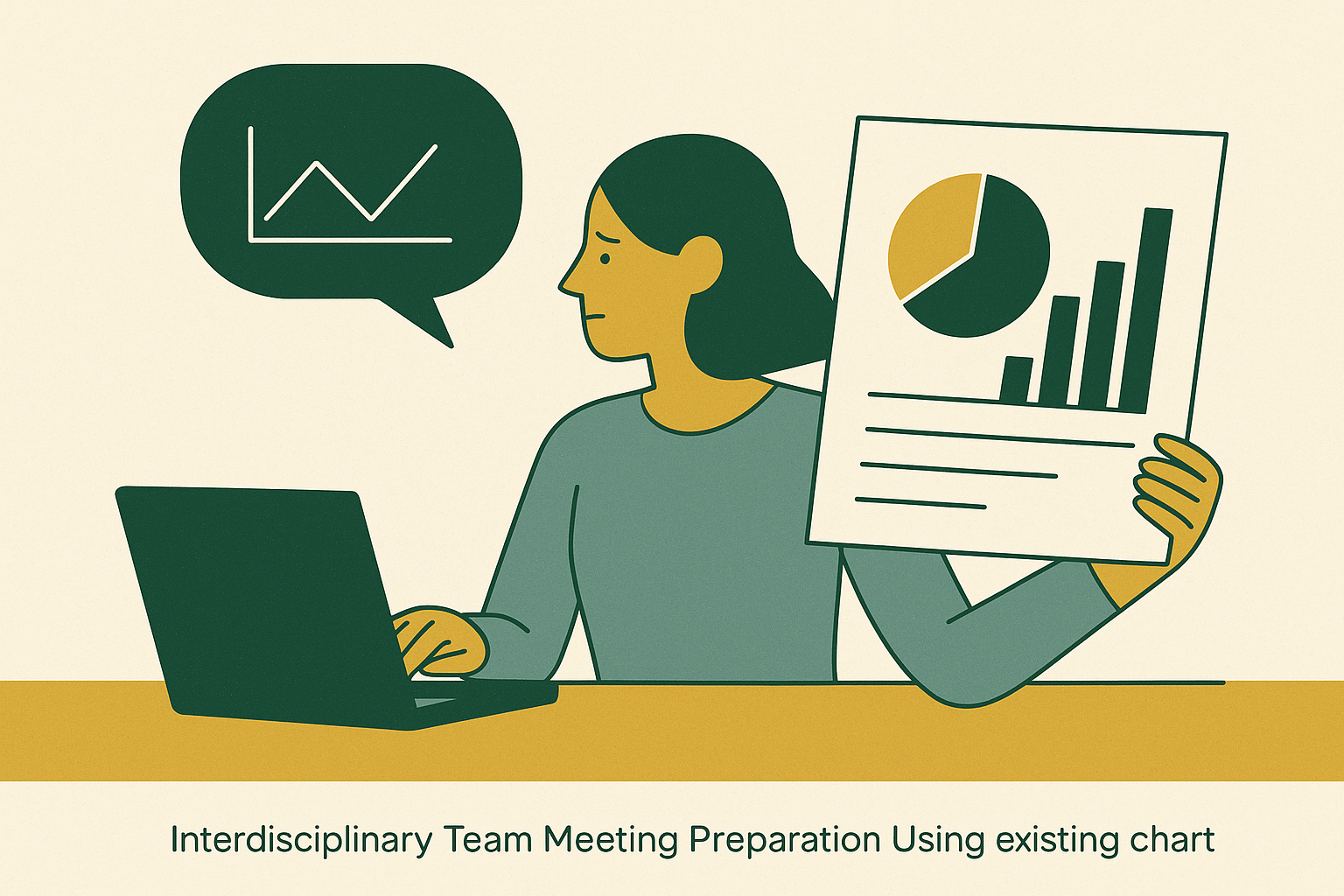
A conference room, a stack of charts, and a nurse flipping through pages trying to remember what happened with a resident's hydration levels three weeks ago. That scene repeats daily in skilled nursing facilities across the country, and it is not a failure of effort. IDT meetings are a regulatory requirement and the primary vehicle for resident care planning in these settings, yet the preparation that precedes them routinely falls short of what the teams need to do their jobs. Nursing, social work, therapy, and dietary each pull their own slice of the record independently, and no one synthesizes the pieces before the room convenes.
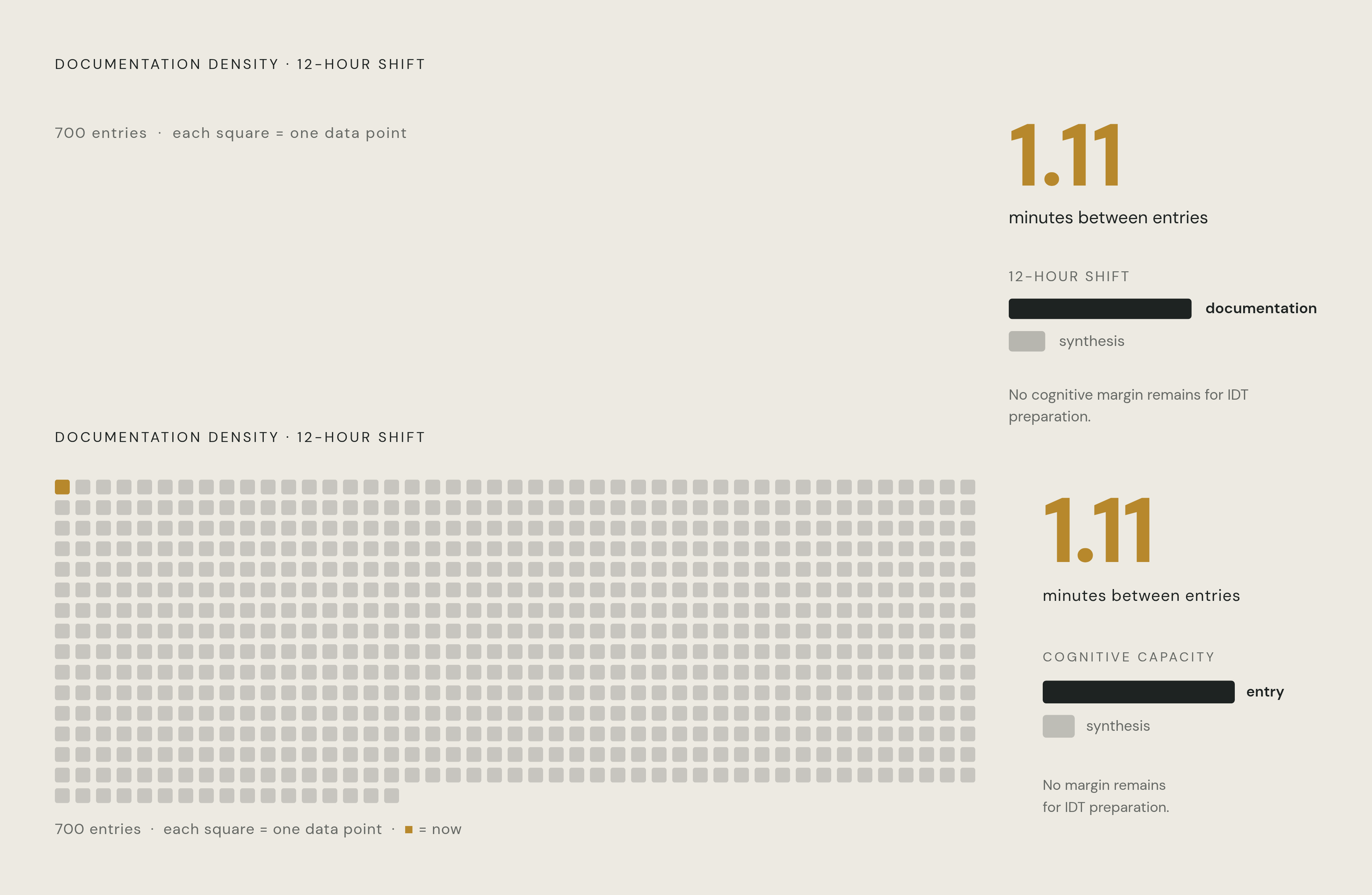
The shortfall doesn't come from a lack of clinical data sitting in the chart. It comes from a documentation burden so heavy that the mental energy required for synthesis is gone before preparation even begins. Nurses document between 600 and 800 discrete data points per 12-hour shift, close to one entry every 1.11 minutes, and a large share of every shift goes to charting alone. By the time a nurse reaches the point where she might step back and ask what the last month of notes says about a resident's trajectory, there is no time left to ask it.
EHR fragmentation makes the problem worse. AHCA/NCAL's February 2026 comments to HHS describe an industry where long-term and post-acute care providers have built non-standardized EHR systems that don't talk to each other, so whether anyone pulls a coherent clinical picture across disciplines depends on who happens to have the time and the access. A therapist's system may not speak to the nursing system, and the social worker's notes may sit in a third platform. Cross-disciplinary synthesis becomes an individual feat of memory and persistence rather than something the process reliably produces, and that is the structural gap the rest of this piece addresses.
Unused chart content in IDT teams
The clinical intelligence a high-quality IDT meeting needs already exists in the chart. It sits in unstructured text that nobody is reading systematically. That distinction matters because it reframes the entire problem: this is not a data collection gap, it is a data utilization gap, and the two call for very different fixes.
If you skip the nursing notes and therapy narratives in IDT preparation, the most clinically dense part of the record goes unread. Behavioral changes, hydration patterns, skin observations, and functional decline appear in free-text notes well before they reach structured fields or trigger an MDS item. A nurse's narrative entry describing a resident who ate less at two consecutive meals and seemed withdrawn in the hallway carries information that a structured checkbox field cannot yet capture, because the pattern hasn't crossed a coded threshold. By the time it does, days or weeks may have passed.
The standardized assessment instrument that drives care planning, whose current version took effect October 1, 2025, is built entirely from assessment data that nursing staff have already recorded. The structured clinical picture exists. It simply isn't reaching the IDT in synthesized form before the meeting starts.
How unstructured notes become risk-stratified IDT agendas
Converting that buried text into something usable is now a solved technical problem, even if most facilities haven't adopted the solution. Natural language processing tools, paired with clinical decision support systems, can take the free-text clinical record and turn it into a risk-ranked list of residents, so the meeting opens with the highest-risk cases instead of working through the census alphabetically.
Domain-adapted NLP, particularly transformer-based models, can now pull early indicators of disease straight from clinical narratives, often before those signals even show up in lab results or diagnostic codes. For IDT preparation, that capability translates into a specific set of outputs: trend data pulled across falls, medication errors, hydration, skin wounds, and behavioral changes; residents flagged for signs of deterioration; outstanding care-plan gaps surfaced automatically; and a synthesized clinical picture assembled before the team ever sits down.
Picture the difference directly. A facility working through its census alphabetically spends equal time on a resident with no new concerns and a resident whose notes, read in sequence, show declining oral intake and unwitnessed falls. Risk stratification corrects that imbalance by directing the team's limited meeting time toward residents whose charts actually signal elevated risk of an adverse event, a prioritization that alphabetical order simply cannot produce.
What an AI-assisted IDT pre-meeting packet covers
Good IDT preparation has always needed to cover a specific set of categories. What has changed is that synthesizing them no longer demands a clinician's unpaid evening hours. A properly built pre-meeting packet, drawn entirely from existing chart data, should lead with falls: trend data, the status of post-fall assessments, and the history of care plan revisions tied to those falls. The stakes here are rising, since CMS is shifting the Falls with Major Injury Quality Measure to a hybrid measure that pulls in Medicare claims data, which puts more pressure on documentation accuracy and coordination across disciplines. The OIG's own findings give this weight: nursing homes failed to report a large share of falls with major injury and hospitalization among Medicare-enrolled residents, which makes accurate, chart-sourced fall documentation both a clinical priority and a compliance exposure.
Skin and wound status comes next: wound progression or healing trajectories pulled from nursing notes across the full review period, flagged for the team rather than reconstructed from memory in the meeting itself. Hydration and nutrition follow, since documented intake patterns and flagged deviations live almost entirely in unstructured notes and are the category most often missing from manually prepared summaries.
Behavioral and functional changes deserve particular attention. These are observations CNAs and nurses record in narrative form, and they represent the earliest signals of cognitive or functional decline, which also makes them the category most likely to be missed when preparation stops at structured fields. Medication safety belongs in the packet too: documented concerns, PRN usage patterns, and reconciliation gaps pulled from pharmacy and nursing notes. And the packet should close with outstanding care-plan gaps, meaning items that should have been addressed since the last IDT meeting and haven't been. That last category gives the meeting its accountability, turning the IDT from a status update into a forum that tracks whether the plan actually got carried out.
Building CNA and cross-disciplinary input into the process
None of this solves a longstanding structural problem on its own. Automated chart synthesis speeds up preparation, but it does nothing by itself to fix the marginalization of CNAs and other disciplines that has shaped IDT meetings for years, and a summary handed to the team without full participation can quietly reinforce the same hierarchy it should be correcting.
CMS mandated CNA integration into IDT and resident care planning back in 2017, but it never issued clear implementation guidance, so nursing homes have had no concrete roadmap for making that integration work in practice. CNAs observe residents more continuously than anyone else on the team and are the most likely source of the behavioral and functional observations buried in free-text notes, yet their input is also the most likely to get filtered out when one clinician assembles the pre-meeting summary alone.
An AI-generated summary presented as the final word before the team convenes risks shutting down the conversation an IDT meeting exists to have. The synthesis should open the discussion, not replace it. The fix is procedural rather than technological: distribute the chart-sourced packet to every discipline before the meeting, rather than having one person present it at the table. Giving every discipline the same starting point closes the information gap that has historically sidelined CNA and social work voices, and it does so without requiring a single new policy on paper, just a change in who sees the packet and when.
IDT meeting quality, survey outcomes, and quality measures
The quality of IDT preparation is not an internal efficiency matter. Documentation gaps in a poorly prepared meeting raise quality-measure problems, Five-Star ratings, and survey citation risk. MDS coding errors run straight into PDPM reimbursement, the Five-Star Quality Rating System, and Medicare audit exposure, and the MDS is built from the same clinical documentation that a well-run IDT meeting should already be synthesizing. The two processes are not parallel activities that happen to share a records system. They are the same documentation, viewed from two different angles, at two different points in the compliance calendar.
AAPACN's 2026 Quality Conference session, "How to Manage Your Quality Measures on a Daily Basis," makes this connection explicit: MDS assessments fuel the quality measures, and the IDT is the team responsible for acting on what that data shows, which makes IDT preparation a quality-measure management activity rather than something separate from it. Falls illustrate the stakes concretely. Falls with major injury now affect Special Focus Facility selection and Care Compare quality measures, and the OIG's finding that nursing homes failed to report a large share of these falls points to exactly the kind of gap that accurate, chart-sourced IDT preparation can close.
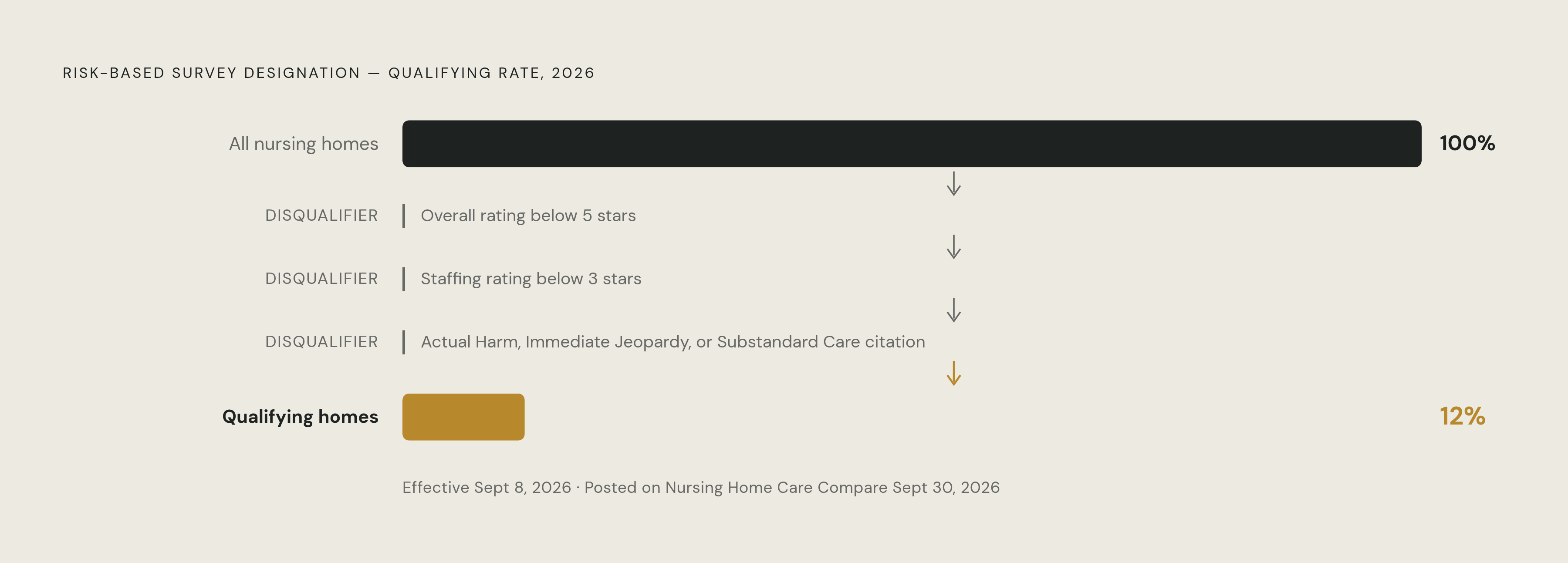
CMS's Risk-Based Survey process, effective nationwide beginning September 8, 2026, adds a further incentive, with High Performing Facility designations set to post publicly on Nursing Home Care Compare starting September 30, 2026. Facilities that demonstrate continuous quality management, the kind that rigorous IDT preparation supports directly, qualify for a more streamlined survey process, though only about 12% of nursing homes currently qualify for Risk-Based Survey treatment. To qualify, a facility cannot have an overall rating below 5 stars, a staffing rating below 3 stars, or any citation for Actual Harm, Immediate Jeopardy, or Substandard Quality of Care. Well-prepared IDT meetings protect against exactly those outcomes, by catching care gaps in the chart before a surveyor catches them in a resident's room.
Capabilities and limits of AI tools for SNF chart synthesis
The tools worth adopting for this work work from documentation already sitting in the chart, require no duplicate data entry, and produce output a clinician can question and check rather than a black-box summary she has to accept on faith. The first question to ask of any tool is whether it actually reads unstructured clinical notes at scale, not just structured MDS fields, because the free text is where the clinically dense signals live. A tool that only parses coded fields will miss the hydration pattern, the behavioral shift, the skin observation buried in a narrative note three entries back.
Different tools occupy different parts of this workflow, and it helps to know which part a given product actually addresses. Some tools, such as Twofold, focus on the documentation generation side, functioning as a scribe that helps produce the clinical note in the first place, rather than on the retrospective synthesis of existing notes for IDT preparation. Neither function substitutes for the other, and a facility evaluating tools should be clear about which problem it's solving before it signs a contract.
Explainability is not optional in this setting. A tool should be able to show the clinical reasoning behind a risk flag, not just produce a score with no visible logic behind it, because a model that cannot explain why a resident was prioritized puts the team in the position of trusting output it cannot verify. And the constraint that overrides all the others is practical rather than technical: AHCA/NCAL's February 2026 comments on the ASTP/ONC AI request for information identify reimbursement, interoperability, and population relevance as the binding limits facing long-term and post-acute care providers. A tool that demands new data entry or a full EHR replacement faces an adoption barrier that no amount of underlying capability can overcome. The tools that will actually get used in skilled nursing facilities are the ones built around the documentation habits already in place, asking nurses and CNAs to keep working as they already do while the system lightens their load.
Sources
- Survey Preparedness | CMS Compliance Group
- IDT Resources for Post-Acute Care Teams - AAPACN
- Effective Interdisciplinary Team Meetings
- MDS 3.0 and the RAI Process - Articles and Tools from AAPACN
- Interdisciplinary Team Meetings in Practice: an Observational Study of IDTs, Sensemaking Around Care Transitions, and Readmission Rates - PMC
- Original Study Development of a Predictive Hospitalization Model for Skilled