Incident Report to Care Plan Linkage Gaps Surveyors Cite
Documentation of incidents alone does not guide care without actionable handoffs.
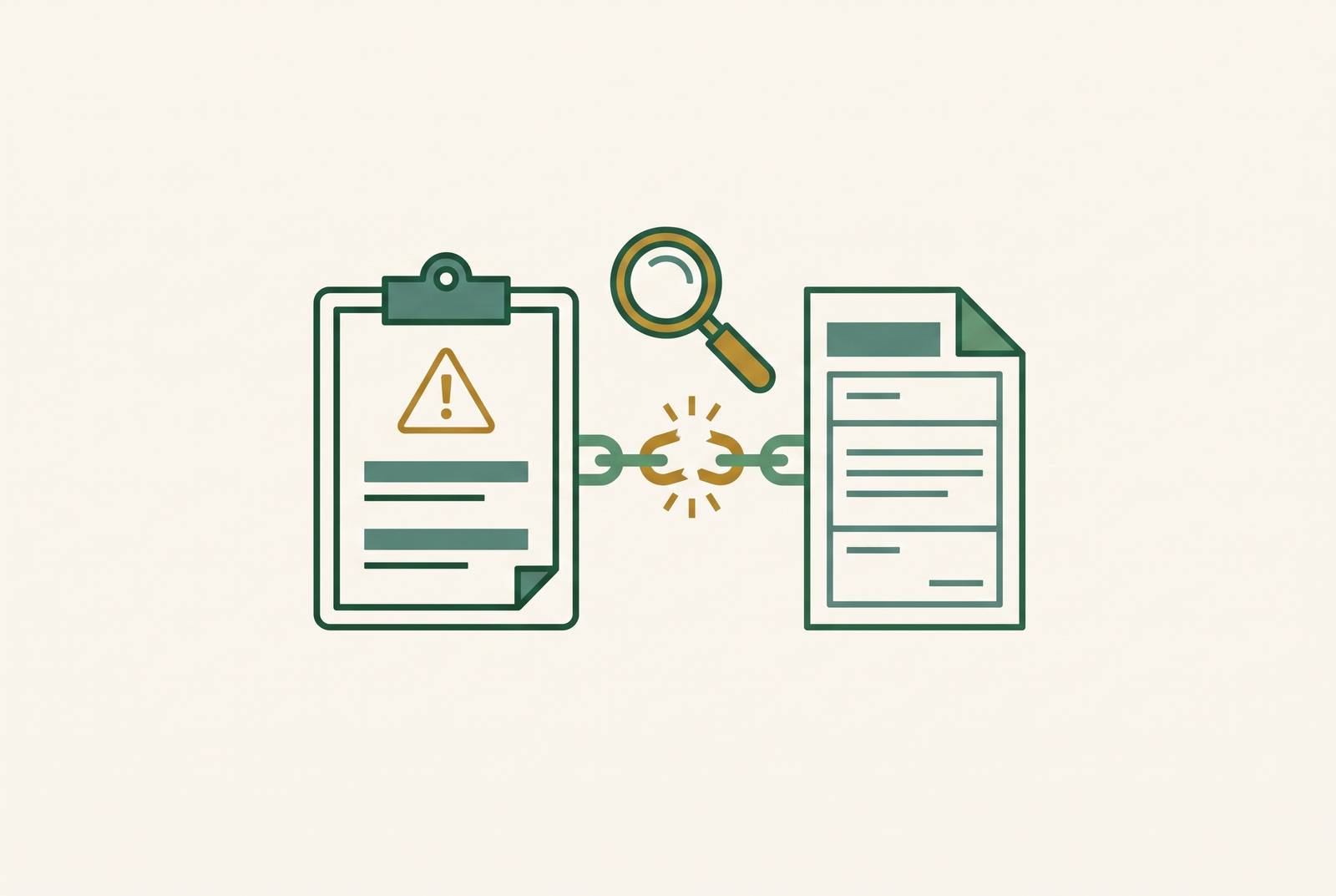
Incident report-to-care-plan linkage gaps arise when documented changes in a resident’s condition never become actionable instructions for the team providing care. Closing that gap requires more than a completed incident report or an edited care plan. Facilities need to make existing clinical information visible across shifts, with someone assigned to act on it and a time to do so, so the plan both records a decision and guides care.
The specific handoff that creates incident-to-care-plan linkage gaps
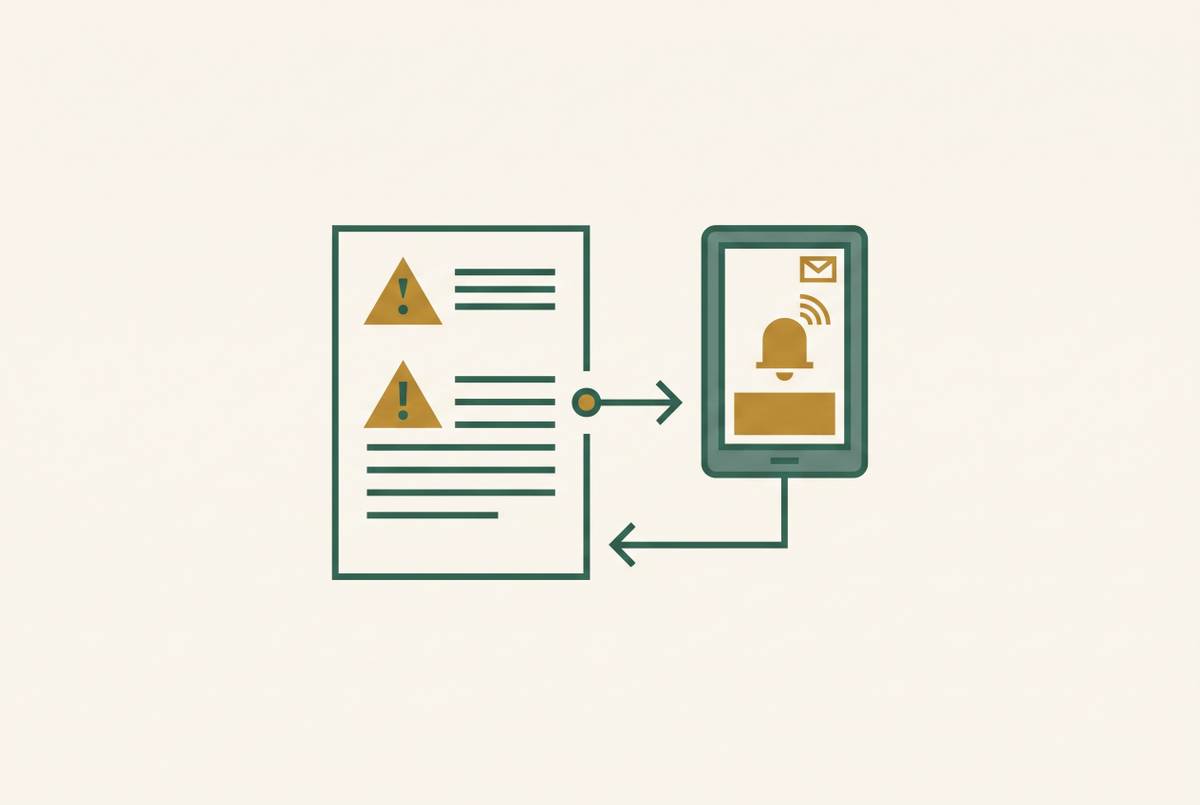
A resident falls, a nurse writes the incident note, and the shift ends. The next team has no actionable signal about what must change. Even if the nurse updated the care plan immediately, the revised intervention may not be visible, assigned, or time-bound for the staff expected to deliver it. The break occurs between decision and execution. Documentation records a response, but the handoff does not reliably translate that response into care.
This is not fundamentally a knowledge or motivation problem. The EHR can contribute directly through incomplete workflows, inconsistent data flow between modules, and documentation triggers that are quietly missed. An entry in one part of the chart does not necessarily prompt action in another. As conditions change and incidents accumulate, the care plan can continue describing the resident as they were. The record contains newer information without making it usable at the point of care.
Care transitions compound this break because incoming information is already fragmented across discharge summaries, medication lists, and scanned PDFs. Staff must reconstruct the clinical picture before they can decide how the plan should change. That work competes with the handoff itself. When critical details remain buried or arrive inconsistently, the receiving team starts with an incomplete picture, and subsequent documentation may preserve the disconnect.
Why surveyors treat this gap as a citable deficiency, and which F-tags it triggers
Surveyors expose the disconnect by cross-checking care plans against MDS assessments, care notes, and incident reports. They follow the clinical thread across the record. An incident report establishes that something happened, while the assessment and care plan should show how the team understood the event and responded. When those records diverge, the facility cannot demonstrate a coherent response to the resident’s changing needs.
F689, covering accident prevention and supervision, maps directly to this chain after a fall. Documentation must show that staff identified fall risk, took prevention steps, completed a post-fall assessment, and updated the care plan to reflect what they found. A missing link creates citation exposure. CMS nursing home certification data shows that F0689 was the single most-cited deficiency during a recent inspection window of under two months. The same data shows 342 F0684 citations in that window, so quality-of-care concerns were also among the frequent findings.
F684 applies when care delivery concerns are visible but the record does not show that the team identified, assessed, and responded to changing needs. F656 covers the comprehensive care plan itself, including whether it shows the resident’s condition as it is now. F641 covers how accurate the assessments used in that plan are. These tags examine connected parts of one process. An assessment that is wrong can weaken the plan, while one that is right but never reaches the plan leaves the response incomplete.
The OIG identified falls as an active review area through 2026. A completed incident report therefore cannot stand alone as evidence that the facility addressed the underlying risk. The rest of the chart must support the response.
How the regulatory environment in 2026 raises the cost of each linkage gap
CMS’s Risk-Based Survey, put in place nationwide beginning September 8, 2026, changes what happens after a serious finding. Facilities that perform better get streamlined surveys, but those with Actual Harm or Immediate Jeopardy citations lose RBS eligibility and return to the traditional process, which takes more resources. The gap can therefore cost more than a citation. When a linkage failure contributes to a disqualifying finding, the facility also loses access to an advantaged survey track.
Complaint investigations make that exposure especially important. They account for less than a third of citations nationally, yet produce the vast majority of Immediate Jeopardy findings and most Actual Harm and Immediate Jeopardy citations combined. An unresolved incident that generates a complaint therefore has disproportionate regulatory weight. August 2026 data indicates that roughly one in four nursing homes is overdue for a statutorily required standard survey. That backlog does not protect facilities from complaint-driven scrutiny and can leave documentation problems accumulating between standard surveys.
CMS Validation Audits add another route through the same records. Healthcare Management Solutions, LLC, conducts the audits, with SNFs randomly selected annually for cross-checks of MDS items against clinical documentation. A gap between the assessment and supporting notes can therefore create QRP and VBP accuracy exposure as well as survey risk. The underlying records serve several oversight purposes.
CMS memo QSO-26-03-NH, originally issued January 30, 2026, and revised April 3, 2026, addresses expanded authority to impose both per-instance and per-day Civil Money Penalties. The memo also directs public display of Per-Instance CMPs on Nursing Home Care Compare beginning June 24, 2026. Enforcement becomes visible beyond the regulatory relationship. Prospective residents and families can see financial consequences that previously might have been understood mainly as an internal compliance concern.
Where the information needed to close the gap already sits in the EHR
Observations, assessments, and post-incident notes record changes in condition in free-text fields every shift. The clinical information is already inside the EHR. What is missing is a reliable connection between those entries and the care plan workflow, because storing text does not automatically make its contents a trigger for action.
The distinction becomes clear when comparing connected and disconnected workflows. Purpose-built SNF systems can use MDS completion to generate care plan goals and queue relevant calculations. In generic EHRs or those whose parts are only partly linked, those steps may stay separate, causing documentation errors and billing gaps where the care plan should be updated. Information entered for one clinical purpose must reach the next task that depends on it.
Discharge summaries, medication lists, and scanned PDFs may contain critical details that are inconsistent, outdated, or buried. Most SNF EHR vendors transmit admission, discharge, and transfer signals without functional status, care plan goals, or readmission risk data, so awareness that a resident has arrived does not provide a complete basis for planning care.
Unstructured nursing observations also contain information useful for recognizing deterioration. Using those observations along with structured resident, facility, and social data makes predictive models better, though few post-acute systems are fully integrated. The relevant observations can be extracted and routed without adding another documentation burden.
What extracting and routing that unstructured data actually enables
Natural language processing can find changes in condition already recorded in nursing notes, such as a fall, a skin wound observation, or a behavioral shift. Extraction turns those details into usable signals. The practical sequence is that an incident occurs, a nurse documents it, the information is extracted, the care plan is flagged for an update, and the resident’s risk score is updated. The purpose is to connect the note to the next clinical decision.
That connection also supports a structured quality check across the resident census. When an assessment describes a changed condition but the care plan does not, the discrepancy can become visible without waiting for a surveyor to assemble it. The comparison follows the same clinical thread used during survey review. It addresses the gaps associated with F689, F656, and F684 by showing where documented needs and planned care no longer align.
Risk stratification adds prioritization to that cross-check. Extracted information can support ranking residents by deterioration risk across falls, medication errors, hydration, skin wounds, and behavioral changes. This draws attention to risk as it develops, before an adverse event occurs. It also places the care plan flag in the resident’s wider clinical picture, with each note seen as part of that picture.
The efficiency gain follows from that clinical function. Nursing managers can review information that is already organized and ranked instead of reconstructing it from scattered entries at shift end or before a survey. This changes the timing of review. As surveyors review facility data more often before they arrive, ongoing cross-checking lets managers address discrepancies before surveyors find them at the entrance conference.
The legitimate objection to automated clinical documentation tools and how facilities should weigh it
Facilities evaluating automation need to distinguish useful extraction from unreliable content creation. A 2025 instrument-validation study published in the Journal of Medical Internet Research used simulated outpatient encounters to test ambient digital scribe products that were on the market. The study found errors in the majority of generated draft notes. That finding is relevant to tool evaluation, but it does not establish an SNF-specific error rate under higher-complexity conditions.
The setting limits what can be inferred. SNF documentation involves longitudinal resident histories, multiple concurrent conditions, and regulatory specificity that outpatient scribe tools are not designed for. Those differences prevent a direct transfer of the outpatient result into a numerical estimate for skilled nursing. They also make it inappropriate to treat a generated note as equivalent to an established clinical record merely because it reads fluently.
Healthcare professionals have expressed consistent skepticism about black-box models and a strong preference for transparent ones. A risk score must be understandable to its users. If a nursing manager or surveyor cannot connect a flag to the documented observations behind it, the score becomes a liability.
The lesson for facilities is to apply automation selectively, with transparency as a design standard. Risk flags should be grounded in the specific nursing notes that produced them, while the human documentation remains the authoritative record. No new documentation layer is needed for that purpose. Tools that extract and route what nurses already wrote introduce a different and lower risk of new errors than tools that generate clinical content on their behalf.
What closing the gap looks like in practice for nursing managers and facility operators
The nursing manager’s day begins with an organized, ranked view of residents who need attention, bringing together information from disparate chart entries. Review becomes a prioritization function. Documented changes can be compared with current care plans, and interventions can become visible, assigned, and time-bound for the next shift. The team can act on information already recorded in the chart.
That visibility also changes preparation for survey review. Continuous readiness means keeping the care plan aligned with the resident’s current condition rather than bringing it up to date only before an inspection. Surveyors see the same cross-checked picture the facility has already reviewed. The ranked risk view can also support staffing decisions, care coordination conversations, and family communication, extending its use beyond the compliance process.
For operators, the financial case comes from lowering CMP exposure, keeping or improving Five-Star performance, and staying eligible for streamlined RBS oversight. Public display of Per-Instance CMPs adds a consequence visible to prospective residents and families. These outcomes affect census, reimbursement, and the cost of running the facility. These outcomes, which an automated flag cannot guarantee, explain why reliable follow-through deserves attention as a continuing operating discipline.
The prerequisite is that the system works from records nurses already create. Adding data entry to fix a documentation handoff would bring back the workload that makes the gap hard to manage. Proactive management of that underlying clinical data gives facilities greater control across survey, Five-Star, QRP, VBP, and RBS evaluation. The data is already there; the problem is whether it is visible.