Surveyor Document Request Patterns During Focused Infection Control Surveys
Infection control documents remain audit priorities even after the focused survey format ended.

The retirement of the standalone Focused Infection Control Survey changed the route of oversight while leaving the evidence facilities must produce unchanged. Requests for infection control documents are still a key part of complaint investigations and standard surveys. Readiness therefore depends on keeping a complete, retrievable record of surveillance, clinical response, staffing, and quality oversight, rather than assembling documents when a focused survey is expected.
Why the Focused Infection Control Survey's retirement did not reduce infection control scrutiny
CMS memo QSO-25-23-ALL, released July 30, 2025, retired Focused Infection Control surveys from the long-term care survey process effective July 31, 2025. The focused survey originated during the COVID-19 public health emergency and continued on a reduced scale afterward. Its retirement removed a separate survey format. The memo directed COVID-19 and infection control concerns into complaint investigations outside the Long-Term Care Survey Process, or LTCSP.
When an infection control complaint triggers review, surveyors still need records that establish what happened, how the facility responded, and whether its program functioned as required. The record-pull expectations did not retire with the format. CMS memo QSO-26-14-NH also announced that the Risk-Based Survey, or RBS, would be used nationwide for nursing homes that qualify beginning September 8, 2026. That approach concentrates survey resources on higher-risk facilities and complaint investigations rather than distributing them evenly across the field.
Where infection control citations now land inside the standard survey
F880, the core infection prevention and control program requirement, appears in approximately two in five standard health surveys nationally. It remains one of the most persistently cited tags in long-term care. The standard recertification survey and complaint investigations use the same citation tags that the focused survey used. Consequently, a facility does not need to receive an infection control complaint for its program to face review.
CMS memo QSO-25-12-NH places infection prevention and control within a broader set of revisions covering nursing services, resident assessment, administration, and Quality Assurance Performance Improvement, or QAPI. The revised framework also incorporates Enhanced Barrier Precautions for preventing the spread of multi-drug-resistant organisms and updated COVID-19 immunization documentation requirements. These requirements are not a separate compliance island. Their documentation intersects with resident care, workforce competency, and facility oversight. A surveyor looking into infection control may therefore need evidence from several parts of the facility, even when the concern at the start seems narrow.
The document universe surveyors pull when infection control is in scope
Resident-level records include resident rosters and census histories, admission, readmission, and hospital transfer logs, incident and accident logs, and grievance records. Workforce records form a distinct part of the request. They include staffing schedules and timecards, competency checklists, professional licenses, and agency staff contracts. Together, these categories place infection reports within the broader review of the facility’s resident and staffing record.
Infection-specific records include the name and primary professional training documentation of the Infection Preventionist, or IP, and evidence that the IP completed specialized training in infection prevention and control. Surveyors also ask for infection surveillance reports and trend data. The immunization record set covers influenza, pneumococcal, and COVID-19 records for residents and staff. They also ask for records that show compliance with Standard and Transmission-Based Precautions, the policies and procedures of the Infection Prevention and Control Program, and records from the antibiotic stewardship program. The program’s written rules and its operating evidence both belong in scope.
Quality and governance records include QAPI meeting minutes, Performance Improvement Project, or PIP, charters, performance dashboards, and surveillance reports. These documents show the quality oversight associated with infection control work. EHR access completes the scope of review. Surveyors are entitled to full access with no information excluded, so the available record extends beyond prepared reports and structured infection control fields. Narrative clinical documentation remains accessible even when it has not been incorporated into the facility’s surveillance summaries.
Why timing requirements make this document set harder to produce than it appears
CMS memo QSO-25-12-NH added a review of the Payroll-Based Journal staffing data report to the work surveyors do off-site before a survey. Surveyors can check staffing patterns before they enter the building and arrive with concerns they have already found. Their orientation begins before the entrance conference. A complaint investigation has a similar starting advantage because surveyors already have the complaint narrative in hand. They arrive to confirm or expand on an identified concern.
That preparation compresses the facility’s time to assemble a coherent response. Surveillance trend data, IP credentials, QAPI minutes, and staffing timecards may sit in different systems, paper files, or spreadsheets. Each record may exist without being readily producible. Fragmented workflows make it harder to demonstrate coordinated oversight, including the documentation expected under revised F841 medical director accountability standards. The requested records must therefore be located and connected across functions.
A facility unable to produce these materials within the first hours of a survey is already in a defensive posture before a single observation is made. This is a retrieval problem before it is a clinical argument. Staff must find the evidence while surveyors are already following a set line of inquiry. A prepared policy binder cannot substitute for the timecards, surveillance history, or quality records needed to answer that inquiry. The practical test is whether the complete document set can be surfaced promptly.
How documentation gaps become the citation, independent of whether the clinical practice was sound
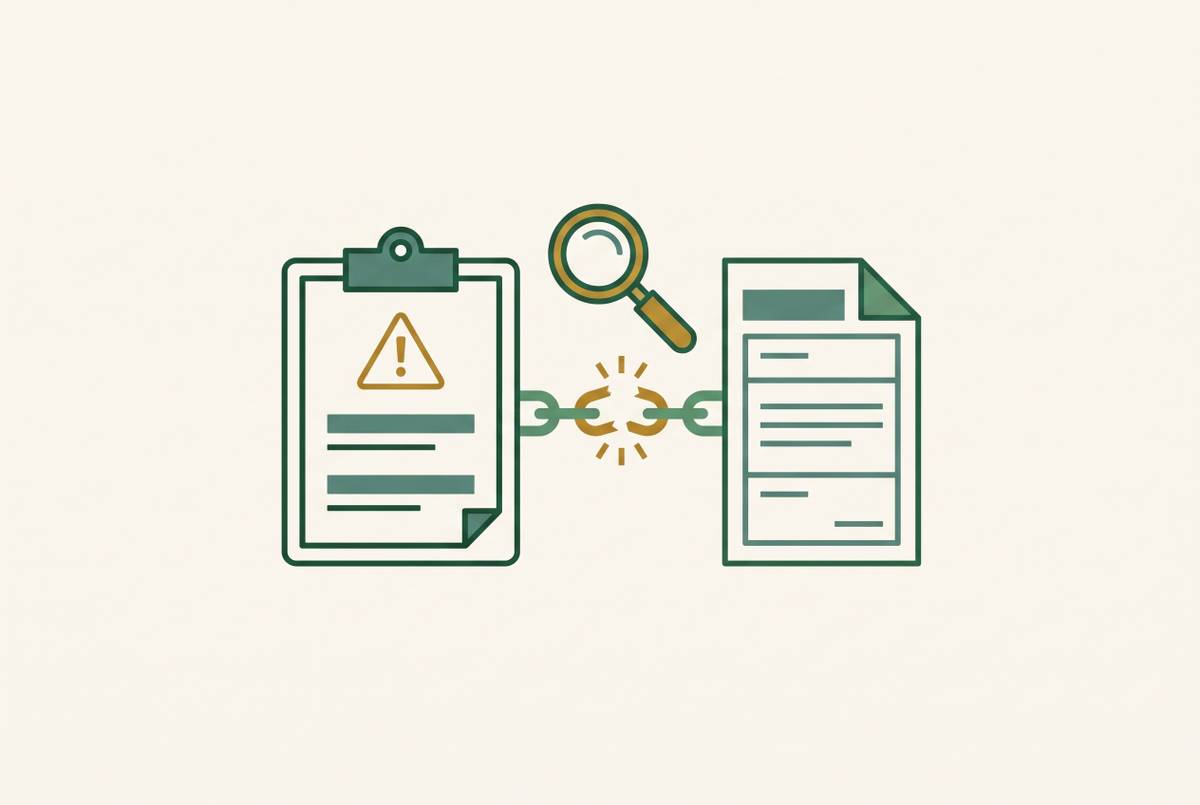
Documentation failure can be an independently citable deficiency. A record must demonstrate the required surveillance, decisions, and response. Recurring failure categories in Statements of Deficiency include early detection failures, communication failures, failures to follow policy and procedure, inaccurate documentation, and delays in initiating a clinical response. These categories distinguish the care delivered from the record needed to establish compliance.
An isolation observation documented in a narrative nursing note but absent from structured surveillance records illustrates the distinction. The note may show that staff observed the resident and recorded the isolation-related information. It does not, by itself, fill the surveillance gap. A surveyor may still find that the facility failed to document the program activity required for oversight. Missing hand hygiene audit dates and undocumented IP surveillance decisions leave similar gaps, because records of care for one resident may not show that the program works as required.
CMS compliance data show that insufficient documentation accounts for the largest share of improper payment rates for SNF inpatient services during the 2024 reporting period. Revised F641 guidance creates a separate escalation for MDS accuracy, directing referral to the OIG for three or more inaccurate codings only when indications also show that the coder knew the coding was inaccurate. To stay ready for infection control review, the facility still needs to produce an auditable record that covers the preceding 90-day review horizon.
What continuous infection control readiness actually requires operationally
Directors of nursing and nursing managers need to make readiness part of existing documentation workflows both during and outside the preparation time a survey window provides. Complaint investigations can begin without giving the facility that time to prepare. Surveyors look back through surveillance history, so the facility needs auditable records that cover the preceding review period. Staff must be able to retrieve surveillance reports and trend data as that history grows. Waiting until entrance to reconcile fragmented records leaves the facility trying to reconstruct oversight under immediate scrutiny.
Surveyors also review both the IP’s primary professional training and evidence of specialized infection prevention and control training. The credential file is therefore a live document set, including the IP’s continuing education record. Training evidence has a practical program connection. SHEA’s October 2025 multisociety guidance reports that facilities whose IPs hold specialized training are more likely to have recommended infection prevention and control policies in place. The same guidance associates participation in surveillance networks that support comparison and performance tracking with decreased rates of healthcare-associated infections, including influenza-like illness, UTIs, and pneumonia over time.
QAPI integration provides the operational link between surveillance and facility action. Because surveyors follow that link, surveillance data must feed into QAPI minutes, PIP charters, and performance dashboards in a traceable chain. An observation needs a documented quality response where one is required. The nursing manager must keep that connection visible as the work occurs.
Where unstructured clinical notes fit into the surveyor's infection control review — and why they are simultaneously the richest evidence and the hardest to surface
Narrative nursing progress notes record early signs of fever, the reasons for starting antibiotics, isolation observations, and trends in behavioral change. These signals are generated dozens of times daily, but EHR-native structured fields frequently do not capture them. The evidence exists, but retrieval is difficult. A surveillance report may therefore omit information that is already present elsewhere in the clinical record. That disconnect is especially important when the omitted information concerns the same resident, event, or response that surveyors are examining.
Full EHR access allows surveyors to read those notes even when the facility has not analyzed them for gaps. Narrative documentation is inside the review but difficult to query. A facility that relies only on structured fields may have a less complete view of its own record than the record makes available to a surveyor.
Tools that read unstructured notes from existing EHR documentation address this specific problem by surfacing compliance gaps and risk signals without requiring a separate stream of staff documentation. A facility can use that capability to identify residents with fever documented but no corresponding antibiotic stewardship note, or isolation observations present in narrative text but absent from surveillance logs. Those mismatches are prompts for review. Their value is that staff can examine and close documentation gaps before a surveyor discovers them. The capability fits the survey task because it makes the existing record searchable in the categories under review.
Machine learning models using vital signs, diagnoses, laboratory results, food intake, and progress notes analyzed through text-analysis-derived risk scores can predict hospitalization or death within seven days among SNF patients. That is a different task from demonstrating compliance. For survey readiness, the narrower requirement remains rapid access to what the clinical record actually shows across residents, including evidence that structured fields have missed.
The objection worth taking seriously: does moving infection control into complaint investigations reduce its reach?
A complaint investigation requires a complaint to trigger it. Facilities that generate few complaints could therefore face less frequent complaint-driven infection control review than under the focused survey’s cadence. That is a legitimate distinction between enforcement channels. CMS explains that state agencies’ complaint-survey workload has grown substantially since 2015, and the RBS approach explicitly redirects resources toward complaint investigations and higher-risk facilities.
The RBS process applies only to qualifying facilities, approximately one in eight nursing homes nationally. The majority remain subject to the standard survey process, where F880 is among the most cited tags regardless of complaint volume. Review can begin with a complaint filed after an outbreak, a standard survey, or an RBS-triggered investigation, while the infection control record-pull expectations persist across those channels.
Sources
- DEPARTMENT OF HEALTH & HUMAN SERVICES Centers for Medicare & Medicaid Services
- CMS Ends Infection Control Focus Surveys
- CMS Revises Infection Control Survey Guidance; Expires Two Other Memos - Virginia Health Care Association
- REVISED: Revised Long-Term Care (LTC) Surveyor Guidance: Significant revisions to enhance quality and oversight of the LTC survey process
- Revised Long-Term Care (LTC) Surveyor Guidance