How CMS Surveyors Read Nursing Notes During Inspections
Surveyors test nursing notes against staff accounts and direct observation to find gaps.
A surveyor walks onto a nursing home floor with three sources of information already running in parallel: the chart, the staff, and the floor itself. The job is not to read a nursing note the way a clinician would, as a narrative of what happened to a resident overnight. The job is to treat that note as a claim to be tested against two other claims, what staff say happened when asked directly, and what the surveyor sees with their own eyes during observation. A note that says a resident's skin was checked, a nurse who cannot describe when or how, and a wound that looks different from what the chart describes: that gap, wherever it opens, is the single most common path to a deficiency citation. Surveyors are not grading effort. A facility can deliver excellent care all shift and still fail an inspection if the record does not show, in writing, that a resident's changing needs were identified, assessed, and responded to. Effort that isn't on the page does not exist for survey purposes, and that asymmetry is built into the software surveyors use to run it, the Long-Term Care Survey Process (LTCSP) and the Automated Survey Process Environment (ASPEN), which together determine how a surveyor moves through a building and in what order they look at things.
How the LTCSP structures surveyor record review
The LTCSP is a structured, software-driven protocol that sequences observation, interview, and record review, so that a gap between those three streams becomes visible without the surveyor having to go looking for trouble. That structure is also not static. CMS revised its surveyor guidance in memo QSO-25-14-NH REVISED, posted March 10, 2025, with an effective date of April 28, 2025, and the update changed how surveyors approach MDS accuracy, psychotropic medication documentation, and care planning. A facility still documenting the way it did before this update is being measured against a rulebook it may not have fully read.
The LTCSP is also no longer the only check a facility has to clear. CMS Admin Info 26-06-NH, released May 15, 2026, describes Federal Monitoring Surveys in which federal surveyors conduct an independent comparative survey of the same facility within 60 calendar days of a state survey, specifically to assess whether the state team identified and cited deficiencies correctly. Passing a state survey does not close the file. Facilities land on the Federal Monitoring Survey list based on data suggesting risk of noncompliance, a history of noncompliance, allegations against the facility, location-specific concerns flagged by CMS, media attention, or other triggers CMS considers relevant. The same risk indicators that worry a state surveyor can earn a facility a second, independent look from federal reviewers.
The evidentiary surface those surveyors work from has also widened. The January 2025 memo added specific instructions for investigating Payroll Based Journal staffing data, Director of Nursing compliance, and psychotropic medication documentation; the March 2025 revision only moved the effective date, so those substantive additions stayed in place. Surveyors now walk in trained to pull on more threads than they were eighteen months ago, and each thread runs back, eventually, to what is or isn't written in the chart.
The specific documentation surveyors are now trained to look for in nursing notes
You do not have to guess what a sufficient note looks like under the updated guidance. It defines insufficiency with enough precision that a director of nursing can hold a note up against the standard and see exactly where it falls short, and most notes, drafted in the last twenty minutes of a shift, will fall short somewhere.
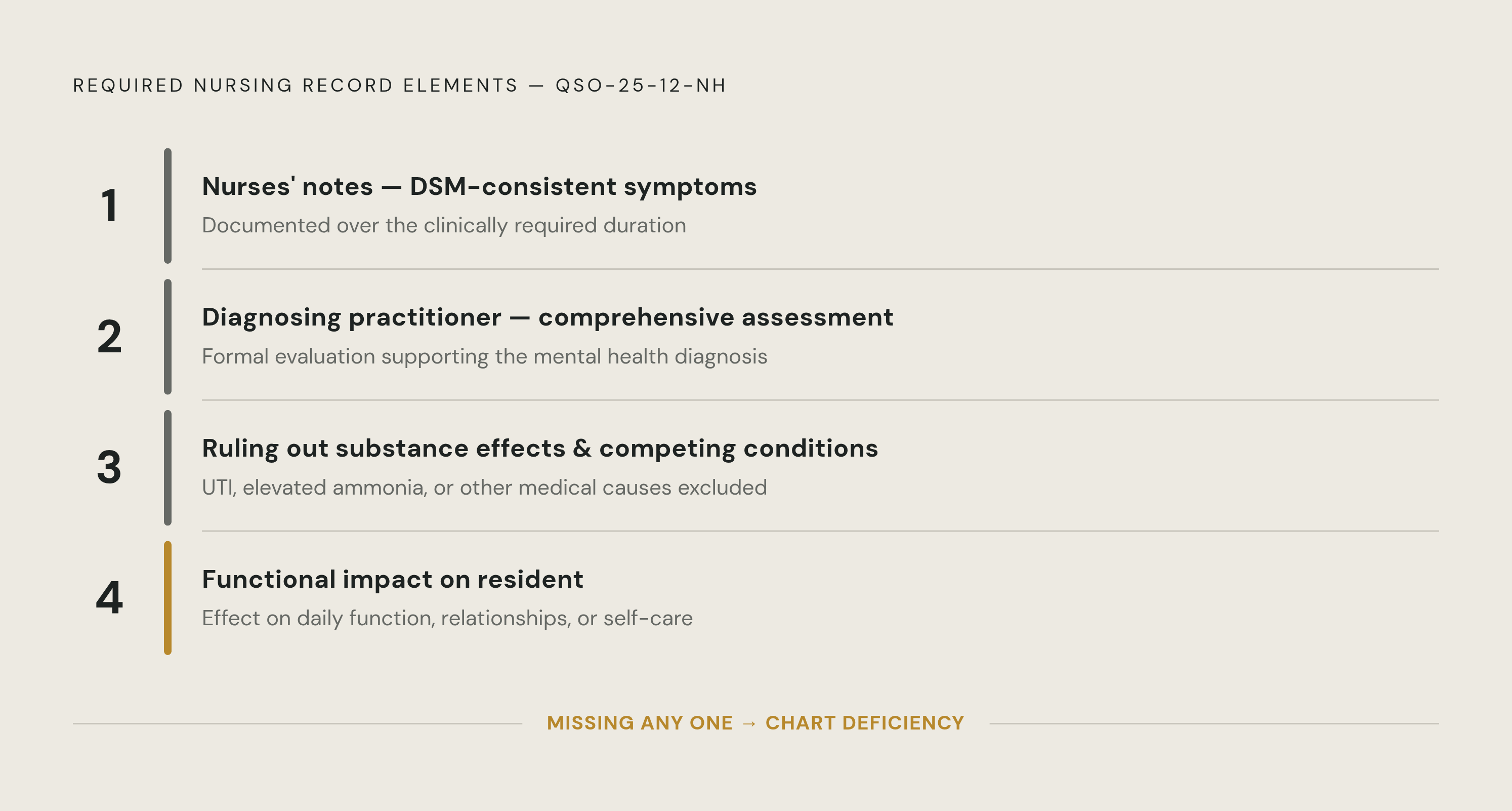
Psychotropic medication and mental health documentation makes the clearest case study, because CMS has been the most explicit here of any clinical area. Memo QSO-25-12-NH spells out four things a record must contain. It needs documentation, including nurses' notes, showing the resident has displayed symptoms, disturbances, or behaviors consistent with DSM criteria, sustained for the period of time those criteria require. It needs documentation from the diagnosing practitioner that the diagnosis rests on a comprehensive assessment. It also needs documentation from that same practitioner ruling out that the symptoms come from a substance or another medical condition, such as a urinary tract infection or elevated ammonia levels. And it needs documentation of what effect the disturbance is actually having on the resident's function, visible in relationships with others or in the resident's ability to manage self-care. Missing any one of those four elements makes the chart deficient by CMS's own definition.
F658, which covers professional standards of practice, carries the same logic. Updated guidance tells surveyors to check MDS coding against the clinical record, and if a facility cannot produce documentation backing up the coding of a new diagnosis, noncompliance follows automatically. That supporting documentation has to cover physical, behavioral, mental, and psychosocial status; it has to rule out substance effects and competing medical conditions; and it has to show evidence of distress, functional change, complaints from the resident, behaviors, and symptoms. Consent documentation for psychotropic medication carries its own explicit checklist under the revised QSO-25-14-NH guidance: the record has to show that the resident, family, or resident representative was told, in advance of starting or increasing a medication, about its benefits, risks, and alternatives, including any black box warning attached to an antipsychotic, and that the resident was able to choose among those options, including the right to say no.
Three different regulatory areas share one identical demand: surveyors are not checking whether a note exists. They are checking whether the note shows that someone made a specific clinical judgment, grounded it in a specific basis, and recorded it at a specific point in time. A late entry, a missing entry, or two notes that contradict each other are not just untidy, they are themselves findings. The lag between when care happened and when it got written down is something surveyors are trained to notice on its own.
The F-tags that most often trace back to nursing note deficiencies
The F-tags that appear most often in nursing home surveys cluster around one recurring pattern: the record does not demonstrate that the facility noticed a resident's needs changing, assessed what that change meant, and acted on it.
F689, which covers freedom from accident hazards, supervision, and the use of devices, gets cited when fall risk assessments, supervision plans, or intervention records are incomplete or were never updated after something happened. A resident falls, and if the chart does not show a current risk assessment plus an updated care plan responding to it, that absence becomes the evidence the facility failed, not just a paperwork lapse alongside the failure.
F656, covering comprehensive care plans, sits among the most frequently cited tags nationwide, and the typical problem is a care plan that no longer matches where the resident actually is. Care plans go stale when the nursing notes documenting day-to-day changes never make their way back into the plan itself, so the plan freezes while the resident's condition keeps moving.
F641, accuracy of assessment, gets triggered when the MDS and the clinical record tell different stories, and the consequences run past the citation itself into reimbursement risk. The April 2025 guidance directs surveyors to check whether documentation supports coded medical conditions, and when a pattern of inaccurate coding occurs across three or more residents, surveyors are instructed to refer the facility to the Office of the Inspector General.
F684, quality of care, is the broadest of the four and covers the cases where something looks wrong in observation or sounds wrong in a staff interview, but the chart never shows that the facility caught the resident's changing condition, assessed it, and responded. Here the citation rests entirely on an absence: not a bad note, but no note where one needed to exist.
Why documentation gaps are structural, not individual
The space between the care a resident actually received and what the chart says about it comes from a timing problem built into how shifts work, rather than from careless nurses or a training gap a new in-service could fix. Care happens continuously, with attention paid minute to minute across an eight or twelve hour shift, but documentation gets compressed into a narrow window at the end of that shift, exactly when fatigue is highest and you can least reconstruct the clinical detail from six hours earlier.
What comes out of that window is a note written to satisfy a compliance requirement, but written too late and too thin to survive the kind of line-by-line reading the updated LTCSP protocol now applies to it. This is not a rare or isolated failure mode. The Black Book Research 2026 Nursing AI Readiness Gap Report found that most nurse managers report documentation requirements regularly cutting into the RN time available for direct patient care, and most report recurring staff complaints about duplicate or overlapping documentation tasks. That is the shape of the problem across the sector, not a story about one understaffed unit.
The obvious counterargument is that facilities should simply train nurses to document more carefully and more promptly. That instruction runs into a staffing arithmetic that has not moved: a nurse's attention during a shift is already fully claimed by direct care, and layering more documentation rigor onto that same workflow without changing when or how it happens produces burnout, not better charts.
What continuous, survey-ready documentation requires from the record
Survey readiness cannot be something a facility switches on the week before an inspection, because the record a surveyor reads reflects every shift that produced it, not only the shifts a facility knew were being watched. CMS Admin Info 26-06-NH says this directly to nursing home leadership: readiness has to extend past the annual survey window, and corrective actions have to be specific, sustainable, and backed by documentation showing the facility returned to compliance and can stay there.
The stakes for failing that standard spread into other areas of the facility's operation. A Federal Comparative Survey can surface deficiencies the state survey missed, and when a Comparative survey finds substandard quality of care, the facility loses its Nurse Aide Training and Competency Evaluation Program. A single documentation gap does not stop at one citation, it can take a training program down with it.
Meeting that standard at the level of an individual note means capturing more than the intervention itself. It means capturing the clinical reasoning behind the intervention, how the resident responded, and any change in condition, recorded close to when it happened rather than reconstructed from memory at the end of a shift. Care plans have to function as living documents that nursing notes actually update: a note that flags a change in condition but never triggers a corresponding update to the care plan exposes a facility on F684 and F656 at the same time. The practical test is straightforward to state and hard to meet consistently: pull any 48-hour window of a resident's notes, check it against that resident's current condition, current care plan, and what staff say in an interview, and the record should hold up, not only during inspection week but on any random Tuesday.
Reaching that standard from inside the shift-end documentation routine most facilities already run is the real operational problem, because the standard demands something the current workflow was never built to produce.
Surfacing nursing notes to close the gap without added workload
The information surveyors are looking for is, in most cases, already sitting in the notes nurses write. Clinical free text captures medical history, how a resident responded to a medication change, shifts in behavior, movement in functional status, all of it. This text is unstructured and non-standardized, so no one can monitor it systematically across a building full of residents without a tool built to read and interpret it at scale.
Natural language processing and machine learning applied to unstructured clinical notes can pull clinically meaningful signal out of note text alone, and they have even predicted mortality risk within the first hours of an admission, well before structured data fields would catch up. In skilled nursing applications specifically, systems take in unstructured clinical documentation at admission, run it through regular review cycles as new notes come in, and generate risk assessments and flag clinical changes as they appear in the text, so the documentation nurses were going to write anyway becomes an ongoing monitoring layer.
The same principle applies directly to survey exposure. A facility that can see, continuously, which residents have documentation gaps against the exact dimensions surveyors check, fall risk assessments going stale, care plans drifting out of sync with current condition, psychotropic medication justification missing one of its four required elements, can close those gaps before a surveyor ever opens the chart. That reverses the current dynamic entirely. Documentation becomes the facility's own early-warning system instead of only the evidence surveyors use against it, built from records staff were already required to produce.
The constraint holds regardless of how the gap gets closed: any fix has to work from documentation that already exists. Asking nursing staff to enter more data on top of an already full shift is not a workable answer given current staffing levels, and it would not solve the timing problem described earlier, only add to it. A facility that reads its own notes continuously, the way a surveyor eventually will, is a facility that stops finding out about its documentation gaps during inspection week.
Sources
- 1 Summary of CMS’s Revised Guidance for Nursing Home Surveyors
- REVISED: Revised Long-Term Care (LTC) Surveyor Guidance: Significant revisions to enhance quality and oversight of the LTC survey process
- DEPARTMENT OF HEALTH & HUMAN SERVICES Centers for Medicare & Medicaid Services
- CMS Releases FY2026 Guidance for Federal Monitoring Surveys in Nursing Homes
- DEPARTMENT OF HEALTH & HUMAN SERVICES Centers for Medicare & Medicaid Services