Predicting Hospital Readmissions From Long-Term Care Nursing Notes
Nursing notes predict readmissions better than structured data alone.
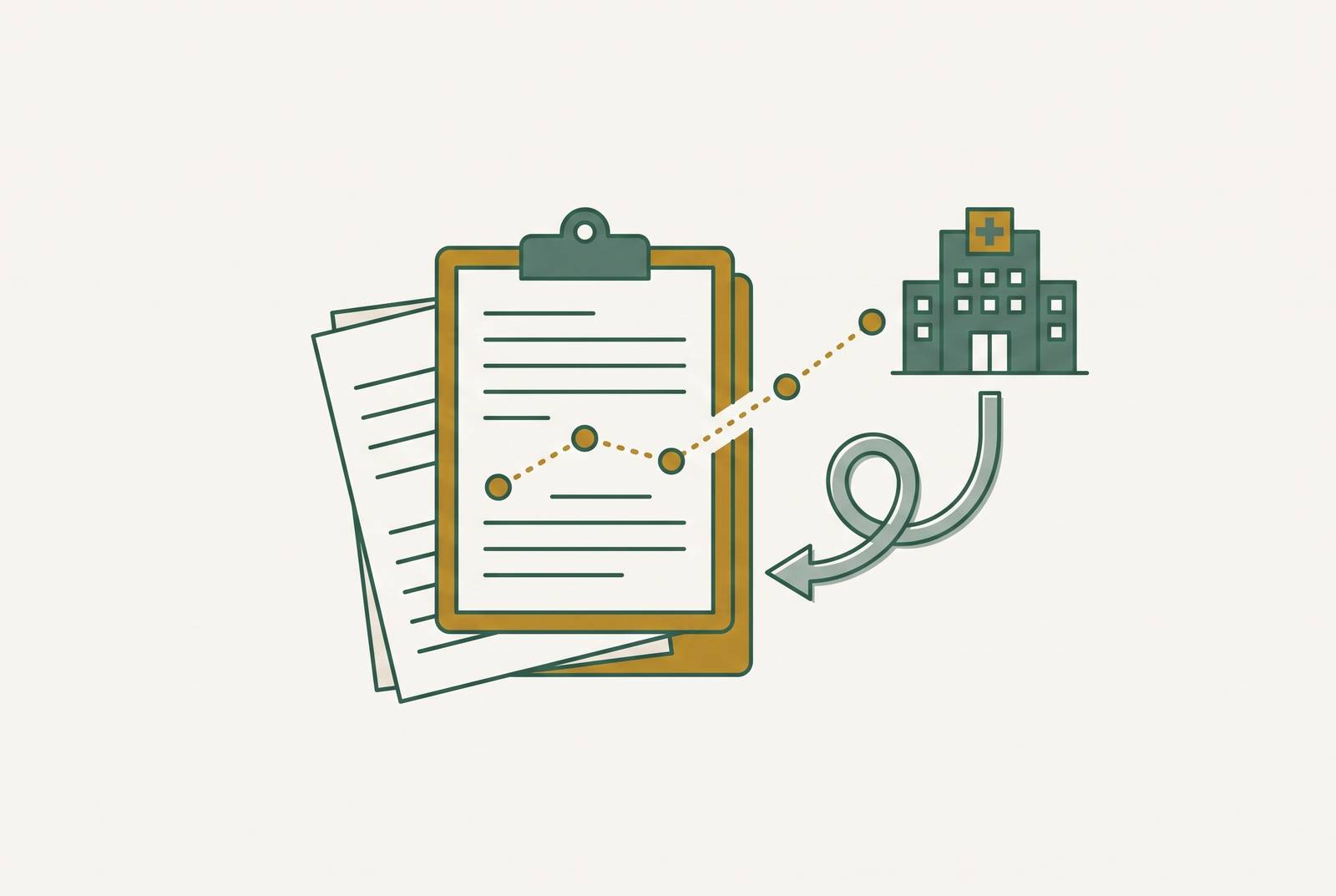
Skilled nursing residents return to the hospital at rates that set them apart from the general patient population, and the gap has less to do with how sick they are than with the transition itself. A University of Alberta study led by Gruneir and colleagues, tracking more than 700,000 patients with a mean age of 78, found that the care setting a patient moves through before and after a hospital stay predicts 30-day readmission on its own. Residents discharged back into long-term care showed an increased likelihood of returning to the hospital, while those newly admitted to long-term care for the first time showed a reduced likelihood. Hospital staff often have limited familiarity with what a skilled nursing facility can actually provide, and that gap in knowledge causes them to discharge patients on assumptions about available resources that turn out to be wrong. Add to that a population that is older, carrying multiple chronic conditions at once, and dependent on nursing staff as the only people watching for day-to-day change, and the result is a group whose risk cannot be read with the same instruments built for a general hospital ward. Any early-warning system for this population has to start from what long-term care actually produces, not what acute care already measures.
Structured EHR fields: what they capture and miss
The tools most facilities already have were not built for the job this population needs done. Structured EHR fields, diagnoses, vital signs, medications, discrete flowsheet entries, record what has already happened to a resident, not how that resident is changing from one day to the next. A fall gets logged once it occurs. A pressure injury gets staged once it has formed. But the changes that lead there, a shift in cognition, a decline in mobility, a resident eating less at each meal, a change in behavior, build gradually and rarely trip a structured field until they cross a threshold that is already a clinical event. In long-term care, the people watching for those gradual shifts are nurses, and the record of what they see lives in the notes they write, often appearing there days before it appears in a coded field. None of this makes structured data useless. It does what it was designed to do: record discrete, countable facts. The gap is that discrete facts were never meant to carry the story of a slow decline, and for a population whose risk is driven by exactly that kind of slow decline, the fields that hospitals and facilities rely on most heavily are structurally incomplete for the task of early prediction.
Nursing notes and the early-warning signals structured data misses
Nursing notes are free-text narratives, written as changes in condition happen, that describe how a resident is responding to care, not just what care was given. That distinction turns out to carry measurable weight. Research out of Yonsei University and Yale University, published in JMIR Medical Informatics and built on a retrospective sample of 12,977 patients across the six diagnoses with the highest readmission risk, found that a model built only on the first day of hospitalization data (Model 1) relied more heavily on nursing-derived variables among its top predictors than a model built on the full stay. BMI, systolic blood pressure, and age mattered in both models, but it was the nursing variables that drove the early discrimination, the period when a clinician has the least structured history to work from and the greatest need for a reliable signal. That finding points to something specific: nursing data isn't a nice-to-have layered on top of structured fields, it carries disproportionate predictive value at the exact moment prediction is hardest, before a resident's condition has fully declared itself anywhere else. The signals themselves, changes in cognition, mobility, skin integrity, oral intake, are the kind of thing a nurse observes and writes down in prose, not the kind of thing a flowsheet checkbox was designed to hold. Facility-level factors shape how those signals should be read, too. Research using a long-term care resident assessment database from a large cohort of skilled nursing facility residents found that facility-level features, such as the proportion of long-stay residents with indwelling urinary catheters, independently correlate with readmission risk. A note-level signal from one resident has to be weighed against the conditions of the facility around them.
Extracting usable signal from free-text nursing documentation with machine learning and NLP
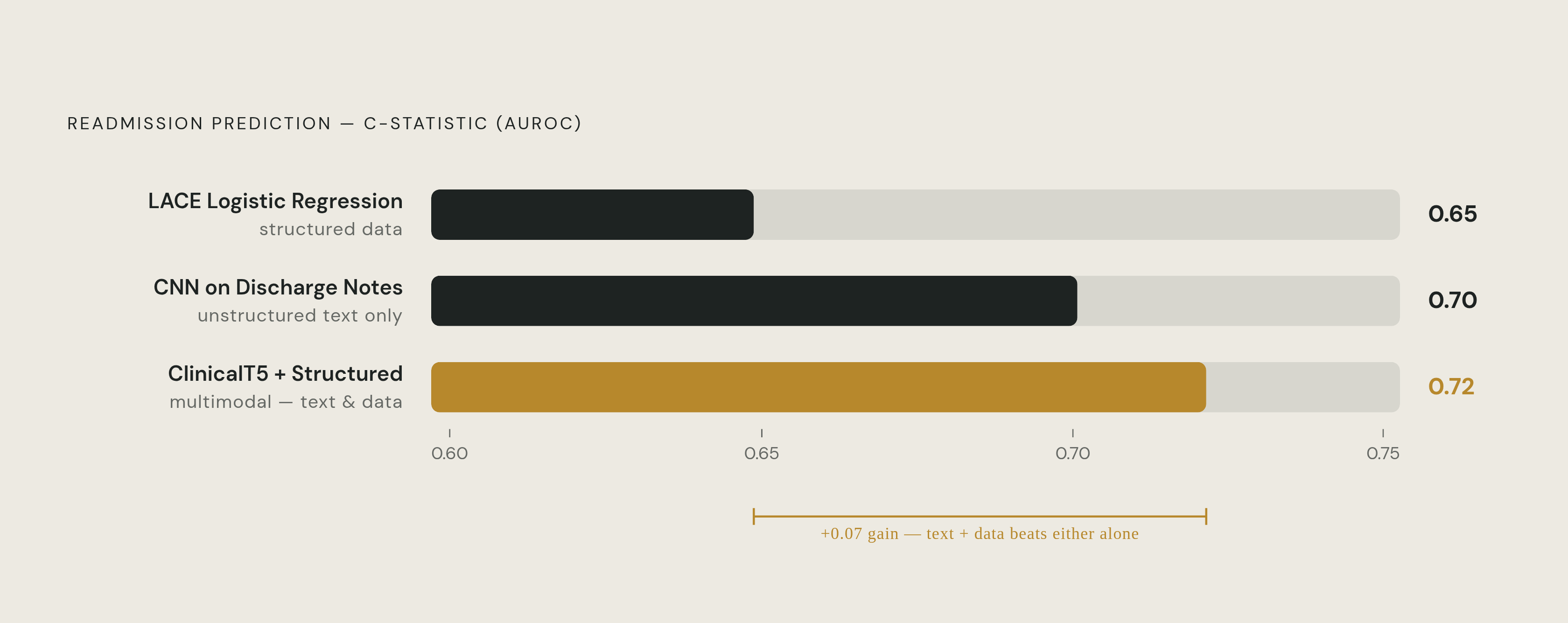
Turning that narrative signal into something a prediction model can use is a question that has already been tested, and the answer so far favors combining nursing text with structured data. Researchers at one rehabilitation institute trained a convolutional neural network directly on unstructured discharge notes and reached a c-statistic of 0.70, compared with 0.65 for a logistic regression model built on LACE score features, a standard structured-data benchmark for readmission risk. That gap, five points on a measure where small differences matter, shows free text carrying more usable signal than the structured variables alone. A study in PLoS ONE, from researchers affiliated with the Royal Marsden NHS Foundation Trust and Anglia Ruskin University, pushed the approach further by fine-tuning a ClinicalT5 language model on clinical notes broken into 200-word chunks, a segmentation choice that keeps the narrative detail of a note intact while keeping the computational load manageable. That text model was then combined with structured inputs in a multi-modal neural network, and the combined model reached an AUROC of 0.72 with balanced accuracy well above chance, outperforming either the text model or the structured model running alone. The chunking detail matters for anyone running a facility, because it means notes don't have to be reduced to keywords or stripped of context to be usable: a 200-word segment still reads like a nurse's account of a shift, not a bag of extracted terms. Interpretability also has to hold up under real use. Recent work focused specifically on skilled nursing facilities, from Lou and colleagues in 2025, applies SHAP values and partial dependence plots to show which resident, facility, and staffing features are driving an individual risk score. Without that layer, a nursing manager looking at a risk flag has no way to act on it, and a model that cannot be acted on has no clinical value no matter how well it scores on a validation set. None of this requires exotic infrastructure, either. Oh and colleagues tested six separate algorithms, logistic regression, random forest, decision tree, XGBoost, CatBoost, and a multiperceptron layer, using five-fold cross-validation and adaptive synthetic sampling to correct for data imbalance, and standard methods performed well once nursing data was properly structured as input.
Where NLP-based readmission prediction in long-term care falls short
The evidence for NLP-based readmission prediction is strongest in acute care, and its track record in long-term care specifically is still early. Three gaps define the distance between what the research shows and what a skilled nursing facility can deploy today. The first is adoption: outside acute care, NLP work has concentrated in home health settings, and long-term care and skilled nursing facilities show up far less often in the published literature, with standardized terminologies and socio-behavioral constructs applied inconsistently from one facility to the next. The second is interpretability: as nursing narratives and the text representations learned from them grow more complex, tracing why a particular phrase or note element pushed a risk score up or down gets harder, and a model nobody can explain is a model nursing staff will not trust enough to act on. The third is generalizability. A 2026 multicenter study in Archives of Gerontology and Geriatrics, led by Mao and colleagues, built a machine-learning model to predict six-month unplanned hospitalization among long-term care facility residents and found real discriminative ability, but calibration varied across facilities, and the authors concluded that broader geographic validation and prospective implementation studies are still needed before the model travels well. The honest version of this objection is that extracting the signal in nursing notes reliably across facilities with different documentation habits, different staffing patterns, and different patient populations remains an unsolved operational problem. That does not make the approach unsound. The fusion architectures already discussed and the interpretability tools built by Lou and colleagues are direct responses to these three gaps, not evidence that the underlying signal doesn't exist.
CMS's shift to preventable readmission measurement
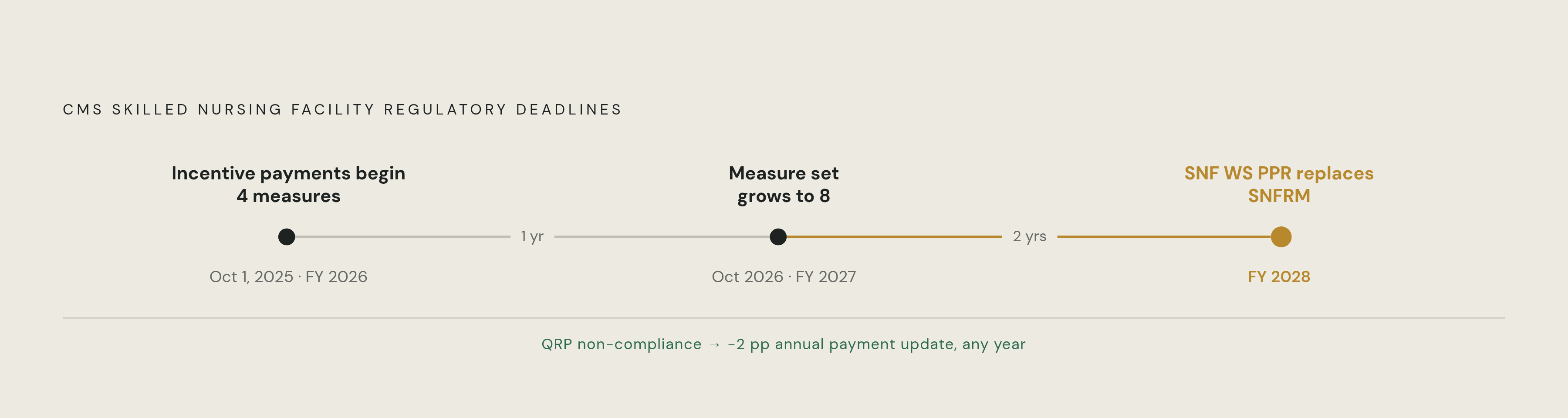
Research gaps are one thing. Regulatory deadlines are another, and CMS has set one. The agency will replace the SNF All-Cause Readmission (SNFRM) measure with the Within-Stay Potentially Preventable Readmission (SNF WS PPR) measure starting in FY 2028. A federal nursing home payment program already expanded to four measures for the FY 2026 program year, with incentive payments beginning October 1, 2025, and the measure set grows to eight total by October 2026, the start of FY 2027. The word "preventable" is doing real work in that new measure's name. Showing that a readmission was not preventable requires a facility to make a retrospective clinical argument, and that argument only holds up if the warning signs were documented and acted on at the time, not reconstructed after the fact. That is a standard built for exactly the kind of continuous, note-level monitoring this piece has been describing, and it cannot be met by a structured flowsheet that only reflects a resident's status after a threshold has already been crossed. The financial stakes attached to this shift are not uniform across facilities. MedPAC's analysis of FY 2022-2023 data shows a meaningful spread between facilities in the top and bottom quartiles of risk-adjusted preventable readmission rates, and facilities sitting in that upper quartile carry the steepest exposure, exactly the group where earlier, note-based intervention has the most room to close the gap. The payment reductions tied to the SNF VBP program in FY 2026 are substantial on their own, and facilities that miss Quality Reporting Program requirements face an additional 2-percentage-point reduction to their annual payment update. Documentation quality carries weight beyond readmission measurement, too. A federal watchdog agency's November 2025 audit of one nursing and rehabilitation center found errors in 99 of 100 sampled claims under a skilled nursing payment model, a result that ties documentation quality directly to audit exposure. Clean, complete notes are now a financial safeguard as much as a clinical one.
The documentation burden on nurses as the operational problem readmission prediction tools must solve
None of the prediction capability described above means anything if it asks nursing staff to write more. Surgeon General's Advisory on health worker burnout found that nurses spend roughly two-fifths of an average shift on documentation. The same staff who produce the notes a predictive model depends on are also the staff already stretched thinnest by documentation demands, so a tool that adds a new field to fill out or a new screen to complete doesn't just burden nurses further, it degrades the quality of the very source it needs to function. KLAS's case study points to a workable alternative. One health system profiled in that research eliminated a large number of documentation fields, recovered a substantial number of nursing hours each year, and saw a meaningful rise in its nurses' Net Experience Score by focusing on frontline engagement. That result shows documentation reduction can happen at scale, and that the notes nurses do write improve in quality once the burden around them is lighter. The design conclusion follows directly: a readmission prediction tool built for skilled nursing has to read from the narrative documentation nurses are already producing, the shift notes, the observations, the day-to-day record of how a resident is doing, rather than asking for a new assessment screen or a new structured template layered on top of an already full workload.
Sources
- Predicting Readmission Among High-Risk Discharged Patients Using a Machine Learning Model With Nursing Data: Retrospective Study - PubMed
- JMIR Medical Informatics - Predicting Readmission Among High-Risk Discharged Patients Using a Machine Learning Model With Nursing Data: Retrospective Study
- Original Paper Predicting Readmission Among High-Risk Discharged
- Predicting readmission risk from doctors' notes
- Predicting 30-day hospital readmissions using ClinicalT5 with structured and unstructured electronic health records
- Predicting Readmission Among High-Risk Discharged Patients Using a Machine Learning Model With Nursing Data: Retrospective Study
- Predicting 30-day hospital readmissions using ClinicalT5 with structured and unstructured electronic health records