Morse Fall Scale Limitations in High-Acuity Long Term Care Populations
A 2026 study found only one of six scale items actually predicts falls.
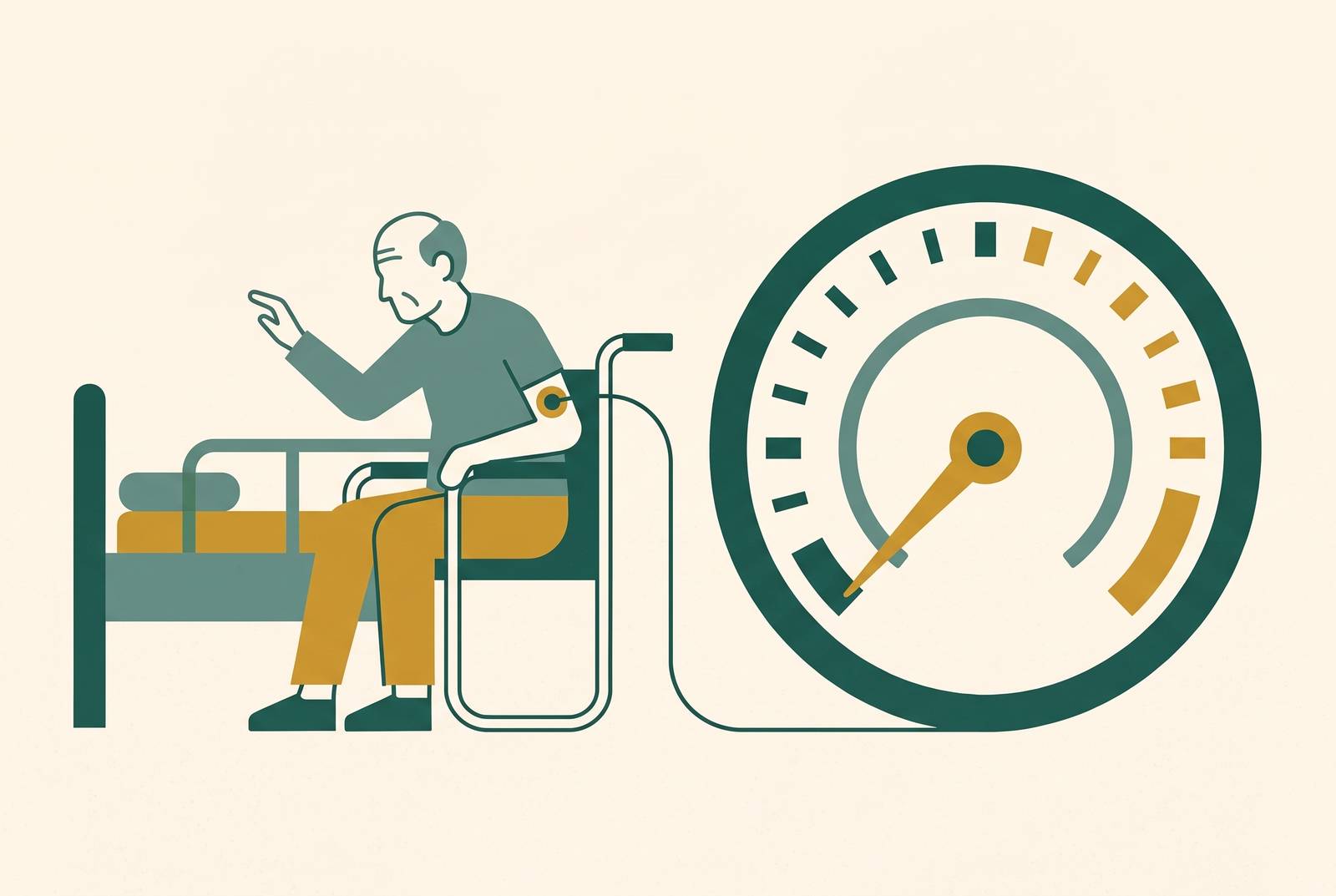
The Morse Fall Scale carries structural limitations that make it a poor discriminator of fall risk in high-acuity long-term care settings. Nearly every resident in these facilities scores high on the instrument, and only one of its six components, a history of falling, reliably separates residents who go on to fall from those who do not.
What the Morse Fall Scale was built to do
The Morse Fall Scale is a nurse-rated, six-item instrument built for acute inpatient care, with some supporting evidence from rehabilitation units, and it carries weaker evidence behind its use in long-term care, though it gets used there anyway. Janice M. Morse, Robert M. Morse, and Suzanne J. Tylko developed it from a case-control study and published it in the Canadian Journal on Aging in 1989, in volume 8, pages 366 to 377. The tool scores six weighted items on a 0 to 125 scale: fall history, secondary diagnosis, use of an ambulatory aid, IV or IV access, gait quality, and mental status, the last of which asks whether a patient's belief about what they can safely do matches what they can actually do. The familiar low, medium, and high risk bands that nurses and administrators talk about are not part of the instrument itself. Facilities set those cut-offs locally, and no regulator mandates the scale or names a threshold for it. A federal research agency carries the MFS as an example tool and it has been built into required clinical workflow at many facilities, but no regulator or accreditor requires its use.
How the six MFS items behave when residents already score high
The scale depends on variation across a population to do its job, and that variation disappears in high-acuity long-term care. When nearly everyone in a facility already carries multiple diagnoses, uses a cane or walker, shows impaired gait, or struggles to judge their own physical limits, the scale's items stop separating anyone, because they saturate across both residents who fall and residents who never do. Conditions that the MFS scores as risk factors, such as multiple diagnoses, ambulatory aid use, impaired gait, and a mismatch between a resident's self-assessed and actual ability, are close to universal in this setting rather than distinguishing features of any particular resident. Facilities have responded by lowering cut-off scores to reflect the generally lower acuity of nursing home residents compared to acute hospital patients, but that adjustment amounts to an admission that the tool and the setting don't match rather than a fix for it. A 2025 prospective cohort study that validated four fall risk tools in Chinese nursing homes found this pattern in practice: at the standard cut-off of 45 or above, the MFS showed high sensitivity but very low specificity, labeling nearly everyone high risk while failing to screen out residents who would never fall. A study conducted in Slovak long-term care facilities found the same underlying problem from a different angle: most of the risk factors the facilities monitored showed high incidence across the entire resident population, not just among those who fell. Shifting the threshold looks like the obvious fix, but the Chinese nursing home study found that adjusting thresholds improved performance only modestly and never produced an optimal balance of sensitivity and specificity, which points to a structural ceiling rather than a calibration error. The scale is not incapable of discrimination everywhere. Mao and colleagues found the MFS performed well in obstetrics and gynecology wards, with an optimal cut-off of 40, a population with a fundamentally different acuity profile where the items still varied enough to separate risk levels. That contrast sharpens the point about long-term care rather than softening it: the instrument works where the underlying population still has range on the traits it measures, and high-acuity nursing homes simply don't offer that range.
What the 2026 JAMDA study found
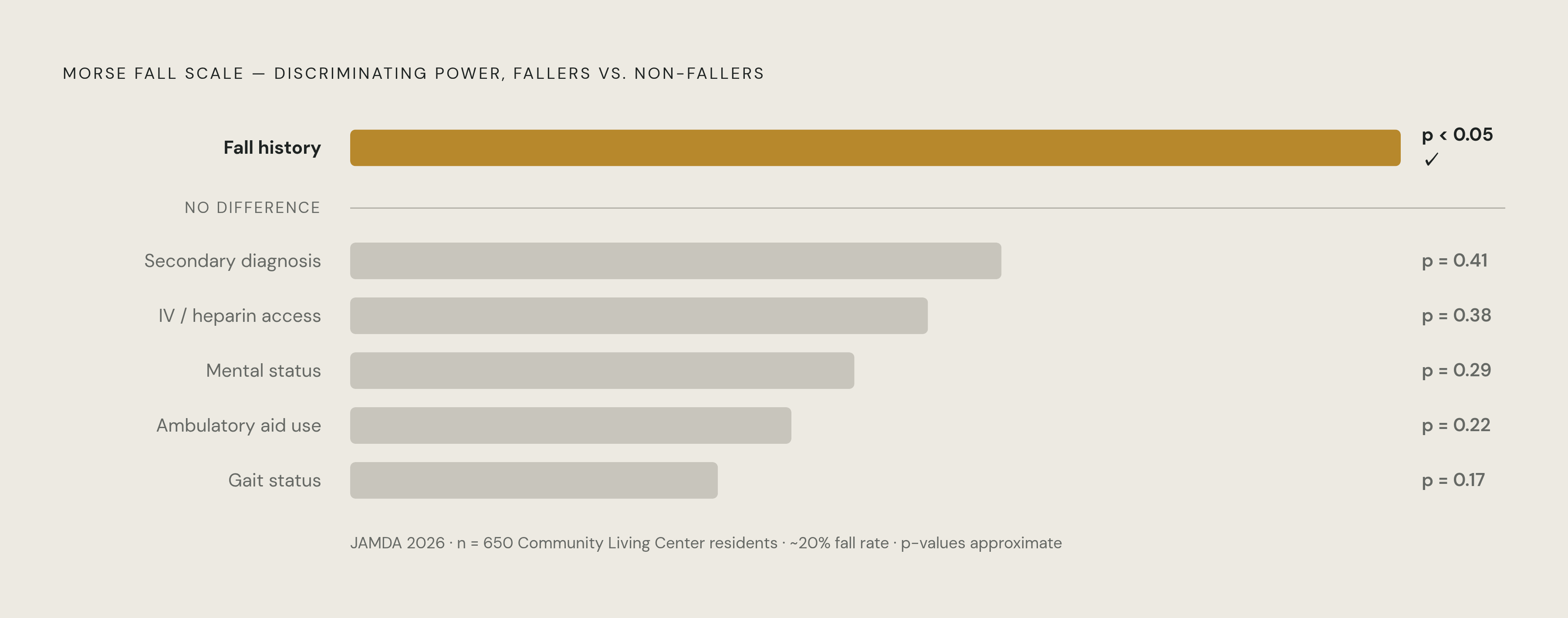
A study published in the Journal of the American Medical Directors Association put this mechanism to a direct test and found that only one of the six MFS items, fall history, distinguished nursing home residents who fell from those who didn't. Researchers examined 650 nursing home residents admitted to a Community Living Center between June 2022 and May 2024, and roughly one in five of those residents fell during the observation period. Across total MFS score, secondary diagnosis, IV access, mental status, ambulatory aid, and gait status, the study found no significant difference between residents who fell and residents who did not. A history of falling was the single item that showed a statistically significant difference between the two groups. The finding is not a story about nurses scoring the instrument incorrectly. It describes a structural redundancy built into the tool itself: five of the six items that are supposed to stratify risk simply fail to vary across this population in any way connected to who actually falls. The Slovak long-term care study reached a parallel conclusion from its own data, identifying prior falls as the strongest predictor and finding statistically significant correlations between fall history, along with factors like gait disorder, ambulatory aid use, and mental disorder, and falling during the study period.
Why a score-driven workflow creates compliance exposure
Once the MFS assigns a high-risk label to nearly every resident in a facility, the score stops doing triage work and starts functioning as paperwork, the kind that invites scrutiny rather than deflects it. CMS guidance already warns surveyors to watch for generic, score-linked documentation, and reviewers are trained to flag boilerplate entries such as "fall precautions maintained" or "high fall risk bundle in place" when no specific measure ties back to an actual scoring item or an individualized care plan. A facility that records an MFS score without linking particular items to particular interventions remains exposed to F-tag citation even though a number was dutifully entered into the chart, because the score by itself is not the documentation a surveyor is looking for. Two prominent clinical authorities have begun moving in the same direction on this question. NICE advised in 2025 against using fall risk prediction tools to predict who will fall, and the Australian Commission on Safety and Quality in Health Care's 2025 hospital guideline takes a different approach entirely, treating every older inpatient as high risk by default and directing clinical attention toward each person's specific risk factors instead of a composite score. Both bodies are moving away from the premise that a single number can answer the question of who needs intervention, which is the same premise that breaks down when the MFS saturates across a nursing home population.
How the regulatory environment has raised the cost of weak fall risk differentiation
Three regulatory developments since 2024 have raised the financial and survey stakes of relying on a fall risk tool that can't tell residents apart, compounding exposure across survey outcomes, quality measures, and program placement. F-Tag 689, covering freedom from accident hazards and adequate supervision and devices, is the second most commonly cited F-tag among state surveyors, with falls as its primary trigger, and inconsistent or vague fall documentation, particularly around fracture cases, leads directly to citations, clustered deficiencies, and litigation exposure. CMS adopted "Percent of Residents Experiencing One or More Falls with Major Injury" as a quality measure in the Value-Based Purchasing program starting with the fiscal year 2025 performance period, which began October 1, 2024; a facility whose fall risk tool can't separate high-risk from low-risk residents now carries that failure directly into its VBP reimbursement. In January 2026, CMS went further and made falls data a direct factor in selecting facilities for its Special Focus Facility program, the first time falls data has served as a direct SFF selection criterion, a change that followed an OIG report finding that nursing homes had failed to report a large share of falls involving major injury and hospitalization among Medicare-enrolled residents. The policy shift has not gone unchallenged. One expert warned that raw falls counts can function as a somewhat arbitrary selection factor, since facilities differ in the acuity and ambulatory status of their resident populations, and noted that CMS has not directed surveyors to weigh the totality of a facility's quality measures when falls data drives SFF selection. That objection matters because it cuts in the same direction as the clinical evidence: a facility with sicker, less ambulatory residents will show a higher raw fall count regardless of how well its staff manage risk, and a selection criterion built on raw prevalence doesn't distinguish that case from genuine quality failure.
Why the problem is not the cut-off score
Recalibrating the MFS threshold treats the symptom rather than the disease, because the instrument was built to capture a single point-in-time snapshot, and the residents it's scoring experience fall risk that shifts continuously with their condition, their medications, and their day-to-day function. Falls occur roughly three times more often in long-term care than in the community, and their causes are multifactorial, drawing on dozens of internal and external risk factors that six structured items were never designed to capture. The 2025 Chinese nursing home study already showed what happens when a facility tries to solve this by moving the threshold: sensitivity and specificity improved somewhat, but never reached an optimal balance, which confirms that the ceiling effect is built into the structure of the instrument rather than an artifact of a poorly chosen cut-off. One alternative approach illustrates what becomes possible once a model draws on richer, more continuously updated data: a model built from Long-Term Care MDS records across five skilled nursing facilities outperformed 22 previously evaluated fall risk tools on a defined prediction window, and it did so using data that facilities already collect routinely rather than requiring a separate nurse-completed workflow.
What validated alternatives exist
Long-term care is not without options beyond the MFS, and some of them show stronger predictive validity for this specific population, but none has displaced the Morse Fall Scale, because operational feasibility remains a genuine constraint on what a short-staffed facility can realistically administer shift after shift. A systematic review of fall risk assessment tools used in long-term care found that the Modified Fall Assessment Tool and the Peninsula Health Falls Risk Assessment Tool both demonstrated good predictive validity alongside good feasibility, yet neither has reached anything close to the MFS's level of standardization across the industry. The trade-off driving that gap is straightforward: tools that score better on predictive validity tend to ask more of the staff administering them, while tools simple enough to match the MFS's ease of use tend to inherit the same saturation problems once they're applied to a high-acuity population. A facility with a genuinely sicker, less ambulatory resident population may show a higher fall rate simply because its residents are more frail, and no fall risk tool, however well validated, resolves that difference on its own. Raw fall prevalence measures, including the ones now feeding into Special Focus Facility selection, don't adjust for this either. The search for a better instrument addresses only part of what drives a facility's fall numbers.
Fall Risk Signal in Unstructured Clinical Notes
The clinical detail that six structured items can't capture, a medication change, a shift in behavior, an offhand note about unsteady gait, a mention of a resident refusing fluids, already exists in most facilities' records, written into free-text nursing notes rather than captured as a checkbox. Electronic health records hold the raw material for genuinely predictive, continuously updated fall risk models, but the models built so far have mostly drawn on structured EHR fields and left the unstructured narrative text unexamined, which is precisely the gap a notes-based approach is built to close. One published study applied deep learning to free-text nursing notes and medication data from a senior living facility, TigerPlace in Columbia, and produced a model with accuracy of 0.81, sensitivity of 0.75, specificity of 0.83, and an F1 score of 0.82, a specificity figure that substantially exceeds what the MFS achieves at standard nursing home cut-offs. Research published in Age and Ageing reached a similar conclusion from a different dataset: unstructured clinical notes offered a genuinely additive path to estimating fall risk compared with traditional prediction models, and predictive performance improved further once information drawn from those notes was combined with structured clinical variables. The approach carries real operational friction. Rapid EHR rollout across the industry has left many facilities with unstructured metadata, duplicative data entry, and a documentation burden that varies by shift, by staff member, and by how comfortable any given nurse is with the EHR system, and note quality has to be accounted for before any facility leans on NLP output as a clinical judgment. Epic's Fall Predictive Analytics Tool shows one version of what integration looks like in practice, computing the number of fall-risk-increasing drug doses and medications a resident has been administered at a given point in time. The signal these approaches extract, drawn from notes nurses are already writing, from medication records already being updated, and from data already sitting inside the EHR, points toward the kind of continuously updated, multifactorial assessment that a six-item checklist built in 1989 for acute hospital wards was never designed to provide.
Sources
- Morse Fall Scale Documentation & Sample Note
- Fall History is the Only Morse Fall Scale Item That Differentiates Nursing Home Residents Who Fall From Those Who do Not - Journal of the American Medical Directors Association
- The risk of falling among older adults in long-term care: Screening by the Morse Fall Scale - ScienceDirect
- Re-evaluating the Morse Fall Scale in obstetrics and gynecology wards and determining optimal cut-off scores for enhanced risk assessment: A retrospective survey
- An interpretable data-driven approach to optimizing clinical fall risk assessment