Early Dehydration Risk Signals in Nursing Documentation
Nursing notes already contain the warning signs—if someone reads them together.
Dehydration in nursing home residents almost never announces itself the way textbooks describe it. The signals that precede a crisis are already sitting in nursing notes, scattered across shifts and fields no one is reading together, and catching them early depends on recognizing a pattern rather than waiting for a symptom.
Why dehydration in nursing home residents rarely looks like dehydration
The PALTmed Clinical Practice Guideline on fluid maintenance in long-term care states that signs and symptoms of dehydration and volume depletion in older people may be vague, deceptive, or absent. This undercuts a lot of standard clinical training, because staff are taught to watch for dry mouth, poor skin turgor, or obvious thirst complaints. In the nursing home population, those signs are often absent entirely, and when they do appear, they don't mean what they would mean in a younger, healthier patient.
Part of the reason is physiological. Aging blunts the thirst response, a condition clinicians call hypodipsia of aging, so a resident who is losing fluid may simply never feel or express the urge to drink. Central nervous system lesions and a long list of common medications add another layer of interference, suppressing exactly the signals a resident would otherwise report to staff. The resident isn't hiding anything. The body itself has stopped sending the alarm.
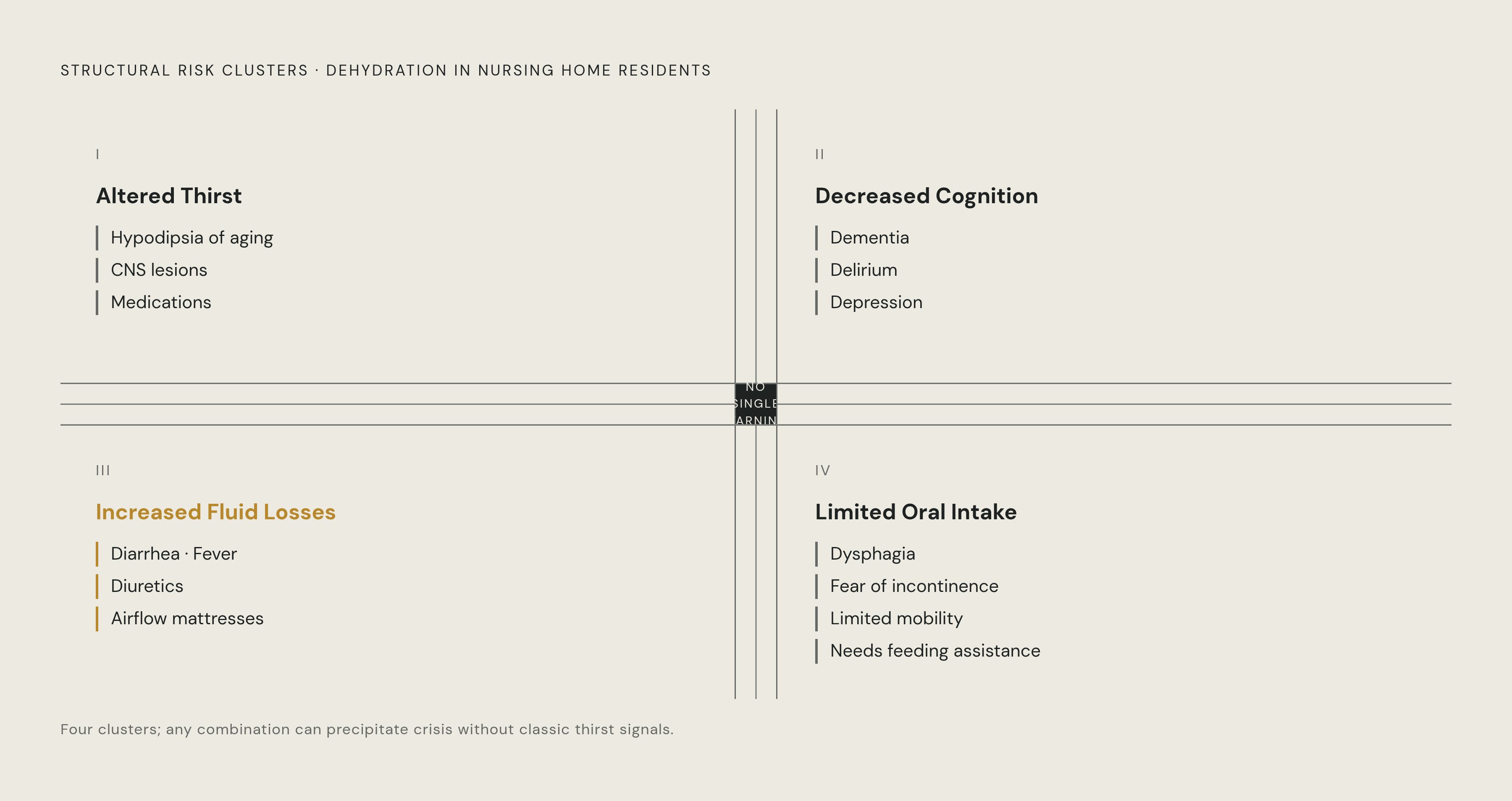
Risk builds instead from a cluster of contributing factors documented in the clinical literature, and they fall into four groups: altered thirst; decreased cognitive function from dementia, delirium, or depression; increased fluid losses from diarrhea, fever, diuretics, or specialty airflow mattresses; and limits on oral intake from dysphagia, fear of urinary incontinence, limited mobility, or the need for feeding assistance. Each factor alone might explain very little. Together, they describe a resident whose hydration status can shift without any single dramatic warning sign.
A systematic review published in BMC Nursing looked for a shortcut through this complexity and didn't find one: it concluded there is no clear evidence supporting any single clinical symptom, sign, or test for detecting water-loss dehydration in older adults. Even elevated serum osmolality, a lab value clinicians might reach for as a more objective marker, turns out to be unreliable on its own. Research on long-term care residents has found that elevations in serum osmolality are frequently observed in people who show no clinically overt signs of dehydration. If a resident won't reliably show the signs, and no single test reliably catches the condition early, detection has to happen somewhere other than the exam room, in the ordinary record of how a resident is doing from shift to shift.
Frontline nursing staff and the barriers to carrying the full detection burden
A 2026 study published in Nutrients asked nursing home managers who is actually responsible for catching dehydration before it becomes a medical event, and the answer was consistent: nurses and nursing assistants, through direct observation and hands-on examination. There is no separate surveillance system standing behind them. The person charting a resident's lunch refusal or a change in urine color is also the person expected to recognize what that observation might mean.
The same study found that these staff understand hydration matters. What they lack is the infrastructure to act on that understanding consistently: limited training specific to dehydration recognition, no standardized protocol for escalating a concern, and record systems too imprecise to support reliable tracking across time. No standardized nurse-led assessment or formal bedside response protocol is commonly applied across long-term care settings. Nursing staff are being asked to catch a condition that evades single-symptom detection, using judgment built on training that often doesn't cover the specific indicators involved, within a documentation system that wasn't designed to connect what they see on one shift to what a colleague sees on the next.
Electronic health record fragmentation adds friction on top of that gap. A nurse documenting a resident's care may need to move across separate tabs to record fluid intake, check standing orders, log an event, review recent labs, and notify a provider, and each of those steps lives in its own part of the system. That fragmentation matters less for its effect on a nurse's workflow in the moment than for where it sends the information afterward: into free-text notes rather than the structured fields that get monitored. That's the detail the next section depends on.
Early signals: the specific language nurses already write
The useful signals for catching dehydration early are already being written down. They just don't look like a diagnosis. They look like the ordinary, almost incidental language of a shift note: "resident refused morning fluids," "urine appeared dark and concentrated," "more confused than usual this afternoon," "not herself today, declined to join activities."
Oral intake and appetite notes carry some of the clearest signals: documented meal refusals, reduced acceptance of fluids, changes in how well a resident tolerates a given food texture, or hesitation at mealtimes connected to swallowing difficulty. A nurse's passing comment about decreased urine frequency, or a darker or more concentrated appearance, is frequently written into a shift note long before any formal intake and output measurement would flag a problem.
Skin and mucous membrane comments appear too, though the PALTmed guideline is careful to note that both skin turgor and dry mucous membranes have limited reliability as standalone assessment points in older adults. Even so, these observations tend to appear as passing remarks in narrative notes, not as entries in a dedicated structured field, and they add weight when they appear alongside other signals.
Functional change appears in softer language still, in comments that a resident seems "less engaged" or declined to participate in an activity they normally enjoy. Functional decline has been linked to inadequate hydration, and this kind of note often appears before any clinical measurement would register a change. Medication-related observations round out the picture: notes about the timing of a diuretic, the use of a laxative, or an episode of fever, all of which the PALTmed guideline identifies as specific factors that increase fluid-loss risk.
No one of these entries, read alone, means much. A resident skips a glass of juice at lunch, or seems a little more tired than usual, and a reasonable nurse moves on. The 2026 Nutrients study found that imprecise record systems stand as a real barrier to effective hydration monitoring, and that finding points to something specific: the signals are being written. They are not being read together.
Structural reasons documentation doesn't become action
Nurses are not failing to observe. But the documentation systems most facilities use are not built to surface a pattern spread across different notes, different shifts, and different staff members.
Early dehydration signals appear predominantly in free-text nursing notes rather than in structured flowsheet fields, and free text is precisely the part of the record that clinical decision tools and standard reporting dashboards typically don't scan. EHR fragmentation compounds the problem directly: a behavioral change noted by one nursing assistant in the morning, a reduced fluid intake flagged by a different staff member at lunch, and a urine observation written by a third person in the evening can sit in three separate documentation locations with no built-in mechanism connecting them. Each entry is accurate. None of them, alone, triggers a response.
Better training and clearer protocols would help close part of this gap, and the 2026 Nutrients study supports that view directly: nursing home care teams recognize hydration as important, but they operate without specific protocols for aggregating and acting on these distributed signals. Training solves the recognition problem for an individual nurse looking at an individual resident in an individual moment. It does less to solve aggregation: the volume and distribution of these notes across a full shift roster, over several days, for dozens or hundreds of residents, is more than any one person reviewing charts by hand can reliably track. The nurse or aide who wrote a given observation may not be the person reviewing the full chart later, and shift handover, the one moment built for transmitting exactly this kind of risk signal, provides no structured prompt that would surface it. Individual observations get absorbed into the background of routine charting.
Requirements for a documentation-aware monitoring approach
Closing this gap starts with a different review habit, not new paperwork. The central principle is straightforward: no single note should trigger a dehydration concern on its own, but a pattern across a 24- to 48-hour window should. Nursing managers reviewing resident charts need to be looking across intake notes, output observations, behavioral changes, and functional comments together, rather than scanning any one category in isolation.
That kind of review should not be applied evenly across a full census. Residents carrying the highest structural risk, those on diuretics, those with dementia, those who need feeding assistance, those with a documented history of dysphagia, warrant a higher-frequency review cadence than lower-risk residents. Treating every resident's chart with the same review schedule spreads attention thin exactly where it needs to be concentrated.
There's also evidence that visibility itself changes outcomes. A risk prompt study tested the idea that surfacing risk signals at the bedside, rather than leaving them buried in the chart, changes nursing home care behavior for the better. The implication for day-to-day practice is direct: making an aggregated signal visible to the people delivering care matters as much as having captured the signal in the first place.
This kind of cross-shift, risk-stratified review works for the residents a nursing manager has already flagged as high-risk, provided there's time in the week to do it by hand. A manager overseeing a full facility census with only a handful of nursing managers cannot read every free-text note from every shift looking for patterns, so this practice needs a mechanism built to handle the aggregation at scale.
Automated analysis of nursing notes as a solution manual review cannot provide
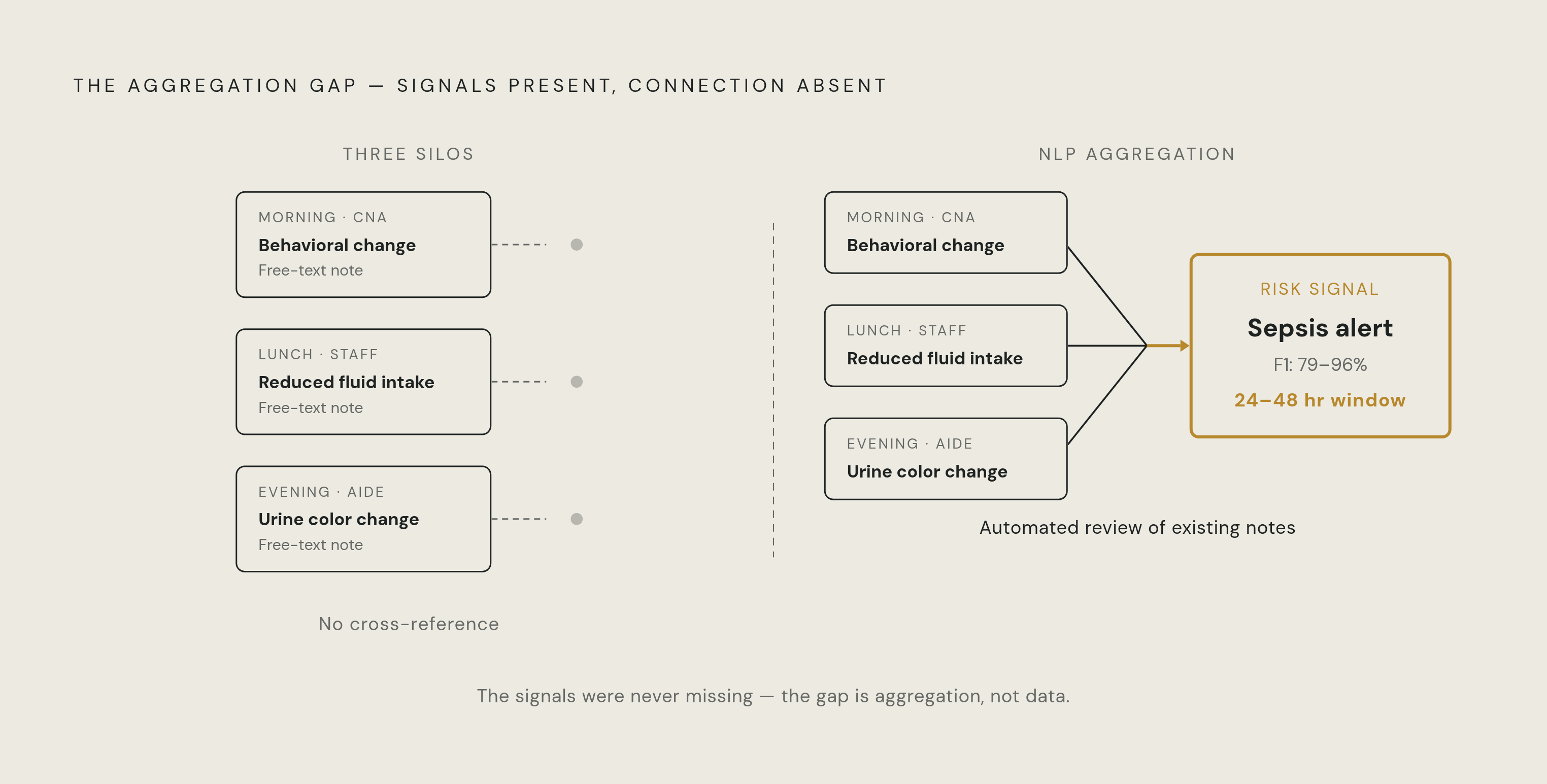
That mechanism already exists in a form that's been tested in adjacent clinical problems. Natural language processing applied to clinical documentation can extract, analyze, and structure information from free-text EHR entries, the exact part of the chart where early dehydration signals live, and this kind of technology is being used with increasing frequency to support clinical decision-making. Related work on sepsis detection has shown that automated systems built to monitor nursing notes for early signs of infection can reach F1-scores ranging from 79 to 96%, a result that demonstrates free-text clinical documentation can support reliable automated signal detection when the model is built around the right dataset.
Applied to dehydration, the same approach means observations currently sitting in three separate shift notes, a behavioral change, a reduced fluid intake, a note on urine color, can be aggregated into a single risk signal without asking nursing staff to document anything new. The notes already get written during normal charting. The gap is in reading them together: it's a problem of aggregation, not of missing data.
The strongest objection to this approach is a fair one: free-text nursing note quality varies, and if the underlying documentation is thin or inconsistent, automated extraction inherits that inconsistency. No algorithm fixes charting that was never done. The goal of an automated layer is to make sure the observations nurses do write actually reach someone who can act on them. Even imperfect documentation, read systematically across shifts, catches more than documentation that is technically present in the chart but never aggregated.
The direction of the field backs this approach. A 2025 systematic review and meta-analysis registered in PROSPERO developed a preliminary scoring tool for dehydration risk stratification, built from pooled diagnostic metrics, and that effort reflects where the work is heading: structured, evidence-based prioritization of which residents need attention first. Tools built to read existing EHR notes and produce ranked resident risk scores, requiring no duplicate data entry and no new workflow layered onto an already full shift, aggregate scattered observations and avoid adding to documentation burden at the same time.
Regulatory consequences of dehydration documentation gaps under CMS survey enforcement
Dehydration is an explicitly cited survey domain, and gaps in hydration monitoring documentation are a concrete, traceable source of deficiency findings.
F-tag F807 sets the federal requirement directly: each resident must receive, and the facility must provide, drinks, including water and other liquids consistent with the resident's needs and preferences, sufficient to maintain hydration. That's a specific tag number surveyors cite when a facility is found out of compliance, a concrete expectation rather than a general one floating somewhere in a larger standard.
When a surveyor finds a deficiency, it gets scored on two dimensions: scope, meaning how many residents are affected, and severity, meaning how much harm resulted. Those two scores determine how heavily the finding weighs against a facility's CMS health inspection rating. Deficiencies scored at "G" or higher, which signals actual harm, trigger escalating enforcement, and a lower severity score of "F" only escalates when it rises to the level of Substandard Quality of Care. A facility's star rating, used by families and referral sources to judge quality, moves on exactly these kinds of findings.
The connection to documentation is direct. A surveyor able to trace a resident's dehydration episode back through the chart, finding that early signals were written down but never acted on, has the evidentiary basis for a deficiency finding. The documentation gaps described throughout this piece are a clinical risk to the resident and a compliance exposure that shows up in exactly the records a survey team is trained to review.
Putting it together: what a practical early-warning system for dehydration risk looks like in a nursing home
The clinical picture, the operational reality, and the regulatory stakes all point to the same conclusion. Dehydration in long-term care residents resists detection through classic symptoms, so the clinical literature is clear that no single sign or test catches it reliably. The staff tasked with detection, nurses and nursing assistants, already understand hydration's importance, but they work without standardized protocols or the record systems needed to track it across time. The early signals exist anyway, written in the ordinary language of shift notes: a refused meal, a darker urine color, a resident who seems less herself, a diuretic given later than usual. Staff notice these signals, but the signals go unread because they sit scattered across free-text fields that no manual review process can reliably scan across a full census.
A practical early-warning system starts with the review discipline nursing managers can put in place today: watching for co-occurring signals across a 24- to 48-hour window, concentrating review frequency on the residents carrying the highest structural risk, and surfacing aggregated findings at the bedside rather than leaving them buried in separate chart sections. It extends, at scale, through automated analysis of the free-text notes nurses already write, turning scattered observations into a ranked, actionable signal without adding a single new documentation task to an already full shift. And it closes with real stakes attached: the documentation gaps this piece has traced from physiology through workflow are the same gaps a CMS surveyor can trace through a chart, scored on scope and severity, and reflected in a facility's public rating.
The signals were never missing. They were sitting in notes nurses wrote during a normal shift, waiting for a system built to read them together.
Sources
- Dehydration and Fluid Maintenance in the Long-Term Care Setting
- Clinical assessments and care interventions to promote oral hydration amongst older patients: a narrative systematic review - PMC
- Hydration and Dehydration Prevention in Nursing Homes: Perspectives, Barriers, and Practices of Care Teams and Managers
- Feasibility of using risk prompts to prevent falls, dehydration and pulmonary aspiration in nursing homes: a clinical study protocol
- Toward Automated Early Sepsis Alerting: Identifying Infection Patients from Nursing Notes
- Systematic Review and Meta-Analysis of Risk Factors for Dehydration and the Development of a Predictive Scoring System