Weight Loss Trending as an Advance Indicator of Resident Decline
Unplanned weight loss signals broader functional decline in long-term care residents.

Unplanned weight loss in a long-term care resident is rarely about food intake alone. It is a measurable output of decline running across cognition, mobility, swallowing function, and the resident's capacity to manage the basic act of eating, and treating it as a dietary problem to be solved by a dietitian's note misses what the number is actually telling a care team.
Weight loss in long-term care residents signals more than a nutrition problem
The instinct in most buildings is to route a weight loss alert to the dietary department: adjust the care plan, add a supplement, note the finding at the next care conference, move on. That instinct is not wrong, but it is incomplete, because the scale is measuring far more than caloric intake. Nutritional status depends on strength and endurance, on the mechanics of swallowing safely, on a resident's cognitive engagement with the meal in front of them, and on their ability to take part in what is, for most people, a social event as much as a biological one. A resident who starts losing weight is, more often than not, losing grip strength at the same time, attending fewer meals, swallowing less safely, and showing less cognitive alertness. Weight appears first on the chart because staff take it on a schedule and record it without fail, while the other declines get noticed less consistently.
A retrospective cohort study by Egbujie and colleagues, following long-term care residents across five Canadian provinces, found that functional decline does not happen in a single undifferentiated slide. It follows four distinct trajectories, and in some of those trajectories, decline can be delayed or reversed if someone intervenes early enough. That finding carries a direct implication for how weight should be read: the earlier a facility picks up the signal, the more trajectories remain open to change, and the more options a care team still has.
The upstream signals that precede weight loss
Weight loss itself is a downstream measurement. By the time it registers on the scale, the conditions that caused it have usually been building for a while, and those conditions leave a paper trail before the number moves. Research using MDS assessment data identified three predictors that reliably precede measurable weight loss in nursing home residents: leaving a quarter or more of food uneaten at most meals, receiving an anti-anxiety medication, and lacking the ability to feed oneself independently. Each of these sits in a structured MDS field already, recorded in the normal course of care.
None of these three findings is exotic. CNAs and nurses document meal completion, medication administration, and feeding dependency as a matter of routine, every shift, every day. The gap is not that this information goes uncollected. It sits scattered across separate records, and no one ever pulls it together into a single risk picture for the resident it describes.
The anti-anxiety medication predictor deserves particular attention, because it points to a pathway that runs from psychological or behavioral change straight into nutritional decline. A resident started on an anxiolytic is showing a behavioral or mood shift serious enough to warrant medication, and that shift precedes the weight change, tying cognition and mood to the nutritional trajectory before any physical deterioration becomes visible. Feeding dependency works differently but compounds the same risk: a resident who cannot feed themselves depends entirely on the consistency and attentiveness of whoever assists them at each meal. That makes the resident's nutritional status a direct function of who shows up to help them eat, and how reliably that person shows up, shift after shift.
Staffing instability and risk cascades
The predictors described above are manageable on their own. Staffing continuity keeps these predictors manageable; staffing level alone does not. A facility can run adequate staffing ratios on paper and still fail a resident if the specific people assisting with meals change constantly.
Research out of Brown University in 2025 linked Payroll Based Journal data to MDS assessments across 15,828 facilities and found that a ten-day increase in "low outlier days," days when direct care hours fell at least twenty percent below a facility's quarterly mean, was tied to measurable increases in significant weight loss, ADL decline, worsened independent mobility, and pressure ulcers among residents with Alzheimer's disease and related dementias. The associations were strongest for CNA staffing instability specifically, which lines up with what CNAs actually do on the floor: feeding assistance, positioning, mobility support. These are the exact functions that stand between a resident and the upstream conditions described in the previous section.
That finding turns weight loss monitoring into a staffing operations question as much as a clinical one. When the aide assisting a resident at mealtime changes every few days, no one can reliably catch a quarter-uneaten plate three days running, because the continuity of observation breaks down along with the continuity of care. Most staffing research before this had focused on averages: hours per resident day, overall ratios. This work isolates day-to-day instability as its own risk factor, independent of the average, and gives facilities a subtler but more useful target for quality improvement than headcount alone.
The trajectory literature and the window for intervention
Functional decline in nursing home residents follows patterns, not a single uniform slope, and intervention only works if you catch those patterns in time. Egbujie's trajectory study found that with timely intervention, ADL decline can be delayed, prevented, or even reversed, but only if the trajectory is identified while there is still room to act on it. The study's central argument is that anticipating where a resident's functional trajectory is heading improves care planning outcomes, rather than simply documenting decline after it has already set in.
Ikuta and colleagues, out of Tokyo Medical and Dental University, looked at how fast and when physical function declines among nursing home residents in Japan, and they found that decline does not move at a single speed across residents. Some decline quickly, some slowly, and recognizing which pattern a given resident is following shows whether early intervention remains a realistic option or whether the window has already closed.
Weight trend monitoring pays off when it places a resident on a trajectory map early, so care planning can still change the next step before a mediation analysis by Prusynski and colleagues, published in Health Affairs Scholar in 2026, examined the effects of declining therapy volumes in skilled nursing facilities and found measurable effects on resident outcomes. When active rehabilitation input drops, weight and functional status decline together, and that relationship speeds up, further evidence that these systems move in tandem.
Regulatory framework for weight loss in 2025 and 2026
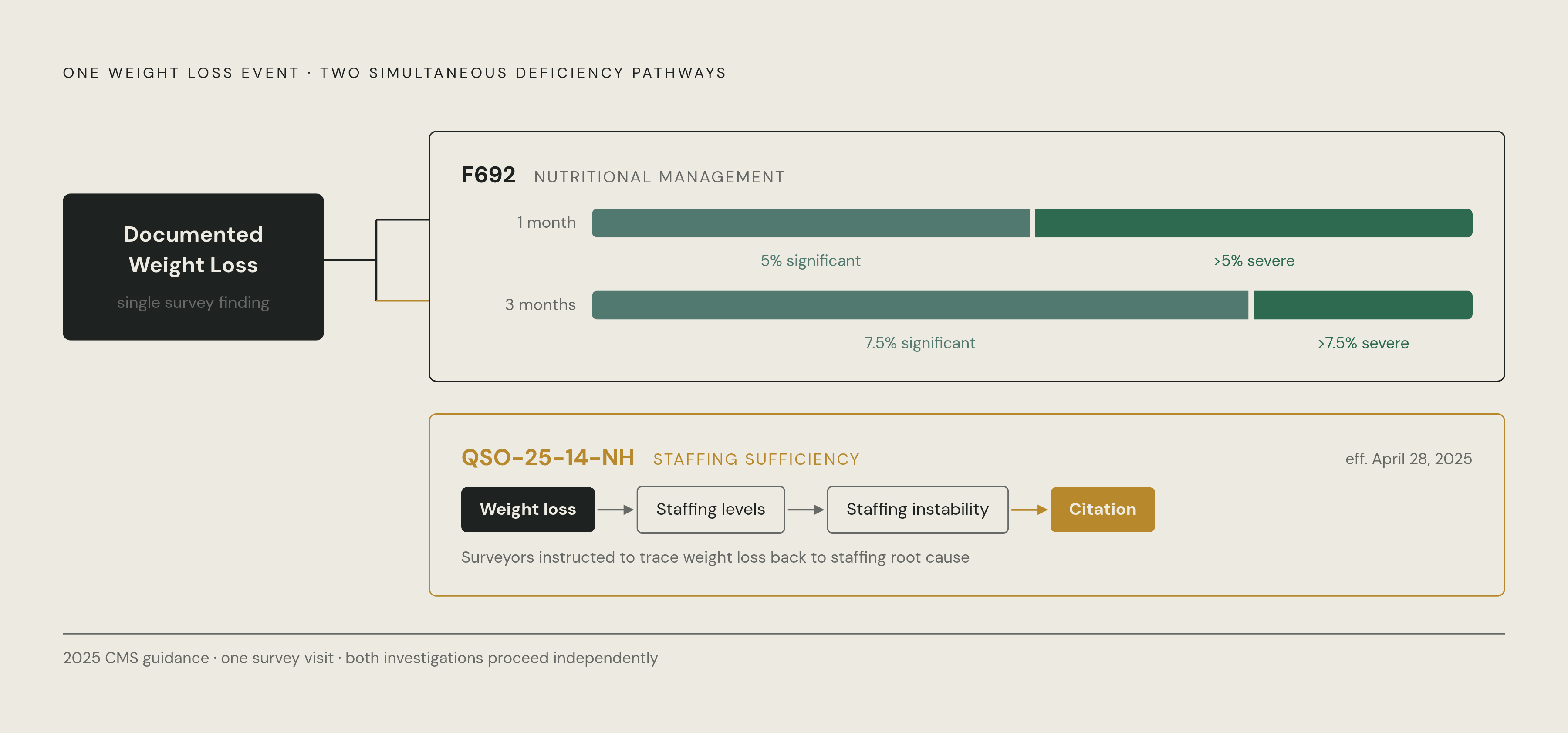
CMS's recent survey guidance has turned weight loss from a single-domain clinical concern into a compliance trigger that touches two separate deficiency pathways at once. The first is nutritional management itself. F692 is the governing survey tag covering this area, and it holds facilities responsible not only for the weight outcome but for the ongoing systems, clinical decisions, and interdisciplinary processes meant to prevent it. A documented weight loss sitting next to a care plan that was never updated, with no interdisciplinary response on record, is a hard pattern to explain to a surveyor.
The thresholds themselves are fixed and specific. A loss of five percent of body weight in one month counts as significant; anything above five percent is severe. Over three months, seven-and-a-half percent is significant, and anything above that is severe. These are the MDS coding thresholds that trigger a citation.
The second pathway opened in 2025. CMS issued QSO-25-14-NH on March 10, 2025, with an effective date of April 28, 2025, releasing major changes to long-term care survey guidelines. The revised guidance explicitly names falls and weight loss as adverse outcomes that may point to insufficient staffing, and it instructs surveyors to investigate whether these outcomes trace back to staffing sufficiency. A single weight loss citation can now open a staffing investigation in the same visit. A facility that handled its nutritional documentation correctly but had staffing instability on the days surrounding the weight loss event now faces exposure on both fronts at once.
The coding mechanics tightened further in the following months. The FY 2026 SNF PPS Final Rule fed into updates built into MDS 3.0 RAI User's Manual version 1.20.1, which took effect October 1, 2025, and which clarified Section K coding for weight loss and weight gain calculations. In December 2025, the American Association of Post-Acute Care Nursing responded by publishing Weight Loss/Gain Calculation Worksheets and Documentation Tip Sheets so facilities could code these events correctly. The regulatory direction across 2025 and into 2026 points the same way: weight loss is treated less as an isolated clinical event and more as a marker that invites scrutiny of the staffing and systems around it.
The data that could catch weight loss early is already in the chart but not in use
Facilities are not short on the data needed to catch weight loss early. What is missing is the step that turns what nurses already write down into a risk signal that reaches a nursing manager while there is still time to act.
Intake notes, nursing progress notes, and therapy notes in skilled nursing facilities routinely describe food refusal, positioning difficulty during meals, fatigue while eating, coughing or choking during swallowing, and how much verbal cueing a resident needed to finish a meal. Every one of these is a predictive signal for weight decline, and none of them lands in a structured MDS field. Studies built on electronic health records often rely on structured fields alone, so they can miss clinical detail that exists only in the notes themselves. The contextual and behavioral texture that precedes a measurable decline lives in the free text, not in the checkboxes.
Weight gets measured on schedule. Upstream behavioral and nutritional signals get written down faithfully in the notes. But nothing connects the two into a single resident-level risk trajectory that a nursing manager can see and act on before the five percent or seven-and-a-half percent threshold gets crossed.
NLP-based extraction of clinical notes and structured weight data
Natural language processing offers a way to pull the nutritional and behavioral signals out of notes that structured fields never capture, and the published evidence now backs its use at a meaningful scale. A scoping review of post-acute care applications found that roughly half the studies it reviewed showed NLP systems performing well enough to be implemented in clinical practice, picking out patient characteristics, symptoms, and risk factors that never made it into structured data forms. That is not a claim that NLP is flawless or that every system performs equally, and the review's own framing, with performance holding up in about half of the studies examined, is the honest way to state it.
The practical value lies in scale. Manual review of free-text clinical notes is slow, expensive, and prone to missing relevant detail buried in a long chart, and NLP does not replace a clinician's judgment so much as make that kind of review possible across an entire resident census rather than one chart at a time. Applied to weight monitoring specifically, NLP can surface language about meal refusal, fatigue during eating, positioning difficulty, and coughing during swallowing directly from nursing notes, linking those upstream behavioral signals to the structured weight trend before the MDS threshold is ever crossed.
Operational requirements for continuous weight trend monitoring to produce a timely response
Catching weight loss early is a workflow problem as much as a technical one. A predictive signal only matters if it reaches the person positioned to act on it, and in a skilled nursing facility, that person is usually the nursing manager. A risk score that never surfaces to someone who can order a dietary adjustment, request a speech therapy consult for swallowing safety, notify the physician or nurse practitioner, or update the care plan does nothing to reduce a facility's compliance exposure, and all four of those responses are what F692 requires once weight loss is identified.
Much of the predictive modeling built so far has been validated on narrow resident cohorts, built in ways that are opaque to the clinicians meant to use it, and disconnected from the daily workflows where a nursing manager would actually need to see it. If a nursing manager cannot interpret a risk score inside their existing routine, it does not meaningfully lower that facility's exposure, however well it performs in a validation study.
The version of continuous monitoring that actually works operationally reads from documentation nurses are already producing, flags residents approaching the five percent or seven-and-a-half percent regulatory thresholds before they cross them, and presents each alert with the context that makes it usable: meal refusal language pulled from the notes, positioning difficulties, and staffing instability on the days surrounding the resident's decline. Research published in Diagnostics found that EHR-based models show clinically useful discrimination for early risk identification, and that multimodal approaches, combining structured and unstructured data, refine risk stratification beyond what single-category weight classification alone can offer. Combining NLP-extracted signals with structured weight trend data in a single system is the architectural case these findings support.
None of this requires adding a new data-entry task to an already stretched nursing staff. The goal is a system that takes documentation nurses are producing anyway and turns it into a ranked, resident-level view of risk that a nursing manager can act on inside the workflow they already have, closing the gap between what the chart already knows and what the care team has time to act on.
Sources
- Staffing Instability and Functional Decline in Long-Stay Nursing Home Residents with Dementia
- Trajectories of functional decline and predictors in long-term care settings: a retrospective cohort analysis of Canadian nursing home residents
- TRAJECTORY OF DECLINING PHYSICAL FUNCTION AMONG NURSING HOME RESIDENTS IN JAPAN
- Using the minimum data set to predict weight loss in nursing home residents - PubMed
- The role of declining therapy volumes in skilled nursing facility outcomes: a mediation analysis