Single Incident Versus Systemic Risk in RAI Coordinator Reviews
Regulators now demand systemic patterns from data built for single incidents.

The MDS look-back window is built to capture discrete clinical events, but CMS's 2026 accuracy mandate and the new risk-based survey both ask for evidence of systemic patterns across a facility's whole record. RAI coordinators now sit between an architecture built for single incidents and a regulatory apparatus that reads those incidents for signs of facility-wide risk, so closing that gap needs coordinators to change how they review what they already document.
What the MDS look-back window assumes
The MDS was built on an episodic premise: whatever happened inside the look-back window is what matters for assessment, payment, and quality reporting. The window functions as a hard boundary. If an event did not occur during that period, it does not get coded on the MDS, no matter what came before it. This was a reasonable design choice when the RAI process existed mainly to produce discrete clinical documentation for reimbursement and resident-by-resident care planning. A nurse assessing a resident needed a bounded, defensible record of what occurred in a defined period, not an open-ended narrative spanning months of care.
That architecture has not changed. The final MDS 3.0 RAI User's Manual v1.20.11, effective October 1, 2026, preserves the same look-back mechanics even as it updates other coding instructions, and the item sets themselves remain intact. The RAI coordinator's job, as the framework defines it, is to code what happened inside that window accurately, not to stitch together patterns across multiple windows. That fidelity to a system built for a narrower purpose than the one now being asked of it is why the strain appears. The strain appears because regulators now expect the MDS to yield systemic pattern evidence, and its architecture was never built to produce that.
The 2026 CMS accuracy mandate's redefinition of a correct MDS submission
Facilities must now review the October 2026 manual with MDS coordinators and interdisciplinary team members, and confirm that coding processes reflect the most current CMS instructions, including the FY 2027 updates layered on top of it. So accuracy review no longer works as just an internal quality habit; it is now a regulatory exposure point. A submission that arrives on time but codes an event incorrectly now carries the same enforcement weight as one that arrives late.
The look-back window itself has not grown wider under this mandate, but the tolerance for error inside it has narrowed considerably. Coordinators once flagged what was clearly documented and left ambiguous events uncoded, but now they face audit risk for exactly those gaps. The tightening produces an ironic consequence: coordinators working under audit pressure code more defensively and more precisely within the window, which leaves them with even less capacity to look across windows for the patterns regulators are increasingly asking facilities to account for. Accuracy and systemic visibility now pull in opposite directions, and both are being demanded at once.
The Risk-Based Survey's Pass/Fail Eligibility Judgment
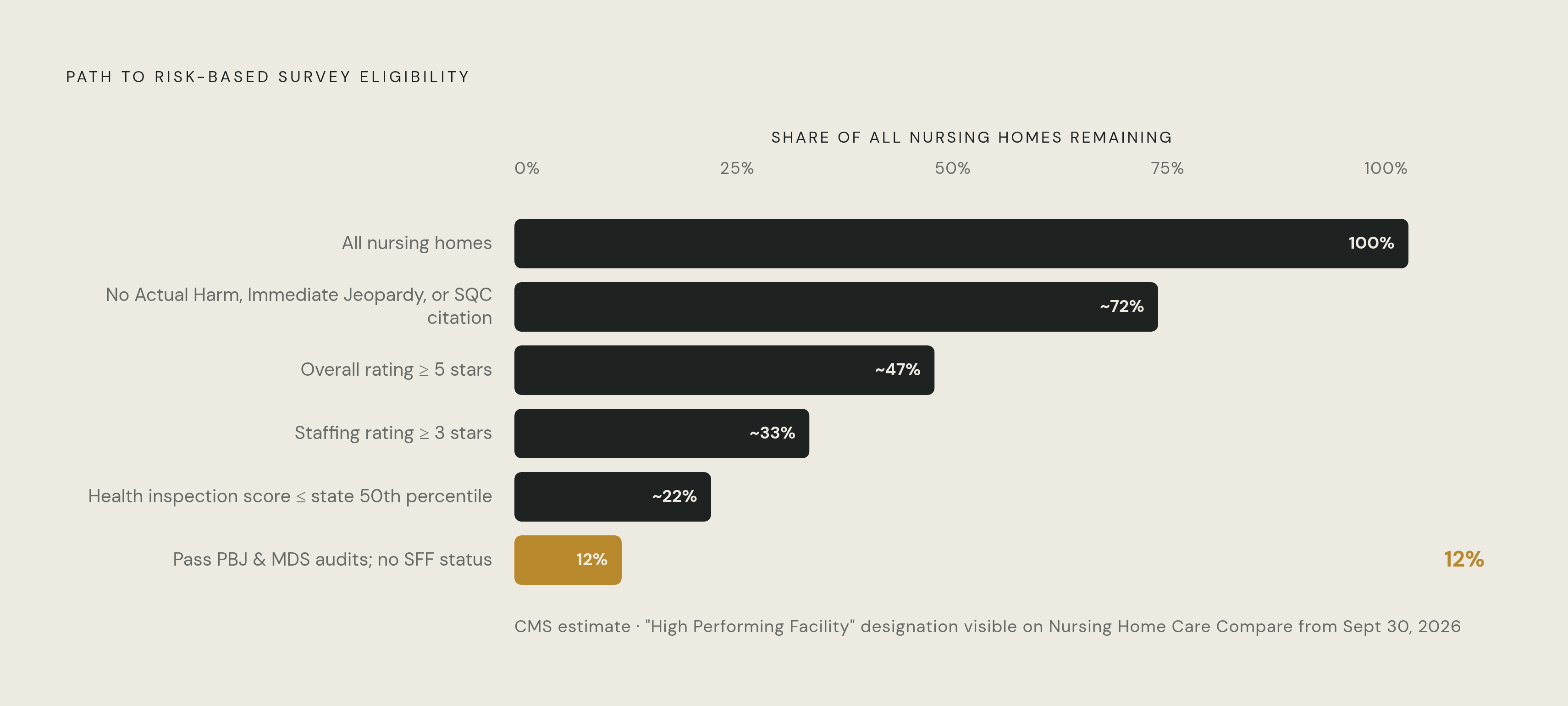
The Risk-Based Survey, which launched nationwide on September 8, 2026, does not look at individual incidents one at a time. It asks whether a facility's cumulative record contains any disqualifying systemic indicator. CMS QSO-26-14-NH, issued July 16, 2026, confirmed the nationwide launch and laid out the eligibility criteria that determine which facilities qualify. The list of disqualifying conditions is long: any citation for Actual Harm, Immediate Jeopardy, or Substandard Quality of Care during the last survey cycle, a failed Payroll-Based Journal staffing data audit, a failed MDS resident-assessment audit, an overall rating below 5 stars, a staffing rating below 3 stars, a health inspection score above the state's 50th percentile, and Special Focus Facility candidate status, among other factors. The SFF program itself was revised significantly as of January 28, 2026, and its selection emphasis shifted from staffing toward resident fall prevalence.
A single disqualifying criterion anywhere on that list removes a facility from eligibility, with no partial credit for strong performance elsewhere. CMS estimates that only about 12% of nursing homes nationwide will initially qualify, so most facilities carry at least one systemic disqualifying criterion somewhere in their performance history. Starting September 30, 2026, facilities that do qualify receive a "High Performing Facility" icon on Nursing Home Care Compare, turning RBS eligibility into a visible, public competitive signal rather than a quiet regulatory classification. Families see that icon when they compare options during an admissions decision, so facility operators now have a financial stake in systemic performance that goes beyond compliance.
Falls now carry particular weight in this calculus. CMS's January 2026 revision to QSO-23-01-NH shifted Special Focus Facility selection focus from staffing levels to the prevalence of resident falls, but it kept staffing data as a secondary factor; when candidates have similar compliance histories, CMS recommends you select the facility with the higher resident-fall prevalence. An OIG finding noted that nursing homes failed to report a substantial share of falls involving major injury and hospitalization among Medicare-enrolled residents on required assessments. Falls data now touches both SFF selection and Care Compare quality ratings, so a review practice that codes each fall as an isolated event will never surface the facility-level pattern that regulators are reading.
A mid-2026 recalibration of the star-rating point thresholds added another layer to this pressure. Thresholds rose considerably across every rating tier, so a facility's QM score could stay flat even as its star rating fell. The new bar requires 38 additional aggregate QM points to hold a 5-star rating, 33 for 4 stars, 29 for 3 stars, and 23 for 2 stars. In Pennsylvania, more than a fifth of facilities saw their QM star rating decrease with no actual change in underlying performance. A drop caused purely by recalibration still triggers the same downstream consequences as a drop caused by a real decline in care, and a 5-to-4-star QM slide costs a facility the one-star upward adjustment that would otherwise lift its overall rating.
Aggregating MDS Incidents Does Not Produce a Systemic Risk Picture
A facility cannot read its own risk profile just by adding up MDS-coded events, because the data architecture producing those events was built to exclude the very signals systemic risk depends on. The Long Term Care Community Coalition has made the strongest version of this argument against the RBS itself, contending that CMS's risk-based framework relies on performance and quality metrics that may not reliably indicate past quality and safety, nor reliably predict future quality, a concern the NBER working paper "Predictably Unpredictable Inspections" (Gandhi, Olenski, and Shi, November 2025) lends empirical support to. The logic behind that objection deserves to be taken seriously rather than waved off: if the quality measures feeding a systemic risk score are themselves derived from episodic MDS data, then what gets labeled a "systemic risk" rating is really just an aggregation of individual incidents dressed up as an independent, forward-looking signal.
That critique is correct as far as it goes, and it points toward the actual fault line in the data itself, not toward the premise of systemic review. The gap it identifies is most dangerous where low-severity incidents accumulate below any citation threshold. A pattern of subclinical events, each unremarkable on its own but predictive in sum, stays invisible to a look-back-window review built only to flag what crossed a documentation line. It only becomes visible once the harm it eventually causes gets coded as a discrete incident. A unit running consistently thin overnight staffing, or a therapist carrying a caseload that produces gaps in Section GG documentation, escapes formal review entirely until a fall or a pressure ulcer lands inside the next look-back window.
The distortion runs in the opposite direction too. A single high-severity event, such as an Immediate Jeopardy finding, can mark a facility's survey history for several cycles even after the underlying system failure has been corrected, because the Health Inspection Score reflects the last two to three standard surveys. The single-incident frame misses the slow accumulation of low-severity patterns on one side, and over-weights an isolated high-severity event long after the risk behind it has passed on the other.
What unstructured clinical notes contain beyond MDS coding
The longitudinal signal RAI coordinators actually need already exists inside the clinical record, in nursing notes, therapy narratives, and physician documentation, but the MDS coding process leaves most of that material untouched. Unstructured data makes up the large majority of everything stored in an EHR and can hold information that appears nowhere else in a resident's record, the granular, time-stamped narrative detail that a look-back window coding process compresses into a single checkbox. The episodic design of the MDS was never intended to surface facility-wide patterns. RAI coordinators working correctly within the framework's boundaries can be coding every window accurately and still have no visibility into the systemic signals regulators now expect facilities to find.
Current MDS and PDPM coding assistants already ingest hospital discharge summaries, physician orders, and daily clinical notes, and they surface or auto-suggest codes, citing back to the supporting chart evidence behind each suggestion. It remains an episodic function: it improves accuracy inside a given window rather than detecting patterns across several of them. AI scribes now generate the narrative portions of nursing and therapy notes, but a trained nurse or therapist still has to code the structured MDS items and the fields that drive PDPM. That hybrid arrangement leaves the gap between what the clinical record says across many notes over time and what the MDS captures in any single window as the largest blind spot in RAI-based systemic risk detection. Integrating these tools with MDS workflows cuts down on duplicate data entry, but even integrated systems rarely mine unstructured notes for longitudinal risk signals in real time.
The strongest clinical case for mining this data comes from predictive risk stratification. Predictive analytics applied to age, comorbidities, prior hospitalizations, functional status, and polypharmacy can identify high-risk residents within days of SNF admission, well before any look-back window would capture a related incident. The platform did not replace clinical coding; it extracted the signals that clinical coding leaves behind and surfaced them continuously, rather than only at scheduled assessment intervals, and that continuous extraction is what systemic review actually looks like in practice, as distinct from a periodic audit of coded events.
Changes RAI coordinators need to bridge the structural gap
RAI coordinators need to add a cross-window review layer that works alongside accurate look-back coding, to close the gap between the MDS's episodic architecture and the regulatory demand for systemic pattern evidence. The first change is conceptual: coordinators need to separate two questions that most current review workflows conflate into one, asking first whether an incident is coded correctly within the current look-back window, and asking separately whether that incident, combined with prior assessments, signals a pattern that calls for a systemic response. In practice, that means tracking the same incident category, falls, skin wounds, medication errors, behavioral changes, hydration, across multiple assessment periods for individual residents and for entire units, so that a fall in one window registers as a coding event while falls recurring across several windows for the same resident or unit register as a pattern requiring a care plan and a compliance response.
Falls deserve particular attention in this new review discipline. CMS now uses fall prevalence as a Special Focus Facility selection criterion and as a 5-Star risk indicator, so when you review falls coding, you need to connect each incident to the facility's broader prevalence trend instead of treating it as a standalone event. Coordinators also need to check that what nurses document in unstructured notes actually makes it into MDS coding, because gaps between narrative documentation and coded items carry accuracy risk under the 2026 mandate, and they also mark a missed source of systemic signal. The accuracy review requirements built into RAI User's Manual v1.20.11 should work as a standing, systematic check, not a one-time exercise completed at onboarding, especially since a further QM recalibration is expected in January 2027 if current performance trends continue, so the threshold environment coordinators are working against will shift again.
None of this is sustainable if it simply becomes one more manual task layered onto an already strained role. Nursing staff are dealing with high turnover and regulatory overload, and asking RAI coordinators to perform cross-window pattern review by hand, without any tooling to support it, is not a workable long-term answer. The more durable fix is not additional documentation burden but infrastructure that reads the documentation already being produced and surfaces the patterns inside it automatically. Because the RBS aggregates performance across time and across a facility's whole resident population to reach a binary eligibility decision, facilities need real-time visibility into cumulative incident trends, not just accurate coding of each discrete event as it occurs. A clinical intelligence platform that reads existing EHR documentation can flag emerging patterns in falls, medication errors, or other incident categories as they develop, giving RAI coordinators and facility leadership the early warning that CMS's eligibility criteria are actually built to measure.