Shift Note Completeness Audits Using EHR Access Logs
EHR access logs reveal documentation gaps and late entries without burdening nursing staff.
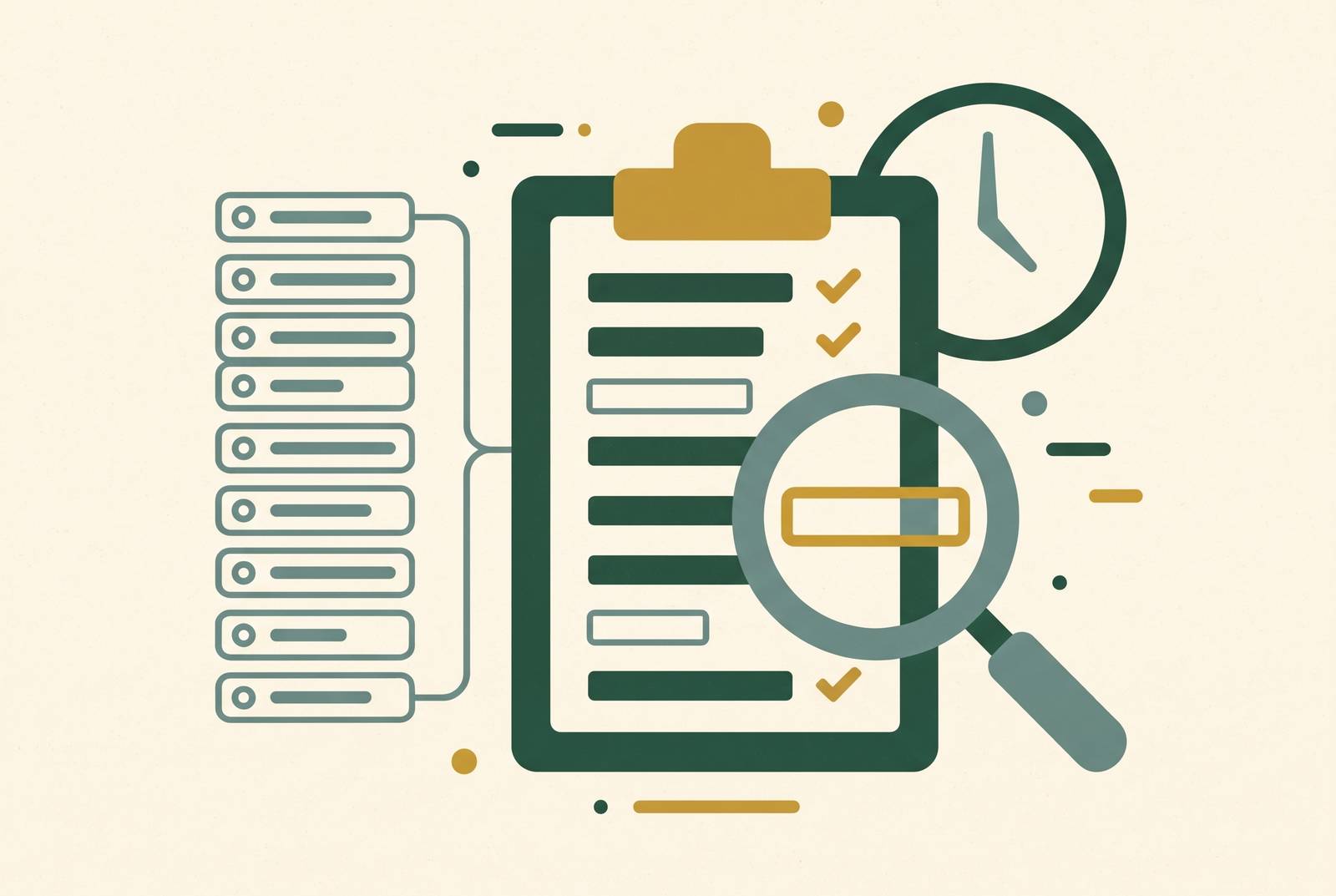
Audits of shift note completeness can use EHR access logs to find missing notes, late entries, and residents whose charts were never opened. The evidence already exists in the system. By reading it against shift assignments and the resident census, facilities can detect documentation gaps before a survey or incident exposes them, without adding another documentation task for nursing staff.
Why shift note completeness is harder to see than it is to measure
The nurse closest to the documentation has the least visibility into whether it is complete across the shift. Each entry takes attention, so the nurse may miss the pattern across the shift. A nurse can chart constantly and still leave required categories uncovered.
That asymmetry extends through the facility’s management structure. Nursing managers cannot review every chart in real time across a full census, and operators may learn about omissions only when an audit or survey identifies them. The missing element is a view across residents and shifts. Treating this as a visibility problem, rather than assuming a behavior problem, makes it possible to examine coverage without mistaking activity for completeness.
What EHR access logs actually contain and why they are already sufficient for a completeness audit
EHR access logs record which user account performed an action, when it occurred, and where in the system it happened. Their fields include a unique user ID, patient identifier, action type, timestamp with timezone, session ID, source device, and module accessed. Events include logon and logoff, note creation and editing, and flowsheet entries. These are operational traces. They distinguish a chart being viewed from a note being authored or an existing entry being changed.
Those distinctions support the basic completeness audit. Note-creation events show whether documentation was added, timestamps show when it was added in relation to the shift, and patient identifiers show which residents the activity covered. Most EHR systems already use their audit functions to record this activity. The practical task is to read an existing data layer for clinical oversight.
Reliable interpretation still depends on reliable capture. Clock synchronization makes timestamps comparable across modules, while consistent schemas and event IDs make actions interpretable. Immutable storage protects the event history, and back-pressure alerting identifies dropped events. Without these safeguards, what looks like missing documentation may be a gap in the logs. Access logs provide the raw evidence for a completeness audit, but they do not independently establish whether a note’s clinical content is adequate.
The documentation patterns access logs surface that chart review alone cannot
A finished note conceals much of its production history. A group of note-creation events near the end of a shift can show that notes for several residents were batched, even when every chart looks complete. That timing raises the possibility that entries were reconstructed from memory hours after care. Logs show the delay, while a chart review checks accuracy by showing whether key details were lost.
Missing-resident patterns require a different comparison. Comparing the census with the shift’s sessions reveals residents with neither a chart-view event nor a note event in the log. There is no new entry to inspect.
Authorship sequences can also identify entries that warrant closer examination. A long note saved within seconds of chart access, or a new note created just after someone viewed a prior note, may be a sign of cloning. Neither signal proves that content was copied. It directs the reviewer toward repeated information that may obscure a change in condition.
The supplied malpractice composite illustrates a pattern logs can expose: notes authored after a patient’s death, backdated, and entered from a non-clinical workstation. Preserved creation and modification timestamps allow reviewers to distinguish when an entry was made from its stated effective time.
How the 2025 CMS Final Rule and the shift away from staffing ratios raise the stakes for documentation evidence
CMS’s Data Validation FAQ attributes the MDS-based measure validation process to the FY 2024 and FY 2025 final rules, with implementation beginning in FY 2027. CMS will select up to 1,500 skilled nursing facilities annually for these audits. Completeness is not merely an internal quality concern when the facility must produce records supporting its assessments.
The Office of Inspector General’s September 2025 report describes a separate escalation path for inaccurate MDS coding. When a surveyor identifies a pattern involving three or more residents and indications that staff knew the coding was inaccurate, the surveyor should refer the case for investigation of falsification of a resident assessment. That threshold requires more than a missing note. Nevertheless, documentation gaps can weaken the evidence supporting coding and complicate the facility’s response when accuracy is questioned.
CMS published the repeal of national numeric staffing minimums in December 2025, effective February 2, 2026. Facilities are therefore held more accountable for how they perform, as shown by survey findings, PBJ audits, and past patterns of deficiencies, with less weight given to simple staffing ratios. The Risk-Based Survey model began rolling out nationwide September 8, 2026, with the Care Compare icon launching October 8, 2026. These mechanisms make the record over time consequential. Log-based completeness review helps facilities find weaknesses in that evidence before they become financial or legal exposure.
Designing a systematic access-log completeness audit: the four questions and how to answer them
To make these checks part of each shift’s oversight, facilities should use four questions to guide the audit for each shift and unit. The first is whether a note was created. Pull note-creation events from user sessions tied to the shift and compare them with the unit’s resident census for that date. Flag residents with no note-authorship event where documentation was required. That comparison produces the initial gap report.
The second question concerns when the note appeared. Compare creation timestamps with shift start and end times, distinguishing entries clustered near shift end from those created after it. Charting should occur as close to care as possible because delays increase opportunities for errors and omissions. Define a timeliness threshold relative to the care event. A stated interval gives managers a reproducible review trigger.
Third, check resident coverage by comparing chart-open events with the full census to find residents whose records no user opened during the shift. Attribution needs careful handling at this stage. A resident may be undocumented, or the relevant staff session may be unlinked. Cross-coverage and on-behalf-of access therefore need encounter linkage or team assignment references so that logs show when coverage was provided.
The fourth check compares the log signals with what is in the chart. Compare the time between chart opening and note saving with the length of the note, and check creation events that come right after access to a prior note. These signals warrant documentation review. Modification events after an incident, or edits from a device not associated with the care unit, likewise warrant documentation review. The chart adds the clinical context that the timing of events alone cannot show.
Before applying these comparisons routinely, establish unique user IDs, synchronized clocks, and logs stored with UTC timestamps and a recorded timezone. Shared credentials defeat individual attribution and violate HIPAA’s unique user identification requirement. Assign the gap report to a nursing manager or DON with a documented response process. Review the prior shift’s findings daily. Pulling and cross-referencing this evidence manually becomes burdensome as the census and number of shifts increase, which makes aggregation the next operational problem.
Why manual log review does not scale and what automated analysis changes
Nursing managers cannot continually reconcile full access logs with the census while also managing care delivery. Nurses may already spend up to 40% of their shift documenting, and oversight consumes time otherwise available for direct supervision. A thorough review of logs needs the full metadata, beyond what filtered reports contain. Obtaining and interpreting those fields demands technical access and time that shift managers rarely have.
Automation addresses the aggregation burden by running the four-question logic against incoming events to produce a ranked report of missing notes, late entries, possible clone signals, and unaccessed residents. Managers can then look into the flagged gaps. Automated analysis can also keep a timestamped record of each gap it finds and each response that is documented, showing that oversight is ongoing.
The underlying measurement infrastructure is not new. EHR utilization analytics already examine time in the system and action sequences to identify workflow opportunities. Reorienting that analysis toward resident coverage supports completeness auditing with the same data. Its value depends on identifying the decisions managers need to make.
How documentation pattern monitoring connects completeness to resident risk
A missing shift note removes information from the resident’s risk picture. A cloned note may create a similar blind spot by showing an earlier condition as if it were current. Neither establishes that the resident is deteriorating. Both can leave the care team without an updated account of whether the resident’s status has changed.
Gaps involving falls, medication events, skin wounds, hydration, or behavioral changes affect categories associated with adverse outcomes and regulatory citations. A coverage flag becomes more useful when it identifies the missing category and connects it to the resident’s care needs. “Note missing” offers little direction by itself. “No wound-care note for Resident X, who has an active stage II wound in the care plan” gives the manager a specific reason for follow-up.
Thapa et al.’s 2022 study in JMIR Aging found that active medication count was the most significant feature associated with fall risk, followed by active disease count and variables associated with vital signs. That finding illustrates why the availability of documented information is clinically consequential. It does not show that completeness directly predicts outcomes. Missing documentation can leave a risk assessment without information it needs, while access-log flags show where to check the record.
For nursing managers, the practical response is to use category-specific gap reports as a starting point for targeted rounds. Such reports identify uncertainty. Clinical judgment is still needed to make sense of each omission and assess the resident’s condition now. Facilities that check completeness for compliance are therefore using the same data to track what is unknown about residents’ conditions, with no separate cost to collect data.
Building continuous audit readiness from the log layer up
Readiness still requires a response to each meaningful finding. An accumulating report of unresolved gaps is not evidence that the facility has corrected them.
The internal framework should include a daily report from the prior shift’s logs, reviewed by the nursing manager before the next shift begins. A weekly review should look at repeated flags by resident, shift, and staff account to tell problems across the system apart from isolated lapses. Findings and remedial steps need timestamps and assigned owners. State-level data-handling and documentation requirements also belong in the framework because they can affect log capture and retention beyond federal requirements.
This approach fits scrutiny of the documented record over time better than a chart audit triggered by an approaching survey. Logs show what was done, when, and for which residents, while managers review the clinical content to check whether the documentation matches the care given and whether a resident needs follow-up.
The first action is to assess whether the current EHR audit practice reads the log layer for completeness signals. Any gap identified by that assessment is the first priority to close. The achievable posture is routine detection, assigned follow-up, and preserved evidence of the response, rather than reconstruction after a survey or incident.