Skin Wound Staging Discrepancies Between Shift Notes
Inconsistent staging across shifts inflates costs and masks wound deterioration.
A wound recorded as Stage 2 on the 7-to-3 shift can turn into a Stage 3 narrative description by the time the 11-to-7 nurse finishes charting, and nobody formally reconciles the two entries. That gap between what one shift writes down and what the next shift writes down is the subject of this piece. It matters because the stage recorded at any given moment doesn't just describe a wound. It feeds MDS coding, quality measure calculations, PDPM reimbursement, and the resident's permanent record, and per AHRQ data, the cost of an individual pressure injury to a facility ranges from $20,900 to $151,700. That range starts with something as ordinary as a word choice on a chart.
Wounds are staged using a system built by a wound care advisory body, running from Stage I through Stage IV, plus two categories, unstageable and Deep Tissue Pressure Injury, that don't fit neatly on that ladder. NPUAP (as it was then called) switched from "pressure ulcer" to "pressure injury" back in 2016, but ICD-10-CM has never made the same switch. Category L89, as of the FY2026 coding guide, still uses "pressure ulcer." Clinically, everyone means the same thing. On the page, two different vocabularies are doing the same job, and that mismatch is one more seam where inter-shift ambiguity can slip in.
What each NPIAP stage requires a nurse to document, and where subjectivity enters
Start with Stage I, because it's the stage most dependent on the nurse actually looking closely. It's non-blanchable erythema of intact skin: the skin doesn't turn white under pressure the way healthy skin does. On lighter skin, that's a fairly obvious visual cue. On darker skin tones, the redness may not show at all, so the nurse has to rely on discoloration, warmth, edema, or induration instead. That single fact, buried in the FY2026 coding guide and echoed in wound documentation training, causes inter-rater variability, because nurses relying on different cues reach different conclusions from the same skin. Two nurses looking at the same darker-skinned resident's sacrum can reach different conclusions in good faith, simply because one felt for warmth and the other looked for color.
Stage II is partial-thickness skin loss that exposes the dermis, sometimes showing up as an intact or ruptured blister. It gets confused, often, with moisture-associated skin damage, which looks similar on a quick pass but falls under a completely different ICD-10 category. Stage III is full-thickness loss with visible fat, and here the anatomy itself works against consistency: a shallow Stage III at the occiput, where there's barely any tissue depth to lose, looks nothing like a deep Stage III at the sacrum, where there's much more tissue to burrow into. Stage IV exposes fascia, muscle, tendon, ligament, cartilage, or bone, and frequently comes with tunneling and undermining, both of which have to be measured, not just noted as present.
Then there's unstageable, which isn't a failure of documentation, it's a clinical finding. If slough or eschar covers the wound bed, nobody can see how deep it goes, and the true stage stays unknown until debridement. Deep Tissue Pressure Injury is arguably the trickiest of the group: persistent non-blanchable discoloration in deep red, maroon, or purple, or a blood-filled blister sitting over a dark wound bed. Pain and temperature change often precede the color change, so a nurse doing a quick visual check on a busy shift can miss it entirely.
CMS guidance lays out what has to be documented for every wound: symptoms, wound characteristics, location, size, depth and stage, and how the wound is responding to treatment. Miss any one of those elements on a given shift, or describe it differently than the last nurse did, and the gap becomes part of the record. Standard wound documentation frameworks break the assessment down further, covering wound bed characteristics, wound edge findings, and periwound skin condition. Each of those is its own small judgment call, and judgment calls made by different people at different times of day don't always land in the same place, even when both nurses are doing their job correctly.
Who is authorized to stage
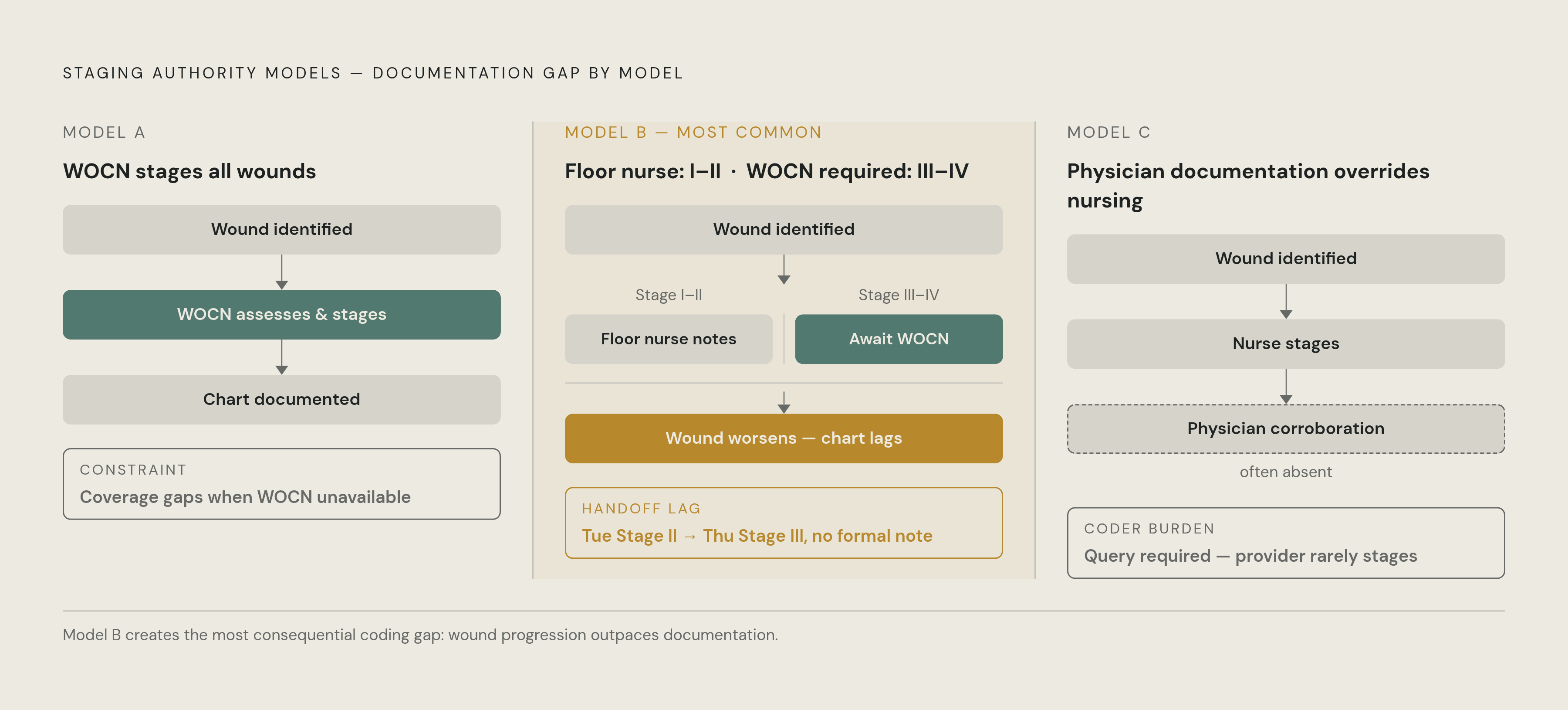
Who actually gets to write the stage number on the chart is not settled the same way everywhere, and the ACDIS CDI Leadership Council's February 2025 responses make that plain: facilities have picked different answers, and each answer comes with a tradeoff. Some restrict all staging to a WOCN, a wound-certified nurse. That produces the most clinically accurate charting and removes the guesswork floor nurses otherwise face, but it only works if there's enough WOCN coverage to see every resident who needs it, and there often isn't.
The more common compromise lets any nurse stage a Stage I or II, but reserves Stage III and IV for the WOCN. That split sounds reasonable on paper, but it builds a handoff into the documentation process itself: a Stage II a floor nurse charted on Tuesday might have progressed to a Stage III by Thursday, and if the WOCN hasn't seen it yet, there's no formal note reflecting that. The wound got worse. The chart didn't catch up.
A third model leans on physician documentation as the deciding word. Some facilities have internal policy that says if the physician documents a stage, it overrides nursing. But the Official Guidelines for Coding and Reporting actually work the other way around in most real cases: the stage can come from nursing documentation, as long as a provider documents the diagnosis in the same place. Physicians, in practice, are often not comfortable staging pressure wounds themselves, so that provider corroboration frequently just isn't there. Coders and CDI specialists end up with nursing-only staging and have to query around the gap.
The practical result: a WOCN's note on a wound tends to be detailed and authoritative. A floor nurse's note on the same wound two shifts later might describe it in narrative language, "wound appears deeper, more drainage noted," without formally re-staging anything. Now the chart has two entries that don't agree, and neither one is technically wrong. Two facilities can run opposite staging-authority policies and both be defensible internally, but a surveyor walking into either building applies the same regulatory standard regardless of which model the facility chose.
How shift-to-shift note behavior creates an uneven documentation record
Day shifts and night shifts don't write notes the same way, and that's not a guess, it's a pattern researchers have actually measured. Research into clinical note patterns has found that day shifts produce a much larger share of total notes overall, while night notes are far more likely to describe acute changes, things like sudden instability in a resident's vital signs.
Apply that pattern to wound care specifically. A wound gets formally staged at Stage 2 during the day shift, when documentation volume is high and the WOCN or day charge nurse is likely on the floor. Overnight, a nurse notices the wound looks worse, drainage has changed, and there's a new area of breakdown, and writes a long, descriptive note about it. But if that night nurse isn't authorized to formally re-stage under the facility's policy (Model B above), the observation is in the chart as narrative text. The official stage on record still says 2. The clinical reality, based on what's actually written down, might already be a 3.
That asymmetry compounds over time. The chart ends up with a layer of formal, day-shift-dominated staging entries sitting on top of a layer of night-shift narrative notes that sometimes tell a different story. Nobody notices unless somebody sits down and reads across every shift's notes in sequence, which is not how most charts get reviewed day to day.
The Lecturio framework's wound documentation trigger list expects nurses to document at admission, whenever the wound changes, on a set schedule, after any treatment procedure, and at discharge. That's a reasonable list. But if the next scheduled formal assessment isn't until the day shift, and the change happened at 2 a.m., the only record of that change is the narrative note, not a structured wound entry. The system is working exactly as designed and still producing a gap.
How handoff breakdowns convert note-level inconsistencies into care errors
A discrepancy sitting quietly in the chart is one problem. A discrepancy that changes what treatment a resident actually receives is a different, more serious one. A study of a hospital burn unit, published by Rostami and colleagues in a burn care research journal in 2022, found that order discrepancies in electronic medical systems, combined with poor communication between providers, nursing staff, and wound care technicians, led directly to incorrect wound care treatment. Not documentation errors on paper. Actual treatment errors on real wounds.
The same study surveyed nurses before any intervention and found 66% said they got their information on wound care routine from verbal handoff at shift change, 22% from resident or fellow notes, and only 11% directly from EHR orders. Verbal handoff, the least auditable and easiest source to garble or forget, was doing most of the work. When that's the primary channel, a written discrepancy in the chart can sit there untouched, because the receiving nurse is following what she was told at the bedside, not what's written on the page that contradicts it.
After the unit introduced structured daily wound care rounds, the numbers moved. Every nurse surveyed after the intervention wanted it to continue, and a mid-intervention satisfaction check found most nurses felt communication had improved and discrepancies between staff had gone down. That's a burn unit, which is a more acute setting than most skilled nursing facilities. But the mechanism doesn't change with the setting. Wound care technicians, floor nurses, and WOCNs who never share a structured moment to compare notes will each walk away holding a slightly different mental picture of the same wound.
The most damaging version of this handoff failure is what's sometimes called reverse staging. It comes from a misunderstanding about tissue: muscle and connective tissue lost to a Stage 3 or 4 injury doesn't come back the way skin does. As a wound heals from the bottom up and starts to look better on the surface, a nurse who doesn't understand that can chart a lower stage than the wound has actually earned. That's not a minor clerical slip. It builds a paper trail suggesting the resident doesn't need skilled nursing care anymore, when in fact the underlying tissue damage, and the risk of recurrence, hasn't gone anywhere.
The cost of staging discrepancies when they reach the MDS, the coder, and the surveyor
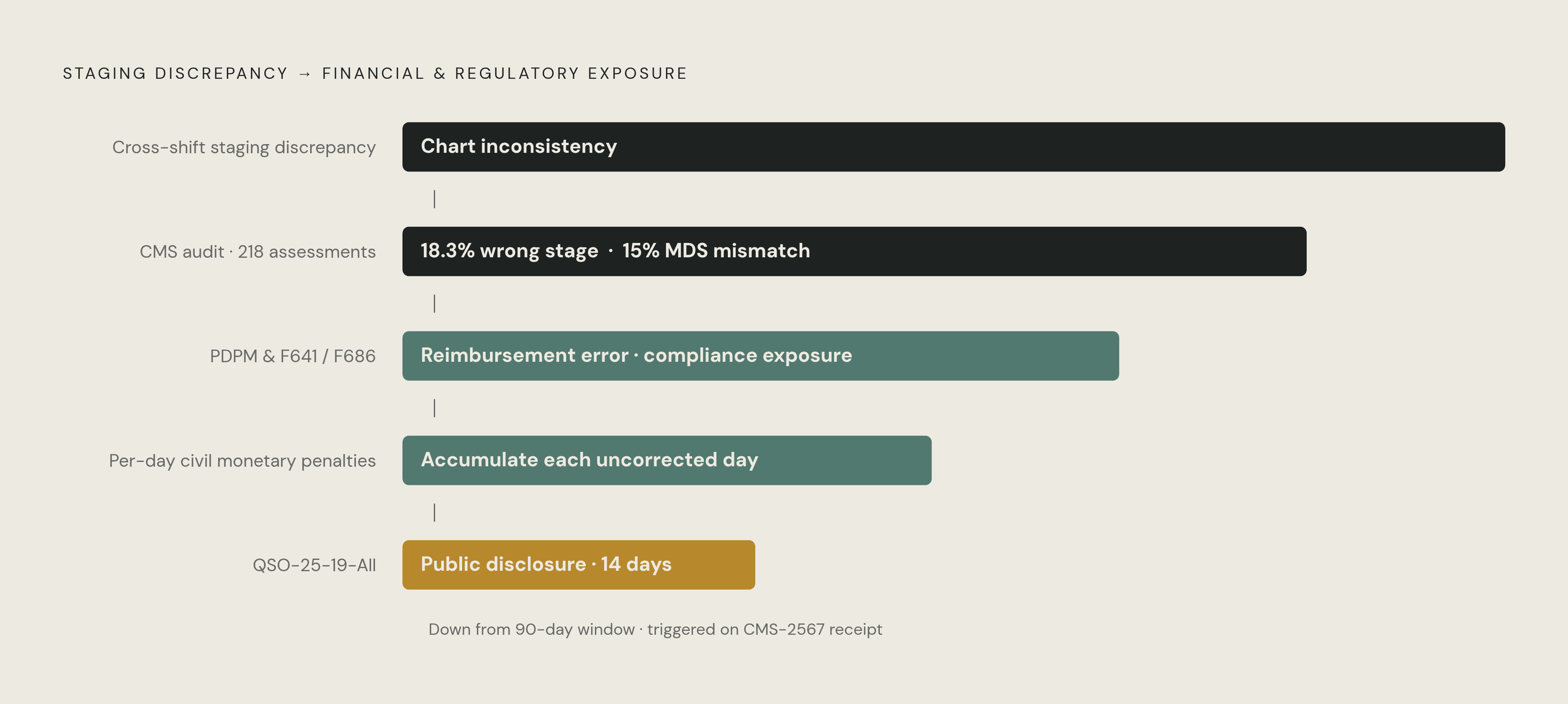
Wound stage documentation eventually has to become MDS coding, and that's where inconsistency turns into measurable error. A CMS audit of 218 assessments found 8.3% incorrectly reported how many pressure ulcers a resident had, and 18.3% had the wrong ulcer stage entirely. An OIG report on an earlier version of the MDS found 15% of assessments had inconsistencies between the pressure ulcer items and the underlying medical record. These are a meaningful chunk of the sample, not rare outliers. They're a meaningful chunk of the sample.
As of 2025, CMS updated its surveyor guidance under F641 to explicitly include a check on MDS coding accuracy. When the MDS doesn't line up with what's actually in the clinical record, a facility is exposed twice: once on the compliance side, and once on reimbursement, since PDPM payment depends on that same coding. F686 covers pressure injury prevention directly, and it operates on the premise that most of these injuries are preventable with timely assessment and the right individualized interventions. Surveyors lean heavily on documentation to check whether that care actually happened, and F686 review is designed to catch a staging discrepancy between two shift notes.
MDS quality measures also track whether a resident develops a new or worsened pressure ulcer during a stay, with particular attention to Medicare Part A residents in stays of 100 days or less. If a wound gets mis-staged in a way that makes it look like it worsened, even when the "worsening" is really just a documentation correction and not an actual clinical decline, that can trip a quality measure flag the facility didn't earn. Reverse staging carries its own separate financial cost: when a wound is down-staged on the mistaken belief that it's healed more than it has, reimbursement drops, even though the resident is still at high risk and still needs the same level of skilled care. The facility is giving up revenue it actually earned, based on a documentation habit rather than a clinical fact.
The FY2026 coding guide counts facility-acquired Stage 3, Stage 4, and unstageable pressure injuries as Hospital-Acquired Conditions under the CMS HAC program, which ties them directly to reimbursement and quality scoring. And the broader audit environment around wound-related billing has gotten sharper. In 2025, federal oversight activity targeted improper billing tied to skin substitute products, with significant payment suspensions reported against providers under scrutiny. The OIG released a report titled "Medicare Part B Payment Trends for Skin Substitutes Raise Major Concerns About Fraud, Waste, and Abuse." Wound documentation, specifically, is under more scrutiny now than it was a few years ago.
The regulatory environment that makes undiscovered staging gaps more expensive than they used to be
Regulatory language has moved in a direction that makes small charting gaps costlier than they used to be, and none of the recent changes work in a facility's favor if the underlying documentation is loose. QSO-26-03-NH, effective March 31, 2026, updates Chapters 5 and 7 of the State Operations Manual, tightening how surveyors run investigations and how facilities are expected to respond to deficiencies once they're cited. It's not a wholesale rewrite of the survey process, but it measurably narrows the room for ambiguity in a handful of critical areas, and wound care documentation is squarely inside that narrowing.
Financial penalties have expanded too. The FY 2025 final rule broadened CMS's use of both per-instance and per-day civil monetary penalties, explicitly framing the goal as driving sustained correction of health and safety deficiencies. Per-day penalties are the ones that hurt most in a documentation context, because a staging inconsistency that spans several shifts, or several weeks, accumulates penalty exposure with every day it goes uncorrected.
Public disclosure has also sped up. Under QSO-25-19-All, released June 18, 2025, deficiency findings become publicly releasable within 14 days of a facility receiving its CMS-2567 form, and promptly. That's a sharp change from the old 90-day window. A wound documentation citation is now public record within about two weeks of the survey finding it, not three months later.
CMS is also rolling out a risk-based survey model that gives consistently high-performing facilities a more focused, lighter-touch survey. Roughly 12% of nursing homes nationwide are expected to qualify for that lighter review. Facilities with visible wound documentation inconsistencies are unlikely to land in that 12%, so they're statistically more likely to draw the deeper, more intensive survey instead. Surveyors doing those deeper investigations are trained to read across shift notes. A contradiction buried in a night-shift narrative note, sitting next to a day-shift formal stage entry that doesn't match it, is more likely to get found now than it would have been even two years ago.
Building a system that catches staging gaps before the surveyor does
Wound staging accuracy can't be treated as a once-a-quarter compliance project. Charts get written every shift, every day, so the review of those charts has to run on the same clock, catching gaps as they form rather than reconstructing them after the fact during survey prep.
The first fix is authorization clarity. Facilities need a written, enforced policy spelling out exactly who can formally document a stage at each NPIAP level, and the policy has to be specific enough that nobody's guessing. The ACDIS CDI Leadership Council responses from February 2025 show that facilities that pick one of the three models and enforce it consistently produce more reliable documentation than facilities that leave the question open. Even an imperfect model, applied consistently, beats no model applied inconsistently.
The second fix is structured handoff, and the Johns Hopkins burn unit study already showed what that looks like in practice: daily rounds where nursing staff and wound care personnel actually talk through wound status together, out loud, instead of relying on a verbal pass-off at shift change. That kind of structured touchpoint is a documented intervention that reduced discrepancies in a real clinical setting.
Third, weekly documentation audits, which F686 guidance already expects facilities to run. But a weekly audit that reads backward through the week's charting, checking that a wound entry exists somewhere, isn't the same as an audit built to catch cross-shift contradictions. The method has to specifically compare what the day shift wrote against what the night shift wrote, for the same wound, in the same window of time.
The information needed to do that already exists. Shift notes, nursing assessments, and wound descriptions get entered into electronic health record systems every single day, across every shift. The Stage 2 entry from Tuesday's day shift and the narrative description suggesting something worse from Tuesday night are both sitting in the same record, a few screens apart. Nothing about closing this gap requires new data. It requires someone, or some structured process, actually reading across the shifts before the surveyor does it first.