Behavioral Incident Clustering in Memory Care Units
Recognizing behavioral patterns helps memory care units prevent crises before they happen.
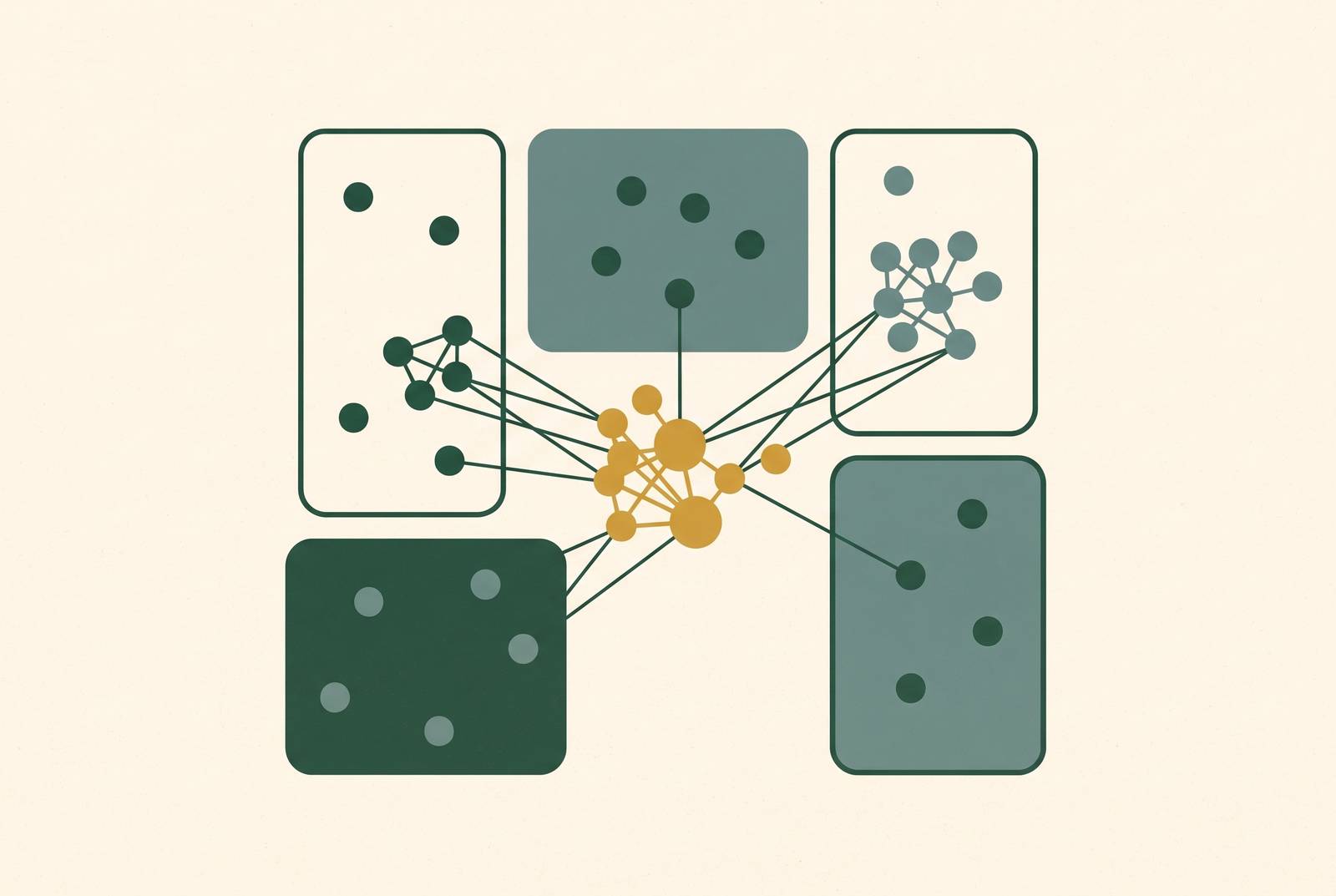
Nearly every person living with Alzheimer's disease will show at least one behavioral or psychological symptom at some point, and for roughly a third, those symptoms become severe. This piece is about what happens between the first sign and the crisis: behavioral incidents in memory care units don't occur randomly. They cluster, by resident, by hour, by trigger, by the physical layout of the unit itself, and facilities that learn to read those clusters can step in before harm occurs rather than write an incident report after it.
The scale of the problem is not shrinking. A national association's 2024 report put the number of adults living with Alzheimer's dementia in the country at 6.9 million, with projections reaching 13 to 14 million by 2060. adults living with Alzheimer's dementia at 6.9 million, with projections reaching 13 to 14 million by 2060. Agitation-related symptoms, wandering, rejection of care, physical and verbal outbursts, are among the most frequently documented categories of behavioral and psychological symptoms of dementia (BPSD) in institutional settings. None of this is going away on its own. A facility that manages it well, versus one that ends up in a state investigative report, is distinguished by whether anyone is reading the pattern before it becomes an event.
The clinical structure of behavioral symptom clusters in dementia
BPSD is a spectrum that includes aggression, agitation, hallucinations, delusions, disrupted sleep, wandering, and oppositional behavior, and each of these has its own prevalence curve and its own path t... It's a spectrum that includes aggression, agitation, hallucinations, delusions, disrupted sleep, wandering, and oppositional behavior, and each of these has its own prevalence curve and its own path through a resident's decline. That sounds obvious once stated, but it matters clinically, because it means the symptoms aren't interchangeable warning signs. They cluster into distinct patterns.
Factor analysis of Neuropsychiatric Inventory (NPI) data by the European Alzheimer's Disease Consortium (PubMed PMID 18351187) identified four named clusters that together account for 58% of the common variance across patients. A psychosis factor groups irritability, agitation, hallucinations, and anxiety. A psychomotor factor links aberrant motor behavior with delusions. A mood lability factor ties together disinhibition, elation, and depression. And an instinctual factor covers appetite disturbance, sleep disturbance, and apathy. These aren't abstract categories invented for a paper. They describe how symptoms actually co-occur in the same patient over time.
Which cluster a resident falls into often depends on the underlying disease. Research on dementia subtypes has found that behavioral-variant frontotemporal dementia (bvFTD) tends toward disinhibition, obsessive-compulsive behaviors, and apathy, while Alzheimer's disease trends toward anxiety, paranoia, and visuospatial disturbance. Apathy is the single most common NPI symptom overall, at 59.6% prevalence, followed by depression at 58.5%, irritability at 44.6%, anxiety at 44%, and agitation at 41.5%. Ninety-six percent of patients display at least one symptom, per the European Alzheimer's Disease Consortium's data.
None of this is theoretical for the nurse charting a 2 a.m. shift. When a resident starts refusing meals, sleeping poorly, and withdrawing from group activities in the same week, that's not three separate problems. It's the instinctual factor appearing on schedule, and it's a pattern a trained eye, or a system built to flag it, should catch before the resident deteriorates further.
Behavioral changes as signals of underlying medical events, not just dementia progression
Behavioral change in a dementia patient is frequently mistaken for progression of the disease itself. Often, it's something else entirely, something treatable, if caught in time.
KFF Health News reported on a fatal incident in a Minnesota memory care unit. According to the resident's doctor, the man's behavioral changes usually coincided with urinary tract infections. Had that association been flagged systematically rather than noticed in hindsight, it might have supported earlier intervention. That case isn't an outlier so much as an illustration of a broader mechanism: behavioral clusters can act as proxy signals for infection, pain, medication side effects, dehydration, or other acute conditions layered on top of chronic dementia.
Work coming out of the UCSF Memory and Aging Center on EHR phenotyping points to the same conclusion from a different angle. The overlap between neurological, psychiatric, and behavioral symptoms across dementia syndromes often appears as subtle signs well before a formal cognitive or neurological workup produces results. In plain terms, behavioral documentation may capture changes that precede other clinical findings.
A nurse who writes "resident more agitated than usual for three consecutive shifts" isn't describing a bad week. She's recording a clinically meaningful signal. That signal does good only if someone reads across those three shift notes and asks what changed. If behavioral shifts are medical signals, the next question is structural: are memory care units set up to catch them in time, or only to record them after the fact?
The accumulation of warning signs without anyone connecting them
A joint KFF Health News and NPR investigation dug through federal inspection reports, court records, and police reports covering nursing homes and assisted living facilities nationally. The picture it found was not one of isolated tragedies. It was one of documented, escalating warning signs that nobody connected until it was too late.
Since the start of 2024, a federal health regulator overseeing nursing homes has cited nursing homes at least 700 times for failing to protect residents from abuse by other residents, according to inspection reports cited by a health news outlet. In the first three months of 2026 alone, resident-to-resident abuse was cited more often than any other category of abuse, neglect, or exploitation, more often even than staff-on-resident abuse, per inspection records reviewed by KFF Health News. Cornell University researchers' in-depth study of New York state facilities found that one in seven residents across 14 assisted living facilities experienced aggression within a single month, and one in five residents across 10 nursing homes experienced an altercation in the same window. Nationally, residents with Alzheimer's and other dementias make up more than 900,000 of the 2.2 million people living in nursing homes and assisted living facilities, according to KFF Health News.
At Sunrise Post Acute in Banning, California, a state investigative report documented in 2025 (reported by KFF Health News, July 2026) that a high-risk resident's room was reassigned eight times over... At Sunrise Post Acute in Banning, California, a state investigative report documented in 2025 (reported by KFF Health News) that a high-risk resident's room was reassigned eight times over four months. The final placement put him with a 92-year-old roommate whose own dementia caused frequent moaning and yelling, a noise pattern that, by the facility's own documentation, the first resident could not tolerate. The roommate died two days after an assault, of blunt force facial trauma.
Dementia researcher Eilon Caspi, quoted in the KFF Health News reporting, put it directly: "In the vast majority of incidents, there are warning signs in the months, weeks, days, hours, and sometimes minutes and seconds prior." The investigative record reveals a recurring pattern: facilities document escalating behavioral problems in the chart, and then fail to update the care plan, add staff, separate incompatible residents, or bring in psychiatric or medical consultation. The failure is usually that the warning signs sat in separate notes, on separate shifts, written by separate staff, and no one was reading across them. It's that the warning signs sat in separate notes, on separate shifts, written by separate staff, and no one was reading across them.
The four dimensions along which behavioral incidents cluster in memory care units
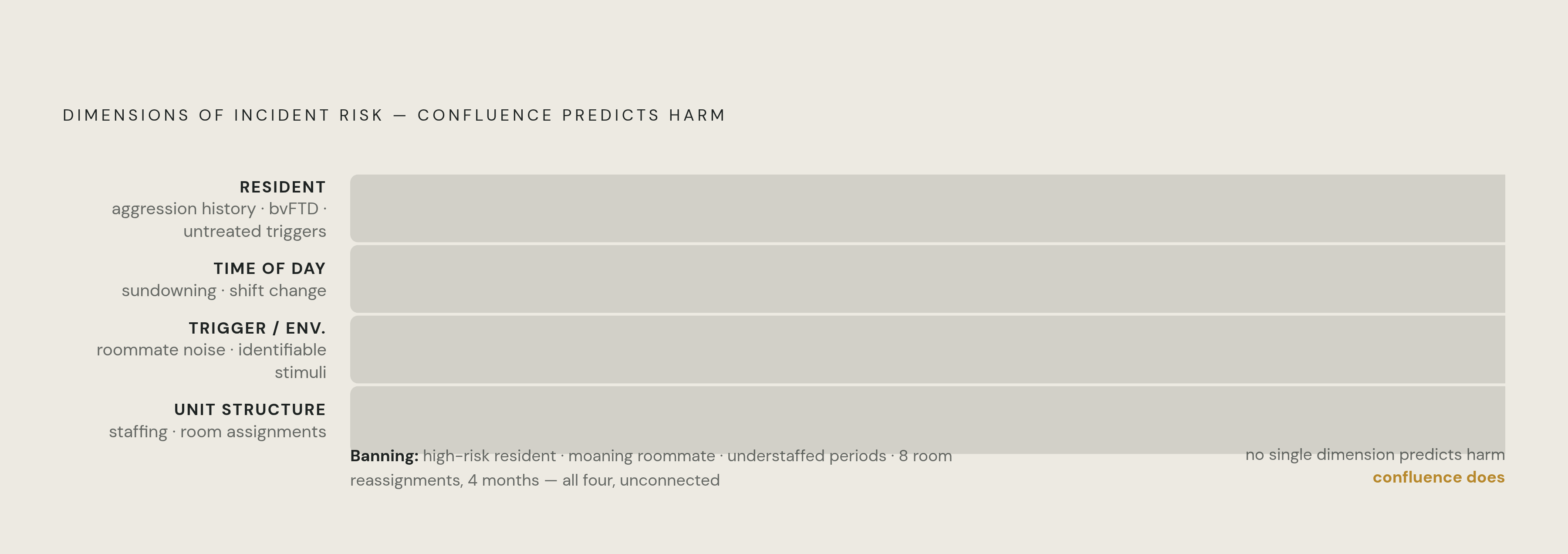
Putting the clinical evidence together with the investigative record reveals a structure. Behavioral incidents in memory care cluster along four dimensions, and they rarely cluster along just one.
The first is the resident. A small subset of residents accounts for a disproportionate share of incidents, usually residents with a known history of aggression, a dementia subtype prone to disinhibition (bvFTD, for example), or an untreated medical trigger that produces the behavior. The investigative and clinical record is clear on this point: once a resident has a documented history of aggression, wandering, or escalating symptoms, charting the next incident isn't enough on its own.
The second is time of day. Sundowning, the well-documented spike in confusion and agitation in late afternoon and evening, and the vulnerability that comes with shift changes, are established high-risk windows. That predictability is useful. It means staffing and redirection activities can be positioned ahead of the risk window instead of scrambled together after an incident starts.
The third is trigger and environment. The Sunrise Post Acute case is, among other things, a case study in trigger-specificity: the resident's behavioral profile and the roommate's frequent moaning and yelling were both part of the facility's own documentation. A multicomponent program at a Northwell dementia-focused unit, described by Chu and colleagues in the Journal of Hospital Medicine (April 26, 2026), used environmental changes, including modifications to common areas, alongside staff education, and saw the use of constant observation for at-risk patients drop from 30.9% to zero. Environmental design only works as an intervention once the trigger has been identified ahead of time, not after.
The fourth is the unit itself: staffing patterns and room assignments at the structural level. When facilities place high-behavioral-risk residents together, or near each other, without matching supervision density to that risk, they create the conditions for clustering before any individual incident occurs. The Banning case involves pairing decisions made at the unit level, not failures by any single caregiver.
These dimensions compound. A resident flagged as high-risk (dimension one), placed in an environment with a known trigger (dimension three), during a high-risk window like late afternoon (dimension two), on a unit that's short-staffed that shift (dimension four), is not a random tragedy. It's a chart note that existed somewhere and that nobody connected to the other three.
Proactive, structured intervention when clusters are recognized
The Northwell dementia-focused unit described in the Journal of Hospital Medicine offers the clearest published example of what changes when a facility builds structure around cluster recognition instead of waiting for incidents. The unit had 10 beds, sat inside a large academic medical center in New York, and admitted 165 patients between July 1 and October 28, 2024. Mean age was 84.7, and 96.4% of patients had at least moderate dementia (FAST stage 6A or beyond).
The intervention combined several pieces at once: geographic cohorting of patients, staff education in de-escalation and redirection technique, environmental modification of common areas, daily interprofessional rounds organized around the "4Ms" framework (mobility, mentation, matters most, medication management), and coordinated discharge planning. The results show a real shift in how the unit handled medication and observation. As-needed antipsychotic use fell from 29.7% to 20.0%. Benzodiazepine use fell from 13.3% to 6.7%. Constant observation, the most staff-intensive and reactive intervention available, dropped from 30.9% to zero. Meanwhile, scheduled antipsychotic use rose from 18.2% to 28.5%, which sounds like it cuts against the trend until you read it correctly: it reflects a shift from crisis-driven, reactive prescribing to planned, proactive management.
This is a hospital-based unit, and the operational realities of a memory care facility are different. But the underlying principle transfers cleanly. Expert guidance and the investigative record together describe what should already be in place at a facility handling behavioral risk seriously: resident assessments tied to documented behavioral history rather than diagnosis alone, individualized care plans that name specific known triggers and de-escalation steps, room and roommate decisions that factor in behavioral profiles rather than just bed availability, physician or psychiatric consultation the moment behavior changes, medication evaluation used alongside behavioral intervention rather than instead of it, and staff trained specifically in dementia behavior management.
Caspi's framing, again from the KFF Health News reporting, gets at the clinical core of it: the usual precursor to an altercation is a specific, identifiable, unmet need. The task is naming the need before the resident has to act it out. It's naming the need before the resident has to act it out.
Identifying clusters by reading across documentation that facilities already generate
The information needed to catch these clusters typically already exists somewhere in the chart. The information needed to catch these clusters typically already exists somewhere in the chart. Research on EHR phenotyping has shown that behavioral and neuropsychiatric symptom patterns can surface through clinical documentation that already exists in the record, without requiring new data collection.
That matters because nurses are already stretched thin on documentation. Nurses working in EHR-based systems log a substantial volume of discrete data points per shift. Asking them to also maintain a separate behavioral-pattern log on top of that isn't a realistic fix, and any approach built around a new manual workflow is going to run into compliance and sustainability problems fast.
The more workable path is analytical, not additive: build the pattern-detection into how existing documentation gets reviewed, rather than layering a new charting task onto an already full shift. Research on dynamic risk monitoring using large EHR systems shows predictive signal can be extracted from routine records. Research on AI and machine learning models that combine multiple signal types, including behavioral patterns pulled from existing records, are increasingly used to estimate risk states and flag trajectories worth a clinician's attention, functioning as a triage tool rather than a diagnostic one.
None of this depends on some breakthrough in artificial intelligence. The information gap here is a retrieval and synthesis problem. The data is already being written down, shift after shift. What matters is whether anyone, or anything, is actually reading across it.
The regulatory stakes of missing behavioral clusters in 2026
The regulatory environment is shifting under facilities at the same time the clinical stakes are rising. CMS's Risk-Based Survey (RBS) process for qualifying nursing homes began nationwide implementation on September 8, 2026, according to Hall Render's reporting. Facilities that qualify get a high-performing facility icon, described by people in the industry as a golden trophy, displayed publicly on Nursing Home Care Compare. CMS expects to make the full list of qualifying facilities available through the Provider Data Catalog and Nursing Home Care Compare starting September 30, 2026. That's a public, searchable distinction, and it rewards sustained compliance rather than a single clean survey.
Behavioral documentation accuracy feeds directly into this. One survey deficiency category covering accuracy of a standardized resident assessment dataset remains one of the most frequently cited deficiencies during surveys, and accuracy in that dataset is directly tied to how well behavioral symptoms get documented, per one industry association's analysis. A facility that isn't accurately capturing behavioral clusters in its MDS submissions is exposed on this front regardless of how well it actually manages resident care day to day.
Medication measurement is also changing. Effective January 1, 2026, CMS re-specified how it measures antipsychotic use, per available industry data, closing a gap that previously missed prescribing outside the standard 7-day MDS look-back window. published data project that the national percentage of residents on antipsychotics may rise from 14.64% to 16.98% simply because the new methodology counts prescriptions the old one missed. Facilities that manage behavioral clusters reactively, medicating in response to crisis rather than identifying triggers ahead of time, are the ones most likely to see that number climb further under the new measure. The ones reading their own documentation for the clusters already sitting in it have a real shot at staying ahead of both the survey and the resident's next bad night.
Sources
- A multicomponent unit-based approach for hospital care of older adults with behavioral and psychological symptoms of dementia - PubMed
- A multicomponent unit‐based approach for hospital care of older adults with behavioral and psychological symptoms of dementia - Chu - Journal of Hospital Medicine - Wiley Online Library
- Violence Repeatedly Erupts at Dementia Care Facilities Despite Warnings, Inspections Show - KFF Health News
- Patient-on-patient violence in dementia care can be fatal, records show : NPR
- Clustering of behavioural and psychological symptoms in dementia (BPSD): a European Alzheimer's disease consortium (EADC) study - PubMed