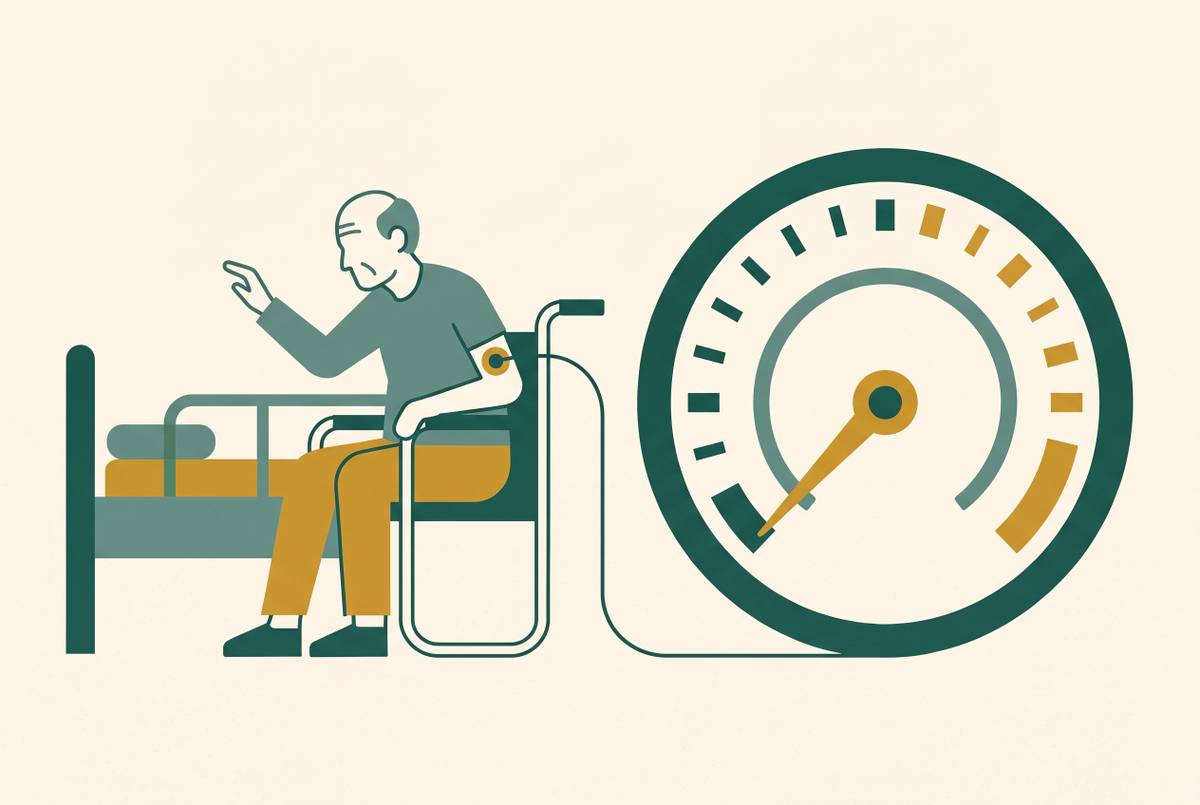
Polypharmacy Risk Thresholds in Skilled Nursing Residents
Nursing home drug counts miss the physiology and combinations that actually drive harm.

Polypharmacy is counted. The field defines it as five or more concurrent drugs, with ten or more marking excessive polypharmacy, and these numbers were built from population-level research rather than drawn up as clinical rules fitted to the body of a nursing home resident. A 2025 study in PeerJ found that 69.1% of nursing home residents met the five-drug threshold, a number that tells you how common the count is but says nothing yet about how dangerous any given resident's regimen actually is. Thresholds like these got adopted because they work as pragmatic, population-level conventions: they can be counted, logged, and compared across facilities without asking anyone to exercise clinical judgment at the moment of measurement. That is their value and their limit at once. They were built to flag that a resident's regimen deserves a second look, not to settle whether any particular combination of drugs is safe for that resident. The field already says as much out loud: polypharmacy is treated as a global health priority precisely because sorting the appropriate cases from the problematic ones is hard, since someone managing several chronic conditions may need five, eight, or more medications and still be properly treated.
How the SNF population makes raw drug counts misleading
A count that works fine to screen a community-dwelling 68-year-old does a different job inside a skilled nursing facility, because the population there changes what the same number means. Older adults generally have decreased renal and hepatic clearance, altered drug metabolism, and a higher baseline risk of drug-drug and drug-disease interactions, and cognitive and physical impairments on top of that make the consequences of a bad combination harder to catch early. SNF residents carry this physiology at a greater concentration than the general elderly population, and the exposure data reflect it: estimates of how many SNF and long-term care patients take nine or more medications swing wildly across studies, and that spread itself is a signal. A single threshold cannot describe a uniform risk level when the underlying studies can't agree within such a wide band. The same 2025 PeerJ study found that 63.1% of nursing home residents had at least one anticholinergic drug on their chart, and anticholinergic burden tracked with potentially inappropriate medication use, a drug-quality problem that a raw count simply cannot see. None of this means the threshold is worthless. It means that counting drugs without accounting for a resident's physiology and how the regimen came together will understate risk in some residents and overstate it in others. Part of the reason regimens end up harder to evaluate is structural: a resident moves through hospital stays, specialist visits, and facility transfers, picking up prescribers along the way, and inconsistent records make reconciling the full list of medications a genuine operational challenge. A threshold built on a count doesn't know whether that count was assembled carefully by one coordinating physician or accumulated across five handoffs with no one holding the whole picture.
What a drug count misses
The harm in SNF polypharmacy concentrates in particular drug classes and particular combinations, not in sheer volume, and some of the most dangerous agents are also among the most routinely prescribed. The 2025 PeerJ study found that benzodiazepines, antipsychotics, and proton pump inhibitors ranked as the most prevalent potentially inappropriate medications among nursing home residents, a finding consistent with results using other screening criteria. A separate cross-sectional study applying the STOPP, Beers, and PRISCUS criteria likewise found benzodiazepines and proton pump inhibitors among the most common potentially inappropriate medications, two drug classes known for narrow therapeutic windows in older adults. In multivariate analysis, the PeerJ researchers found anticholinergic burden and polypharmacy were each independently linked to potentially inappropriate medication use, so the two risks don't just add together, they compound each other. Regulators have started building this logic into formal quality measurement. The 2026 MIPS Measure #238 (Use of High-Risk Medications in Older Adults, CMS156v14, Quality ID 238) tracks how many patients 65 and older are ordered at least two high-risk medications from the same drug class, and it applies directly to skilled nursing facility encounters. That measure exists because drug-class duplication carries its own risk, and a total drug count that looks unremarkable can hide it. Research has also started adjusting for the comorbidity that often justifies a high count. A paper in Studies in Health Technology and Informatics, "Risk Stratification Using a Novel Polypharmacy Assessment Score" by Tsang and colleagues, modeled medication count against age, sex, and thirty-seven long-term conditions to produce a score based on the gap between observed and expected prescribing. That approach predicted clinical outcomes better than a simple drug count, because it accounts for the comorbidity burden that can make a high count appropriate.
What the compliance landscape now requires facilities to track
CMS has moved its scrutiny from counting medications to evaluating which classes residents are on and why, turning class-level review into a survey and payment risk for SNFs. CMS revised its Long-Term Care Surveyor Guidance effective April 28, 2025, under QSO-25-07-NH, QSO-25-12-NH, and QSO-25-14-NH, and surveyors have used that guidance to judge compliance since that date. As part of the same update, the old F758 requirements on unnecessary psychotropic medication use were folded into F605, with new standards that require resident notification and resident participation before a facility initiates or increases a psychotropic drug, and with sharper attention paid to medications administered for staff convenience. CMS then updated its Long-Term Care Survey Process Procedure Guide effective June 23, 2026, revising Survey Resources and Initial Surveys files, and that changes how facilities interact with iQIES when a survey begins. On September 8, 2026, CMS rolled out a new Risk-Based Survey process nationwide for qualifying nursing homes, and it steers survey resources away from higher-performing facilities and toward complaint investigations and facilities where residents face greater risk of harm. These survey outcomes feed directly into Five-Star Quality Ratings, and those ratings shape a facility's insurance contracts and financial footing, so a medication review failure doesn't stay contained to a clinical chart. It can reach the balance sheet. SNFs already face penalties tied to hospital readmissions within 30 days, so a medication error that lands a resident back in the hospital triggers a direct financial penalty on top of the clinical setback.
The resident factors that convert a threshold crossing into a genuine high-risk signal
Once a resident crosses the five-drug or ten-drug line, the useful question for a nursing team isn't whether to act but which specific factors in that resident's case determine how urgent the response should be and in what direction it should move. Anticholinergic burden is one such factor: a regimen that includes one or more drugs with a high anticholinergic load carries elevated risk on its own, a conclusion supported by the PeerJ study's finding that anticholinergic burden was independently tied to potentially inappropriate medication use even after controlling for other variables. Drug-class duplication is another, and it means checking whether two or more agents from the same high-risk class, the criterion now built into MIPS Measure #238 for SNF encounters, are sitting on the same chart. Renal and hepatic function matter as well, because reduced clearance in older adults stretches a drug's half-life and narrows its therapeutic window, turning what looks like a standard dose into something closer to an excessive one for that particular resident. Cognitive impairment and dementia raise the stakes further: residents with dementia face higher risk from anticholinergic drugs specifically, and they are often less able to report early symptoms of harm themselves, which places the detection burden mainly on staff observation. A resident's fall history belongs on this list too, since polypharmacy is already tied to fall risk, and a resident who has already fallen while still taking sedating or hypotensive drugs carries a compounded risk that a drug count by itself will never reveal. The number of prescribers involved in assembling the regimen is its own warning sign, because if a medication list is built across several physicians with no single person accountable for the whole, interaction risk rises independent of how many drugs appear on the list. Finally, condition-adjusted prescribing belongs in this framework as the corrective lens for all the rest: the Polypharmacy Assessment Score approach compares a resident's observed prescribing against what would be expected given their comorbidity profile. A resident managing many chronic conditions may legitimately carry a high count, while a resident with fewer conditions on an identical count represents a considerably stronger flag. None of this is a scoring exercise nurses are expected to run themselves. It is a way of narrowing attention: a structured set of questions that turns a bare threshold crossing into a judgment about which residents need a closer look first.
The role nurses play in catching polypharmacy risk before it becomes a clinical event
Nurses see residents more consistently than any other member of the care team, which puts them in the best position to catch the earliest signs that a medication regimen has turned harmful, but that position only pays off when what nurses observe gets written down in a form someone can act on. An integrative review identified three core nursing functions in reducing polypharmacy risk: carrying out medication reconciliation, working alongside other healthcare professionals, and supporting patients directly, a framing that places nurses as coordinators of the process. Reconciliation at admission stands out as the single highest-leverage moment for catching a problem, and the evidence backs that up directly: a nurse-practitioner-led reconciliation program at a 90-bed SNF reduced hospital readmissions meaningfully within a 30-day measurement window, showing that a structured review at the point of transition catches problems a simple drug-count check would miss. Newer workflow models are building on that same insight. A workflow automation approach presented at the 2025 ASCP Annual Meeting described a system that assembles relevant data before each patient encounter and pairs it with pharmacist review on demand, and it's designed to reduce the burden on nursing staff while it improves quality and cuts regulatory and readmission risk. None of this works, though, if the signals nurses notice stay locked inside individual memory or scattered shorthand. Adverse medication effects often appear first as a quiet combination of behavioral change, a shift in vital signs, and particular phrasing in a progress note, and nursing observations must be documented in a form that supports systematic review, rather than depending on someone remembering a conversation from three shifts ago, for those signals to be caught across a full resident census. Watching for a new or increased drug matters, and so does watching for whether a resident's function, cognition, or fall pattern has started drifting in a way that lines up with a recent medication change.
EHR Data and Clinical Notes: Making Polypharmacy Risk Visible at Scale
Much of the signal that predicts medication-related harm in SNF residents already sits inside the electronic health record, scattered across progress notes, vital sign trends, and behavioral observations nurses have already written down. The signal becomes useful once it is surfaced systematically for review. By 2026, EHRs are increasingly treated as a live layer for predicting risk and spotting care gaps instead of a simple documentation archive, and drug safety work benefits in particular because adverse events tend to appear first as a combination: a lab value shifting alongside a vital sign change alongside a new medication order alongside a particular turn of phrase in a note. A hospitalization prediction model for SNF residents, published in JAMDA in 2025, combined vital signs, diagnoses, lab results, food intake, and clinical notes processed through natural language processing, making it one of the few published examples of unstructured note analysis built directly into SNF workflow. The model reached an area under the ROC curve of 0.75 with high specificity, so it caught true risk without burying care teams in false alarms. That high-specificity, lower-sensitivity design fits the reality of a busy SNF floor: an alert system that fires on every borderline case gets ignored within a week, while one that flags selectively keeps the clinical trust it needs to stay in use. AI models trained on EHR data can pull together demographics, disease type, drug type, and how a resident's medication use has changed over time to identify complex drug interactions, flag high-risk medication use, and build a risk picture specific to that resident, which starts to move the field from counting drugs at a threshold toward ranking risk in a way adjusted for each resident's condition. A technique called extraction-based language model classification has shown it can bring open-source and locally trained models to comparable performance on unstructured documentation: it produces structured risk narratives that match what a nurse case manager would conclude from the same chart, a gain in interpretability as much as in raw accuracy. Adoption still runs into a real obstacle: healthcare professionals have voiced clear skepticism about black-box predictive tools and consistently prefer systems that show their reasoning. AI-assisted polypharmacy monitoring earns a place in practice when it can explain why a flag was raised.
The deprescribing question
Reducing a resident's drug count is not automatically the safer choice, and the evidence on deprescribing reflects that tension. The same body of research that identifies anticholinergic burden, drug-class duplication, and condition-adjusted prescribing as meaningful risk signals also cautions against treating a high count as something to correct by subtraction alone. The Polypharmacy Assessment Score work makes the point directly: a resident managing thirty-seven potential long-term conditions may be appropriately prescribed a regimen that would look excessive on a resident with few diagnoses, and removing drugs from that first resident without replacing the clinical reasoning behind each one risks undertreating conditions that were being managed correctly. Where the evidence offers firmer ground is at transitions of care, where structured medication reconciliation, the kind shown to meaningfully reduce readmissions in a nurse-practitioner-led program at a 90-bed SNF, has demonstrated that catching an unnecessary or duplicated drug at the point of admission or transfer produces a measurable clinical benefit without the ambiguity that surrounds deprescribing a long-standing, stable regimen. CMS's own regulatory stance leans in this direction too. Its psychotropic-medication standards, folded into F605, call for resident notification, resident participation, and a clinical justification that rules out prescribing for staff convenience, a standard built around appropriateness. The honest position for nursing teams is to treat a threshold crossing as the start of a targeted review, anchored in anticholinergic burden, drug-class duplication, renal and hepatic function, cognitive status, fall history, and the number of prescribers involved, rather than as a mandate to simply bring the number down. The research converges on sharper identification of risk long before it converges on a settled formula for which drugs to stop and when.
Sources
- Potentially inappropriate medication and its associated factors in older people living in nursing homes: a cross-sectional study
- 2026 MIPS Measure #238: Use of High-Risk Medications in Older Adults
- Design for Care Compare Nursing Home Five-Star Quality Rating System:
- Potentially Inappropriate Medication and Polypharmacy in Nursing Home Residents: A Cross-Sectional Study
- Submitted 28 November 2024 Accepted 15 May 2025 Published 8 July 2025
- Nurses’ Experiences Concerning Older Adults with Polypharmacy: A Meta-Synthesis of Qualitative Findings