Sleep Disturbance Documentation as a Behavioral Decline Precursor
Documenting sleep troubles early can stop behavioral decline before it starts.
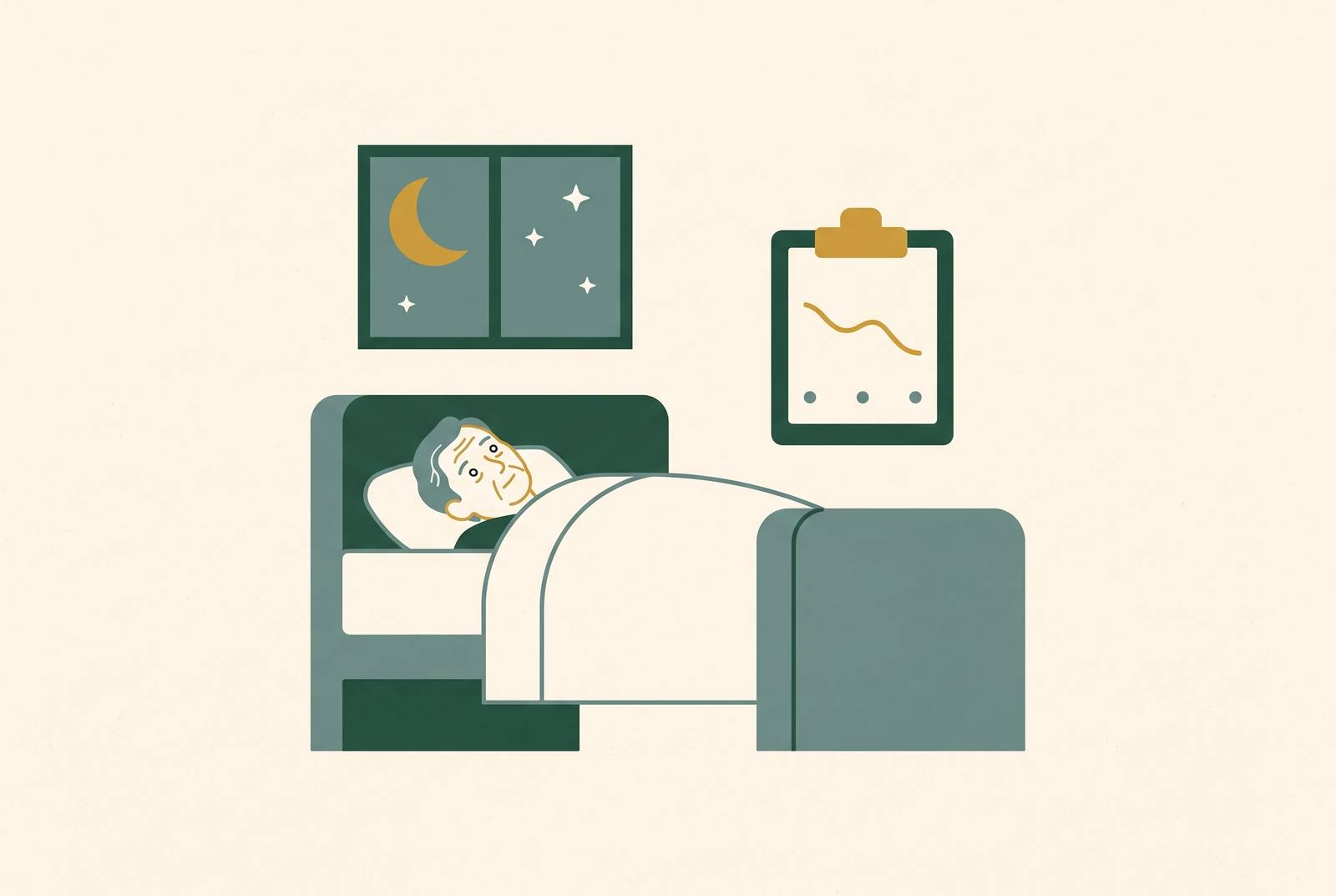
Sleep disturbance in long-term care comes with old age, but it is not just a minor discomfort. Instead, it is a high-frequency clinical event, but the field has filed it away as background noise, something everyone expects and almost nobody tracks. Sleep quality declines with age for straightforward physiological reasons: less deep sleep, more frequent awakenings through the night. But that baseline decline gets magnified inside a facility, where residents hold a less stable circadian rhythm than older adults living at home, regardless of their cognitive status. Sleep disturbances affect up to 70% of skilled nursing facility residents, making the problem far from small and putting it among the most common clinical conditions found in that population. Documentation trails far behind how often the problem actually occurs: a large share of older adults who report sleep concerns never have those concerns written down by a provider. That gap does not come from a lack of clinical knowledge. Nurses watch sleep disturbances happen on every shift they work. What breaks down is how that observation gets handled once it is made: it lands in a narrative note and goes no further.
How disrupted sleep sets off a behavioral cascade
Sleep disturbance and behavioral decline feed each other in both directions, and that two-way relationship is what lets an undocumented sleep problem turn into a worsening behavioral problem with no one ever identifying what started it. Cognitive impairment raises the risk of new sleep problems by disrupting circadian rhythms and triggering nighttime wandering. Sleep disturbance, in turn, speeds up cognitive decline. The consequences do not stop at memory and thinking. Poor sleep connects to depressed mood, cognitive impairment, increased pain, and functional disability, each one compounding the others. Compromised sleep quality is tied to agitation, aggressiveness, and severe neuropsychiatric symptoms, the exact cluster of behaviors that triggers care escalation, psychotropic medication orders, and a higher risk of hospitalization. A particular clinical trap makes this worse: irritability, poor concentration, slower reaction time, and reduced performance are all consequences of poor sleep, but staff often read them as dementia progressing on its own. That misreading leads facilities to treat the behavior while missing what caused it. The MODERATE study gives this mechanism a timeline that nursing managers can actually use: disrupted nighttime sleep precedes heightened agitation across the following week. A week of lead time is a window during which intervention is still possible, provided someone is looking for it.
Which residents are accumulating sleep risk silently
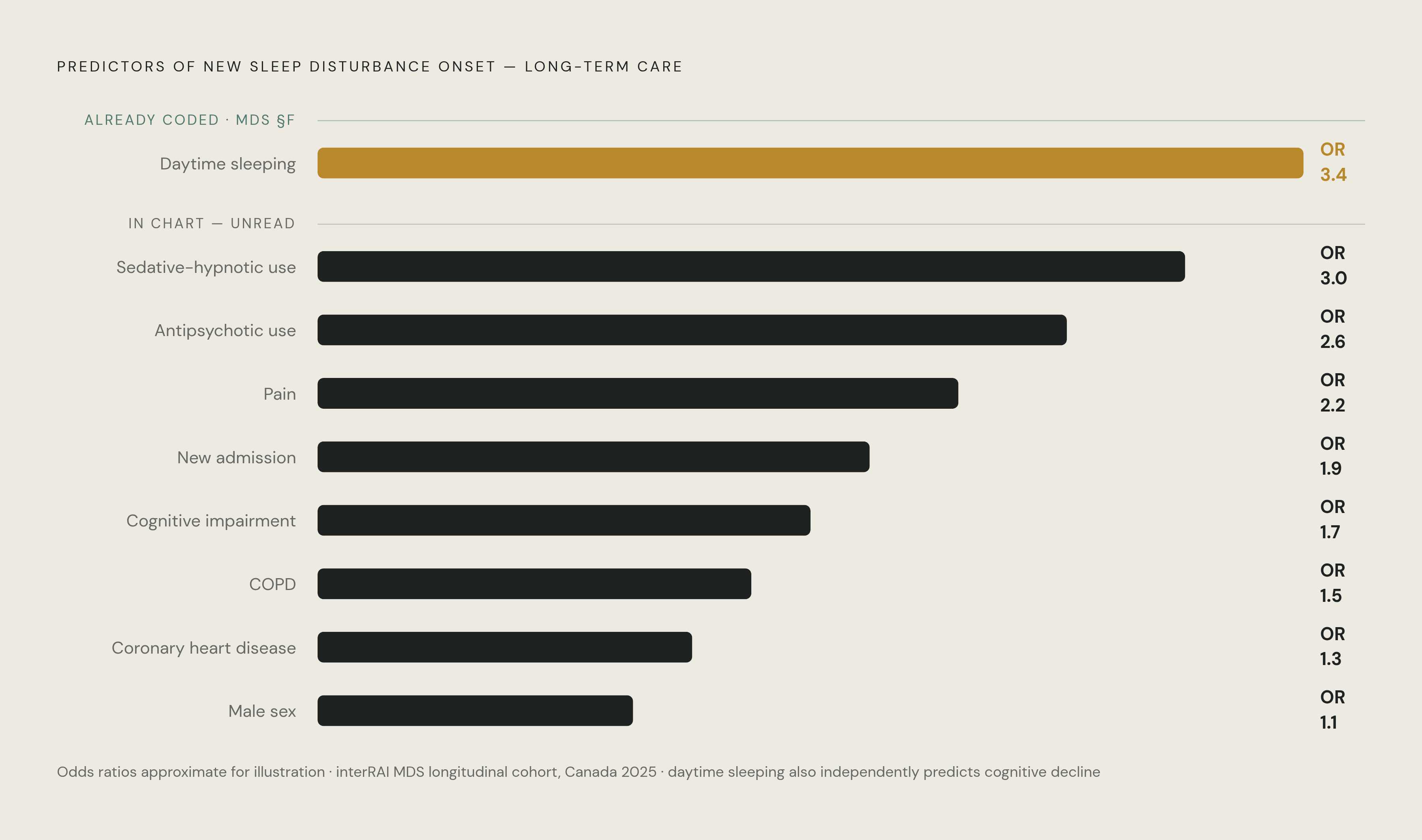
Nine clinical predictors of new sleep disturbance onset have now been identified, and that changes the nature of the problem. Facilities already have what they need to spot sleep problems in specific residents, before those residents ever show behavioral symptoms. A 2025 longitudinal interRAI analysis of Canadian long-term care facilities found nine statistically significant predictors: male sex, new admission, cognitive impairment, pain, daytime sleeping, COPD, coronary heart disease, antipsychotic use, and sedative-hypnotic use. Daytime sleeping earns particular attention among these because it works as a two-way risk signal. It predicts new sleep disturbance and is also associated with lower cognitive scores and faster cognitive decline on its own. That detail matters because daytime sleeping is already documentable on MDS Section F, so the clinical signal is sitting in a field facilities already fill out.
The medication side of this picture carries its own warning. Sleep medications commonly used as first-line therapy in older adults can cause more cognitive problems, more falls, and worse sleep over time, so a short-term fix turns into a longer-term liability. That trade-off is a reason to catch sleep disturbance early rather than reach for a prescription once agitation has already set in. Prevalence varies widely by facility, with rates ranging from 3 to 56%. A spread that wide cannot be explained by resident acuity alone. It points to institutional factors driving the difference, and it means meaningful improvement is achievable where practice changes. None of the nine predictors above require new testing or new instruments to find. They are already present in the chart. No one is reading them together as a pattern.
Why nursing notes go nowhere
Every shift generates usable sleep signal in the form of nursing notes, but most EHR systems are not built to aggregate that signal, cross-reference it, or compare it against coded outcome fields. A nurse writes "resident up three times, appears restless" into a narrative note. That sentence creates a text record, but it does not create a coded data point that any system counts or flags. This is not a sleep-specific failure. The large majority of data in an EHR is unstructured: clinical notes, shift summaries, and narratives written in a nurse's own words. In skilled nursing facilities, you find the clinical reality of a resident's day in that unstructured layer.
The cost of leaving that layer unread is measurable. Manual chart review of unstructured EHR data identified substantially more individuals with insomnia and sleep problems than ICD code review alone turned up. So if facilities rely on coded fields, they undercount a problem their own nursing staff has already written down. Natural language processing applied to clinical text is now a proven way to close that gap. A 2026 foundation model from Bilal et al., published in Nature Communications, combined polysomnography data with clinical records run through an NLP pipeline that pulled clinical outcomes from EMR text using a curated disease vocabulary matched to ICD codes. Cognitive impairment, and secondarily mood disorders, sat among the tracked outcomes, alongside mortality, cardiovascular disease, and neurological disease as the model's primary highlighted outcomes. That result demonstrates that the sleep-to-cognition signal can be pulled directly from documentation that already exists in the record.
The operational implication follows directly: no new data-entry burden is required to fix this. The night-shift note already written is the raw material. What's missing is a system built to read across notes and aggregate what they say, not a nurse willing to write more of them.
What surveyors now review
Under the frameworks now in force, if staff observe a sleep disturbance but never document it or fold it into a care plan, that creates exposure across several F-tags at once. That makes sleep documentation a compliance liability on top of a clinical one. CMS's revised Appendix PP guidance names sleep cycles directly as an area surveyors review for resident preference. Surveyors check whether staff accommodate a resident's preferred sleeping and waking times and whether that accommodation appears in the care plan itself.
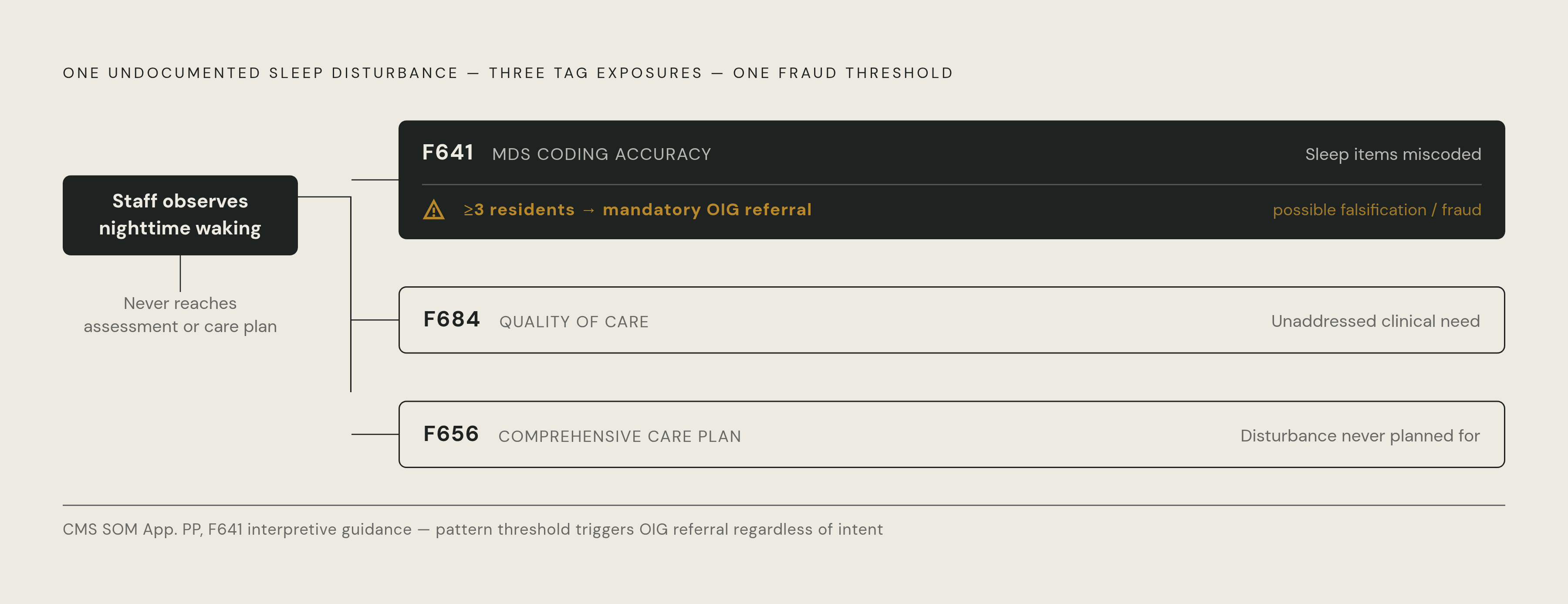
A sleep disturbance that staff witness but never write into the official record compounds across three tags at once: F641 covers MDS coding accuracy, F684 covers quality of care, and F656 covers comprehensive care plans. All three come into play when nighttime wakefulness appears repeatedly in shift notes but never makes it into the resident's assessment or plan of care. F641 carries particular weight here: surveyors are instructed to look for patterns of inaccurate coding across three or more residents, and finding three or more MDS inaccuracies can trigger a mandatory referral to the Office of Inspector General to investigate possible falsification or fraud. CMS survey changes effective April 28, 2025, put more weight on assessment accuracy, real-time care planning, and documentation quality, which are precisely the areas where an untracked sleep pattern leaves a gap a surveyor can find.
The 2026 Risk-Based Survey raises the stakes further for facilities that are otherwise performing well. Launched nationally on September 8, 2026, the RBS offers a streamlined recertification survey for qualifying higher-performing facilities, using a smaller resident sample and fewer survey activities, paired with a "High Performing Facility" icon, a gold trophy, visible on Care Compare. A documentation gap in a high-frequency clinical event like sleep disturbance puts that designation at risk, turning what used to be a penalty-avoidance question into a question about a public-facing reward a facility stands to lose.
What systematic sleep documentation tracking requires in practice
Converting sleep disturbance entries into a usable signal for behavioral decline calls for three capabilities most facilities do not have by default: aggregation across shifts, cross-referencing against behavioral and functional outcomes, and a mechanism that surfaces the pattern without a nurse having to go looking for it. The workflow failure here is not a documentation problem. Nurses already write down sleep observations. The failure is that each entry gets read as a single, isolated event, losing the longer pattern it belongs to. The MODERATE study found that disrupted nighttime sleep precedes heightened agitation across the following week, but you only get use from that if you read across that week instead of just reading last night's note on its own.
Aggregation across shifts comes first. Nurses write sleep entries on different nights, but you need to recognize them as observations about the same resident and accumulate them together, not file them away as separate, unrelated shift notes with no connection drawn between them. Cross-referencing comes second. The interRAI predictors, cognitive impairment, pain, daytime sleeping, antipsychotic use, are already sitting in the record as coded fields. So you can link the frequency of sleep-related notes to those existing fields and build a composite risk picture out of data the facility already has on hand, without collecting anything new.
Surfacing the pattern without manual search comes third. A nursing manager reviewing every resident's chart by hand, looking for sleep trends, is not a workable routine across a facility with dozens or hundreds of residents. The notes need to be read systematically, and the pattern needs to be presented, rather than waiting for a busy manager to notice it buried across weeks of entries. Closing the loop matters just as much as finding the pattern. Once a sleep disturbance pattern triggers a response, whether that's a care plan update, a physician notification, or a medication review, that response should be trackable in the same record that generated the alert. That creates a documented chain from observation to intervention, the exact chain a surveyor needs to see.
Continuous monitoring as the standard, not a periodic chart review
Treating sleep disturbance tracking as a periodic chart audit, rather than an ongoing monitoring function, is what lets the behavioral decline cascade advance unchecked. The evidence supports a real-time, pattern-level standard instead. The timing evidence leaves little room for debate: the MODERATE study established a week-scale lead time between disrupted nighttime sleep and elevated agitation, a window a quarterly MDS review will never catch but a system reading daily notes can.
The predictors identified in the interRAI longitudinal analysis are not fixed points either. Cognitive status, pain levels, and medication regimens all shift between formal assessments, so static, point-in-time risk scoring misses residents who have moved into a higher-risk category since their last evaluation. Compliance readiness runs on the same logic. Survey exposure does not appear at the moment of the survey, it builds up in the documentation record over time. So if a facility's sleep observations are already aggregated, reflected in care plans, and linked to documented interventions, it has nothing left to reconstruct when a surveyor walks in.
When facilities move to continuous documentation monitoring, they recover time that would otherwise go into manual surveillance and reactive escalation, so the clinical benefit and the operational benefit move together. The infrastructure to run this at scale, NLP reading shift notes, ranking residents by behavioral risk trajectory, surfacing documentation gaps before they turn into care failures, already exists in working form. The Bilal et al. model in Nature Communications demonstrates that sleep-to-cognition signal extraction from clinical text is achievable now, not a future capability.
A facility that monitors sleep disturbance continuously is reading the paperwork it already produces, not generating more of it. The data has been sitting in the chart all along. Whether anyone is reading it is the only open question.
Sources
- Predictors of change in sleep disturbance in Canadian long-term care facilities: a longitudinal analysis based on interRAI assessments - PMC
- IMPROVING SLEEP USING MENTORED BEHAVIORAL AND ENVIRONMENTAL RESTRUCTURING (SLUMBER)
- Disrupted Sleep at Night Is Associated with a Higher Level of Agitation Throughout the Week in People Living with Cognitive Decline
- 1 Summary of CMS’s Revised Guidance for Nursing Home Surveyors