Interrai Assessment Triggers for Resident Risk Stratification
Standardized triggers and risk scores guide care decisions across long-term care facilities.

Decades ago, regulators decided long-term care could not rest on informal clinical impressions alone, and that is why interRAI assessment triggers exist. What follows traces that mechanism from the ground up: how individual item responses become triggers, how triggers feed scoring algorithms, and how those algorithms sort residents into risk tiers that nursing teams can act on.
The Care Quality Crisis That Produced a Mandatory Assessment Standard
Long-term care in the late twentieth century suffered from a documentation problem that was really a trust problem: facilities varied enormously in how they recorded resident status, and that variation made it nearly impossible to compare care quality across homes or to catch decline before it became a crisis. Every facility had to complete a standardized Minimum Data Set, item by item, so care planning and case-mix assessment could draw from the same structured source, not from whatever notes a facility happened to keep.
That origin matters because it separates interRAI from the clinical checklists that circulate informally in nursing practice, the ones a unit adopts and drops as staff turn over. The system was built to produce consistent signals across thousands of facilities, and everything the rest of this piece describes, the Collaborative Action Plans, the CHESS and MAPLe scores, the risk tiers nursing teams build around them, depends on that initial decision to make assessment mandatory.
How the MDS produces triggers: item responses, problem flags, and the logic that connects them
A trigger is not a clinician deciding something looks wrong. A trigger fires on its own, the moment specific MDS item responses, alone or in combination, cross a threshold that signals either an active problem or a heightened risk of decline.
Two distinct conditions can set a trigger in motion. The first is a direct problem indicator: a response that shows a condition is already present, such as a mood disturbance item or an incontinence item coded at a level the system treats as clinically significant. The second is a risk factor signal: a response that does not confirm a problem outright but raises the probability of future decline, such as reported dizziness, wandering behavior, or the use of certain drug classes known to carry fall or cognitive risk. Both conditions feed the same downstream mechanism, but they carry different clinical meaning, and a nursing team reading a trigger report needs to know which type it is looking at before deciding how urgently to respond.
When a trigger fires, it activates a Collaborative Action Plan, called the Clinical Assessment Protocol in earlier manuals, inside the interRAI Long-Term Care Facilities instrument. The CAP is a structured prompt that directs the clinical team toward a more focused secondary assessment in that specific domain, whether that is nutrition, mood, or skin integrity. These plans are not forms staff fill out at their own discretion. The interRAI instruments generate them automatically from the item responses already entered. The CAP a nurse sees reflects what the assessment data triggered, not a judgment call made after the fact.
In Ontario's implementation of interRAI LTCF, this process carries a hard deadline. Facilities have a limited window after the Assessment Reference Date to review the CAPs that fired and submit the completed assessment to the Integrated interRAI Reporting System. CAP review is not a task a facility can defer until convenient; it is a timed regulatory obligation built into the reporting cycle.
The range of MDS items feeding this trigger logic is wide. Every one of these domains can generate a trigger on its own or in combination with others, and the resulting CAP set for any given resident tends to reflect a pattern across several clinical areas.
What the embedded algorithms actually measure: CHESS and MAPLe as the engines of risk ranking
Firing a CAP is the start of a stratification process, not its conclusion. The same item responses that activate Collaborative Action Plans also feed into summary scale algorithms built to rank residents by severity and urgency, and this is where the trigger system does its most consequential work.
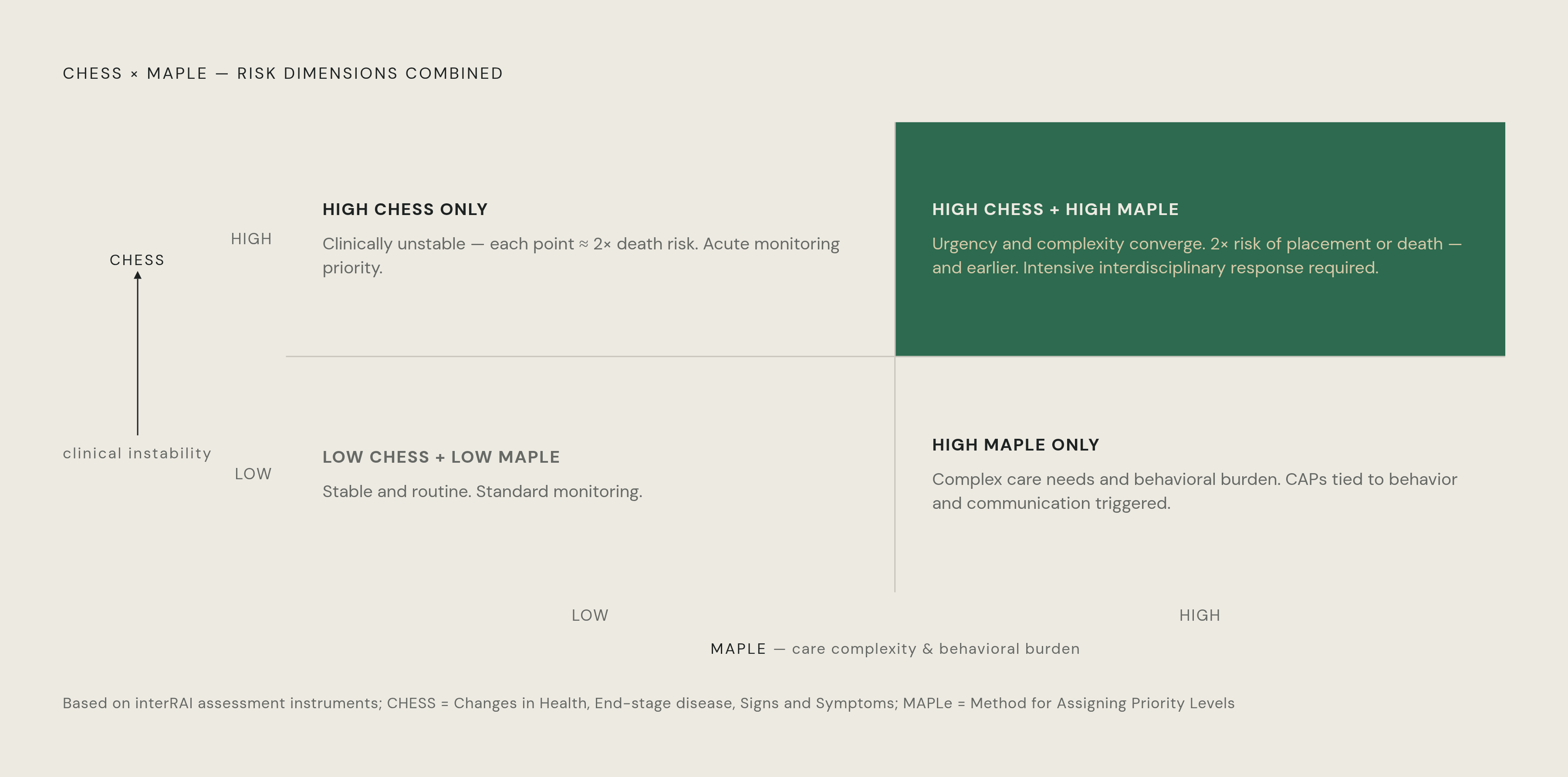
CHESS, an acronym describing its focus on changes in health, end-stage disease, and symptoms and signs, pulls together a set of indicators: decline in Activities of Daily Living, decline in cognition, symptoms such as weight loss, shortness of breath, and edema, and clinician ratings of prognosis under six months. Each one-point rise on the CHESS scale corresponds to a nearly two-fold increase in the risk of death within a short follow-up window, which makes CHESS less a general health indicator and more a specific signal of clinical instability.
MAPLe, the Method for Assigning Priority Levels, measures something else. MAPLe predicts the level of care and resource intensity a resident will need, and residents who score high on it disproportionately trigger CAPs tied to behavior and communication.
The distinction between these two scales is the point to hold onto. CHESS and MAPLe are not two versions of the same risk measurement. High CHESS flags clinical instability and the near-term risk of death. High MAPLe flags care complexity and behavioral burden, the kind of resident who may not be at immediate risk of dying but who requires intensive staff time and specialized behavioral support. A resident can score high on one and low on the other, and the care response those two profiles demand looks nothing alike.
If a resident scores high on both, that resident sits in the highest tier the system produces. Those residents are more than twice as likely to experience long-term care placement or death, and they experience those outcomes earlier than residents who score high on only one scale or neither. That combined finding is the clearest evidence that CHESS and MAPLe, read together, do more analytical work than either scale does alone.
From Trigger Patterns to Resident Risk Tiers
No single score determines where a resident sits on the risk spectrum. The translation runs through a combination of three inputs: which CAPs activated, the resident's CHESS level, and the resident's MAPLe level. Read together, these three pieces position a resident along a risk gradient that tells a care team where to direct its attention first.
That gradient sorts into clinically distinct groups that call for different responses. A resident with high CHESS and moderate MAPLe presents acute clinical fragility, with mortality risk as the dominant concern, and the care plan for that resident needs to center on symptom burden and the management of end-stage disease. A resident who scores high on both scales sits in the highest-priority tier and needs the most intensive interdisciplinary response the facility can organize, drawing in nursing, social work, and often psychiatric or behavioral consultation together.
None of this is a one-time placement. Nursing staff use the assessment information to spot risk factors and build care plans, and then across successive assessment cycles they track how scores and CAPs shift so they can adjust the plan to match. A resident who moves from moderate to high CHESS between assessments is signaling a change that the care team needs to register and act on immediately, not wait to confirm at the next scheduled review.
The CAP review requirement reinforces this tiering logic even where the CAPs themselves never leave the facility. In Canada, CAPs are not submitted to the national reporting system; they stay in the resident's clinical chart and get assessed against provincial standards. That chart-level review is the mechanism that turns a resident's tier into documented, specific care interventions. The score tells the team where a resident sits on the risk spectrum. The CAP review is where that position becomes an actual plan.
Limits of the Trigger System: Subjectivity, Multicollinearity, and the Staffing Constraint
The trigger-to-tier translation is only as good as the item responses feeding it, and those responses carry real limits that practitioners need to understand before treating any score as settled fact.
CHESS depends in part on subjective clinical appraisal, not on a purely biological marker. Some of its components rest on clinical judgment rather than objective physiological measurement, so two assessors evaluating the same resident can land on somewhat different scores depending on how they read ambiguous symptoms. That variability does not make CHESS unreliable, but it means a single CHESS score should be read as an estimate shaped by the assessor, not as a lab value with a fixed margin of error.
A second limit involves overlap between scales. MAPLe and other interRAI instruments share functional items, and Activities of Daily Living is the clearest example of this. Both MAPLe and the separate IADL measure draw on ADL-related information, even though they serve different purposes: MAPLe is a priority-level decision-support tool that factors ADL functioning in among several other inputs to assign care urgency, while IADL directly measures a person's ability to manage instrumental daily tasks independently. That shared input creates statistical redundancy, so it complicates the work of building predictive models on interRAI data, and a model built from these scores needs further validation across different resident populations and countries before anyone treats it as broadly applicable.
The third limit is less a data problem than a workforce problem. The entire value of longitudinal trigger monitoring, the ability to notice that a resident's CHESS score moved or a new CAP fired between assessments, depends on staff who know that resident's baseline well enough to recognize the change. High staff turnover in long-term care directly erodes that capacity: when the staff caring for a resident change frequently, the detection of early decline becomes less reliable, no matter how well-designed the scoring algorithm is.
Urgency of the Trigger-to-Tier Translation in the Regulatory Environment
Accuracy in the trigger-to-tier process now carries consequences that extend well past clinical quality, because the regulatory frameworks built on top of interRAI data are changing on both sides of the border.
In Canada, the national health information agency decommissioned its long-standing reporting platform for long-term care in March 2026, and the Integrated interRAI Reporting System now stands as the new national standard. In Ontario specifically, CIHI is moving to interRAI LTCF version 9.1.5 on April 1, 2026, though version 9.1.4 remains usable after that date with an addendum describing the changes. The item sets that generate triggers and the CAP logic built on top of them are being actively revised, not held in place.
In the United States, a federal health program oversight body updated its MDS 3.0 RAI User's Manual to version 1.20.1, effective October 1, 2025, with a further update to State RAI Coordinator contact information in Appendix B taking effect in June 2026. That matters because MDS coding is the single highest-stakes documentation task in a U.S. skilled nursing facility: a miscoded item can simultaneously expose the facility to compliance risk and change its Medicare reimbursement under the payment model governing its reimbursement rates. Quality reporting requirements are expanding alongside the coding updates. The FY 2026 value-based quality measures now include SNF Healthcare-Associated Infections Requiring Hospitalization, Total Nursing Staff Turnover, and the Skilled Nursing Facility 30-Day All-Cause Readmission Measure, and trigger-based monitoring of the incident categories behind these measures feeds that data in directly.
What continuous, real-time monitoring of trigger patterns adds that periodic MDS snapshots cannot
The MDS assessment schedule, admission, quarterly, and annual, produces a snapshot of risk at fixed points in time. A resident's clinical condition does not wait for those intervals. The trigger logic reflects a resident's status accurately on assessment day, but it grows less reliable with every day that passes afterward, because the resident's condition keeps changing while the score stays fixed.
A resident who looked stable at the quarterly assessment can decline substantially in the following weeks without that decline registering anywhere in the structured data a care team reviews.
The information needed to close that gap already exists in most facilities. Clinical notes entered into electronic health records between formal assessments record the same kinds of observations the MDS items capture, mood change, appetite decline, mobility loss, wound progression, and they capture it continuously, as events happen, at the pace of daily care. The obstacle is that this information lives in free text, with inconsistent formatting, variable note length, and specialized clinical language that makes it hard to extract and act on without a structured process for doing so.
Natural language processing and related analytical approaches are starting to close that gap, because they can pull structured information out of unstructured clinical notes. Some models can identify cognitive status directly from clinician narrative notes and compare the result against the resident's MDS-based cognition score, and they show a real degree of concordance between the continuous narrative record kept day to day and the periodic structured assessment the regulatory system is built around. The significance of this is not that it replaces the MDS. It confirms that nursing staff are already recording the information you need for continuous risk stratification. The limiting factor is extraction and analysis, not data collection.
Operationalizing the Trigger-to-Tier Framework Without Adding Documentation Burden
Facilities do not need to collect more data to act on the trigger-to-tier logic described above. They need to read, more consistently, the data the MDS and daily clinical notes already generate.
Start with the CAP review window itself. Treat it as a clinical conversation, not a compliance task to finish before a deadline. A nurse manager who walks through which CAPs fired for a resident and why, rather than simply confirming the review happened, catches the cases where a trigger reflects a transient issue versus a genuine decline.
Read CHESS and MAPLe together, not in isolation, and build routine habits around that. A resident moving up on both scores at once belongs on every interdisciplinary rounds list until the picture stabilizes.
Protect continuity of assignment where possible.
Finally, treat the clinical notes already written between assessments as part of the risk stratification record, not as a separate narrative kept for legal protection. Reading it with the same rigor applied to the structured score is what turns a periodic snapshot into something closer to continuous, proactive awareness of where each resident actually stands.
Sources
- Integrated interRAI Reporting System (IRRS) metadata
- Optimizing the InterRAI Assessment Tool in Care Planning Processes for Long-Term Residents: A Scoping Review - PMC
- FAQ
- Implementing the Resident Assessment Instrument:
- Adverse Events in Home Care: Identifying and Responding with interRAI Scales and Clinical Assessment Protocols
- CMS’s RAI Version 3.0 Manual CH 2: Assessments for the RAI October 2025
- NHQI Spotlights and Announcements
- Use of the interRAI CHESS Scale to Predict Mortality among Persons with Neurological Conditions in Three Care Settings