Alteration of Resident Condition Documentation Under CMS Guidance
CMS is redefining nursing home documentation as proof of care, not just a record of it.

The effective date to know is February 24, 2025. That is when a new round of CMS guidance began treating resident condition documentation not as a record of care already given, but as evidence that must independently prove the standard of care was met at a specific moment in time. A further revision, Rev. 232, followed on July 23, 2025, amending Appendix PP of the State Operations Manual, with its own new provisions effective April 28, 2025. Each revision layered onto a framework that was already active, so the regulatory shift facilities now face is not one event but a sequence of them, compounding over the course of a single year. Charting once served mainly to track care, but now it has to prove it, and every documentation requirement discussed below follows from that shift.
The new evidentiary standard for mental health and diagnosis documentation
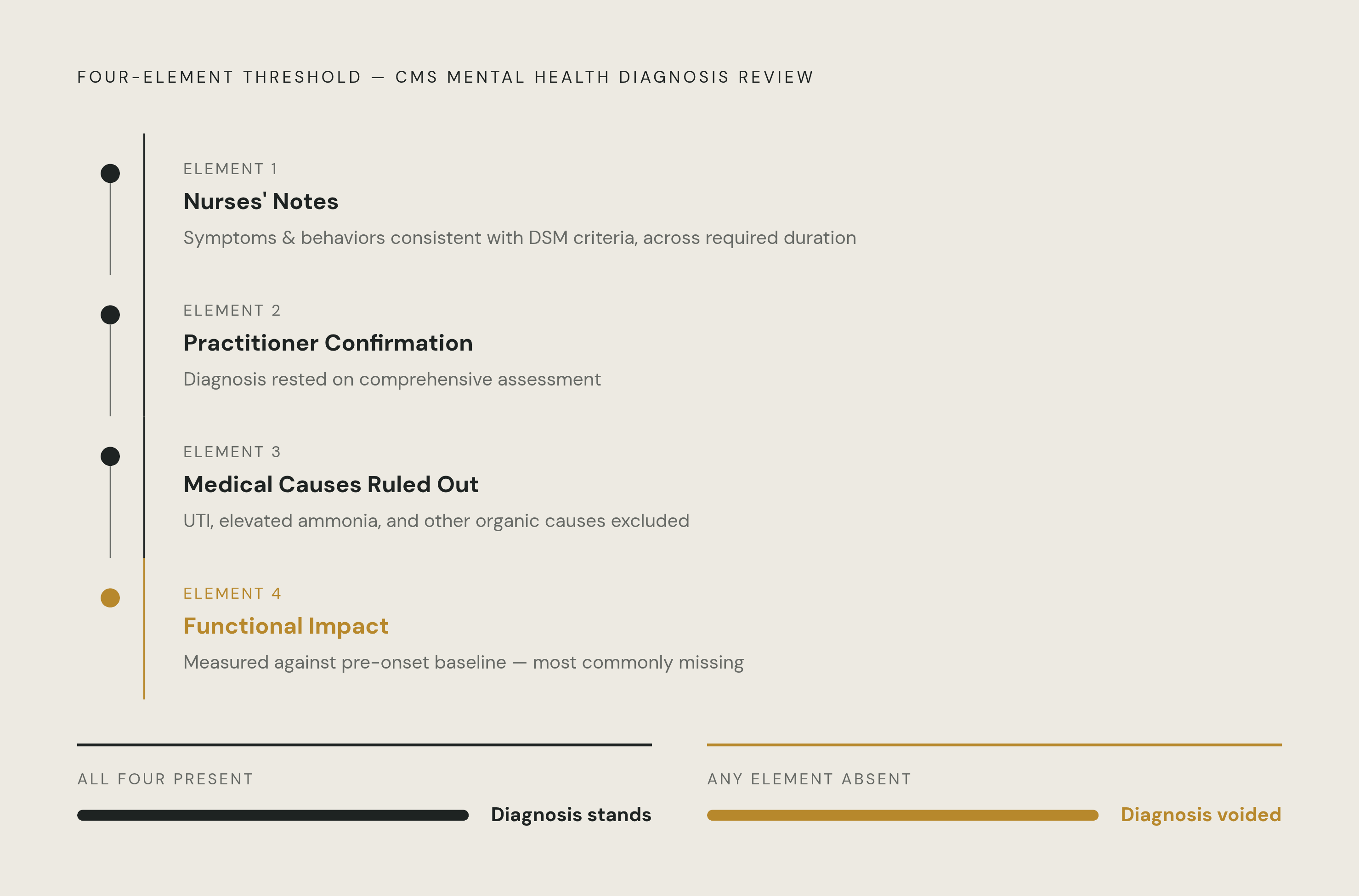
CMS now defines insufficient documentation of a mental health condition with a precision that leaves little room for interpretation. A medical record fails the standard if it is missing any one of four elements, and all four must be present together for the diagnosis to hold up under review. The first is documentation, such as nurses' notes, showing the resident had symptoms, disturbances, or behaviors consistent with DSM criteria, present for the period of time the DSM criteria call for. The second is documentation from the diagnosing practitioner confirming the diagnosis rested on a comprehensive assessment, not a quick impression. The third is documentation ruling out other medical causes; CMS points directly to a urinary tract infection or elevated ammonia levels as two examples. The fourth is documentation of how the disturbance affected the resident's function measured against a baseline recorded before the condition's onset.
The specificity behind this checklist traces back to a documented pattern of misdiagnosis. CMS built an audit tool to find skilled nursing facilities where residents carried a schizophrenia diagnosis but had no medical documentation to support either that diagnosis or the antipsychotic medications prescribed for it. Where that pattern turns up, CMS now instructs surveyors to investigate whether the facility followed accepted professional standards in reaching the diagnosis. A diagnosis code inside a resident's chart now carries a different, heavier meaning. A code sitting alone no longer validates itself. The record has to reconstruct, step by step, the clinical reasoning that produced it, from the symptoms observed through the assessment performed to the alternative causes considered and ruled out.
Psychotropic medication documentation as a parallel compliance flashpoint
The same evidentiary logic that now governs diagnosis extends directly into treatment. A diagnosis, even a well-documented one, does not by itself justify starting a resident on a psychotropic medication. CMS guidance requires the medical record to show, separately, that the facility tried behavioral interventions first and found them inappropriate or unsafe before it turned to drugs. Any change in medication, whether starting or stopping it, has to be grounded in an evaluation of the resident's physical, behavioral, mental, and psychosocial signs and symptoms, and that evaluation, along with the reasoning behind the treatment chosen, has to appear in the record itself.
The practical effect is that a facility can make a clinically defensible medication decision and still be cited for it, if the documentation proving that nonpharmacological options were considered and ruled out simply is not there. The deficiency in that case comes from what is missing in the chart, not from what happened at the bedside. This distinction carries a new weight because of where it now feeds. The Long-Stay Antipsychotic measure was respecified effective January 1, 2026, with an errata clarification issued March 30, 2026, tightening the MDS coding and reporting requirements behind that quality measure. Psychotropic documentation, in other words, no longer stays contained within a single resident's chart. It flows into a measure that shapes how a facility is scored and seen publicly, a connection the next section develops in full.
Falls documentation and MDS accuracy as newly weighted compliance evidence
Falls documentation now carries consequences that extend well past the clinical record. It feeds directly into the Falls with Major Injury quality measure, it shapes a facility's standing on Care Compare's public rankings, and it factors into Special Focus Facility selection. A gap in how a fall gets documented is no longer a problem confined to one resident's file. It is a reputational and regulatory exposure that follows the facility into public view.
CMS released the official Technical Specification Report for the Falls with Major Injury measure on November 26, 2025, and it drew on feedback from a cross-setting Technical Expert Panel held May 12 and 14, 2025. CMS has said additional guidance and public reporting timelines will follow, signaling that scrutiny of falls documentation is still building.
The mechanism driving all of this is MDS coding accuracy. A fall can be described in detail in a nurse's narrative note and still create a compliance gap if that same fall is not coded accurately on the MDS assessment. That gap used to be something only a surveyor, working carefully through a chart by hand, would catch. Now the quality measure algorithms that generate public rankings can catch it too. The distance between a well-written note and an accurately coded assessment has become a direct line to a facility's public reputation.
Transfer and discharge documentation under the consolidated F-Tag framework
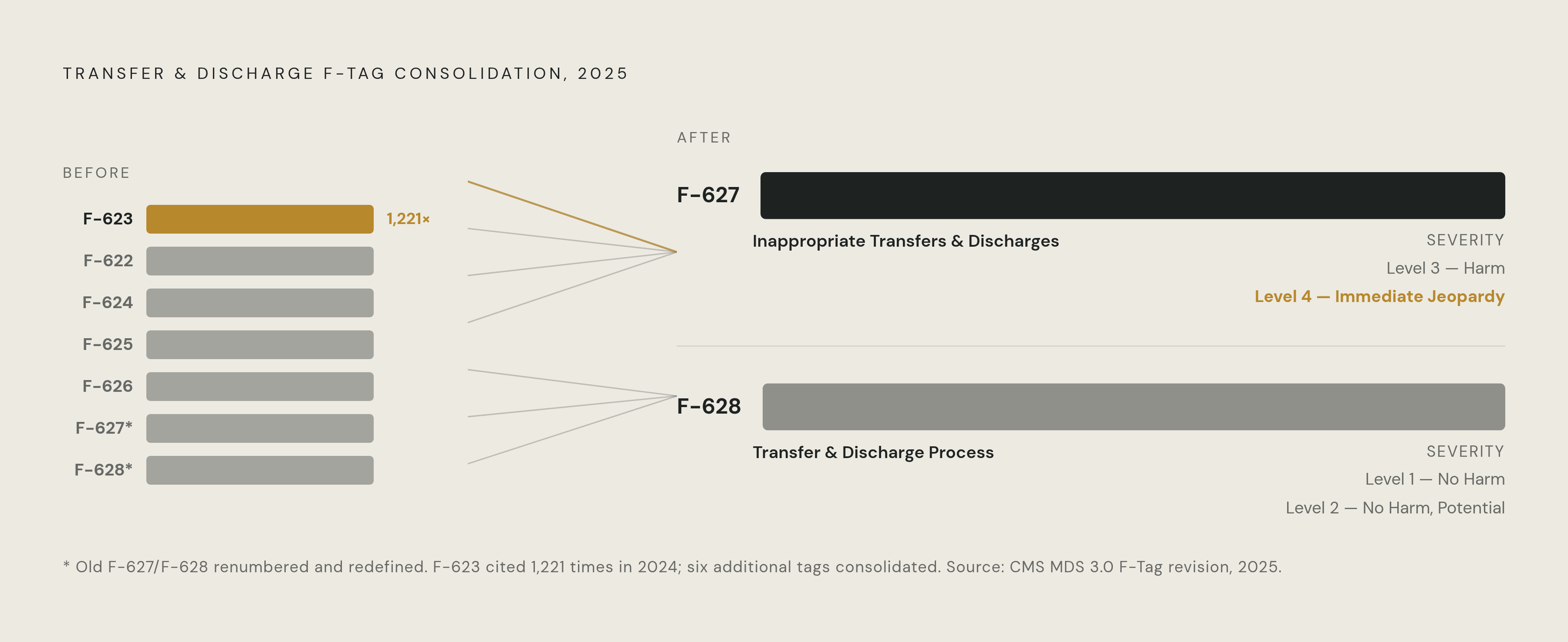
CMS consolidated seven separate transfer and discharge F-Tags into two: F-Tag 627, covering Inappropriate Transfers and Discharges, and F-Tag 628, covering the Transfer and Discharge Process. The consolidated framework makes the medical record the deciding evidence of whether a discharge was appropriate, so a discharge decision can no longer stand on clinical judgment alone. The tags being replaced were far from rarely cited. F-Tag 623 alone was cited 1,221 times in 2024, and the full set of prior tags generated thousands of citations that same year, well before this tighter standard took hold.
Under the new guidance, the basis given for a discharge determines what the record needs to show. A discharge justified by the facility's inability to meet a resident's needs requires documentation of which needs could not be met and proof that the facility tried to meet them anyway. A discharge justified by an improvement in the resident's health requires documentation that the improvement actually occurred, not simply an assertion that it did. In both cases, the chart has to reconstruct the clinical basis for the decision.
The severity attached to failures here is the detail that should concern operators most. Violations of F-Tag 627 are generally cited at Harm (Level 3) or Immediate Jeopardy (Level 4), the same severity ceiling applied to direct care failures. A missing paragraph of documentation in a discharge summary can now trigger the same category of citation as an actual failure in care delivery, so discharge documentation needs the same institutional attention as any clinical safety protocol, not the lighter treatment paperwork has traditionally gotten.
Common shortfalls in documentation practices against these standards
The most common shortfall is fragmentation: documentation about that care is split across disciplines. Physical therapy, occupational therapy, speech-language pathology, nursing, and social work typically keep separate note templates with no structured connection to a single care plan. The chain of clinical reasoning CMS now expects to find in one place ends up scattered across records that no one, surveyor or facility staff member alike, can easily piece back together.
A second shortfall is about timing. Meeting the new standard for condition change documentation means showing the resident's baseline before onset, the period during which symptoms appeared, the alternative causes that were ruled out, and the functional impact that followed. All of that has to be captured as it happens. Sparse notes written in the moment cannot be filled in retroactively once a surveyor or an auditor comes asking, because the clinical observations that would support a retroactive reconstruction were never recorded to begin with.
MDS accuracy compounds both problems. A narrative note can describe a resident's condition in careful clinical detail and still fail to translate into the correct MDS item, because narrative documentation does not automatically populate an assessment. A condition that is, by any reasonable clinical reading, well documented can still be miscoded on the very assessment that feeds the quality measures and public rankings described above. Taken together, these gaps point to a single underlying expectation: CMS wants the record to show a continuous chain of reasoning running from the first observation through assessment, differential diagnosis, intervention, and treatment decision. Most general-purpose EHR workflows were never built to produce that chain as a natural byproduct of routine charting, so the gap is less a failure of individual judgment than a mismatch between how records are built and what regulators now expect them to prove.
Continuous monitoring of unstructured notes closes the documentation gap before a survey.
The evidence CMS is asking for, in most cases, already exists somewhere in the clinical record. It sits scattered across unstructured narrative text, split between disciplines, and spread across time, effectively invisible until a surveyor sits down and manually assembles it piece by piece. That invisibility is the real operational challenge behind the new standards, not a shortage of clinical information.
Extracting and organizing narrative notes on a continuous basis, rather than only when an audit or survey is already underway, turns that invisible risk into something visible and fixable while there is still time to act. A gap in baseline documentation, a missing phrase ruling out an alternative cause, an absent record of a behavioral intervention attempt: each of these can be caught and corrected clinically before a surveyor ever has the chance to cite it.
The same note that records a behavioral change, a fall, or the reasoning behind a medication decision is also, often, the earliest signal that a resident's condition is beginning to shift. Catching that shift early serves the resident and the compliance record at the same time, because the clinical response and the documentation response draw from the same source. Implementations at a group of skilled nursing facilities affiliated with a hospital, run by one vendor, using real-time extraction that processes structured and unstructured EHR data multiple times a day, showed better risk-adjusted readmission rate profiles compared with state and national peers across a 2017 to 2022 analysis. That record points to a simple operating principle: continuous extraction from documentation that already exists, not an added burden of new paperwork, is what produces gains in both clinical outcomes and compliance standing.
What nursing managers and facility operators should audit now
Three documentation categories deserve first attention, because the new evidentiary standard is most demanding there and because survey citations have historically clustered around them: mental health diagnoses paired with psychotropic medication orders, falls documentation tied to MDS coding, and discharge records where a reason for transfer is stated but never reconstructed in the chart.
For each of these categories, the audit asks the same thing regardless of clinical specialty: does the record contain the full chain of reasoning, baseline, symptom period, differential, ruled-out alternatives, intervention attempts, and treatment rationale, or does it contain only the conclusion a clinician reached? A chart that states a diagnosis, a fall, or a discharge decision without the reasoning behind it will not meet the standard, no matter how sound the underlying clinical judgment was.
Care planning discipline matters just as much as any single note. Documentation from nursing, therapy, and social work has to connect to one shared care plan rather than exist as parallel records that never reference each other, because surveyors working through the new F-Tags will read across disciplines to judge whether the record as a whole supports the decisions made. A note that makes sense in isolation but contradicts or ignores another discipline's record undermines the very reasoning chain CMS is looking for.
There is a reward built into this system as well as a risk. The Risk-Based Survey launched nationally on September 8, 2026, and it gives facilities that show consistent compliance access to a streamlined survey process. Beginning October 8, 2026, facilities that qualify receive a "High Performing Facility" designation displayed on Nursing Home Care Compare. Under this structure, families and referral sources can see sustained documentation quality directly, not just a box a facility checks to avoid a citation. The discipline this piece has described throughout, the baseline captured early, the alternative causes ruled out in writing, the intervention attempts recorded before a prescription is written, now carries a visible public reward attached to it, turning what has been treated as a compliance burden into a competitive advantage a facility can point to and keep.
Sources
- Revised Long-Term Care (LTC) Surveyor Guidance
- CMS Manual System Department of Health & Human Services (DHHS)
- DEPARTMENT OF HEALTH & HUMAN SERVICES Centers for Medicare & Medicaid Services
- Quality Measures
- 1 Summary of CMS’s Revised Guidance for Nursing Home Surveyors
- 2025 Updates to CMS Surveyor Guidance on Psychotropic Drug Use
- 1 Understanding CMS Guidance to Antipsychotic Medication Prescribing in the
- Page 1 of 3 DEPARTMENT OF HEALTH & HUMAN SERVICES