Post-Fall Investigation Checklist for Skilled Nursing Facilities
Proper fall documentation now drives regulatory scrutiny and facility ratings.
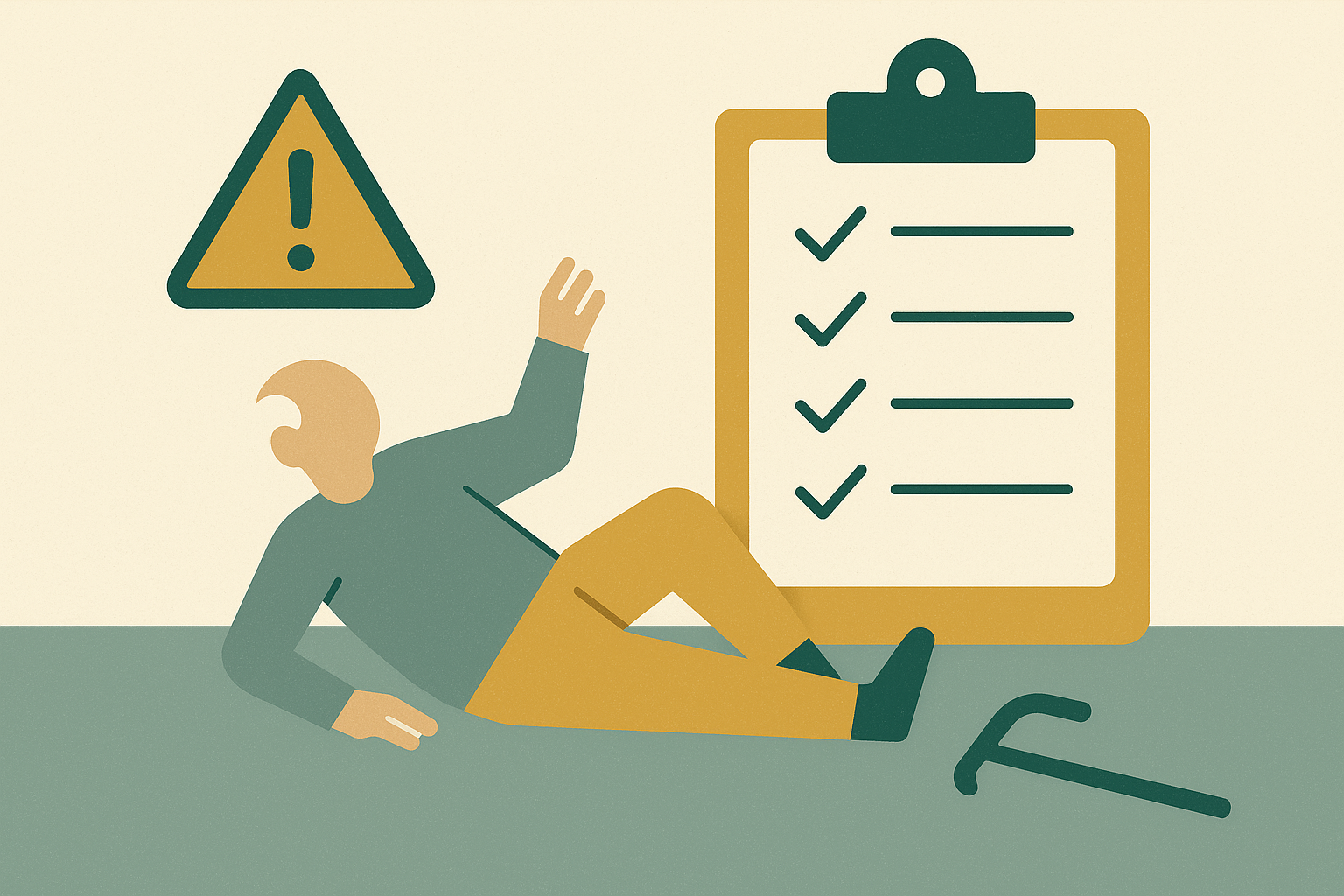
A fall that goes uninvestigated properly doesn't just risk another fall. It compounds into survey deficiencies, MDS underreporting exposure, and a hit to the facility's public rating, all from a single missed step in documentation. Skilled nursing facilities need a structured, time-sequenced approach to fall investigation, because a loose narrative written after the fact cannot survive the regulatory scrutiny now aimed at this exact area. Nearly all falls happen with no one watching, and that changes what the paperwork is for: it isn't a summary of the evidence, it is the evidence.
The regulatory environment that makes the checklist a compliance instrument, not just a clinical one
A federal watchdog agency's report found that nursing homes failed to report 43% of falls with major injury in resident MDS assessments, a figure drawn from a review of 42,236 cases in which 18,369 went unreported. For-profit facilities, chain-affiliated homes, and larger nursing homes showed the highest underreporting rates. The state-level spread rules out coincidence: South Dakota underreported 21% of qualifying falls, while facilities in Washington, DC underreported 64%. A gap that size, moving in that direction across ownership type and geography, is a pattern, not noise in the data.
The OIG's own language stays careful, but the implication isn't subtle. Facilities may have a disincentive to report falls with major injuries, since doing so lowers public quality scores on CMS Care Compare, and the report notes that underreporting clustered most heavily among facility types that would plausibly want to protect those scores. The report stops short of naming motive. The clustering does that work on its own.
This sits inside a broader tightening. The OIG's active workplan for 2025 and 2026 names falls reporting accuracy as a target, alongside inappropriate use and reporting of antipsychotic medications. The November 2024 Nursing Facility Industry-Specific Compliance Guidance, the first industry-specific guidance issued under the updated November 2023 General Compliance Program Guidance framework, gives facilities a written standard to be measured against. CMS's State Operations Manual update, QSO-26-03-NH, originally slated for a March 30, 2026 effective date and since pushed to April 30, 2026, tightens surveyor investigation procedures and expands the agency's ability to impose per-instance and per-day civil monetary penalties, aligned with the FY 2025 SNF PPS final rule.
The Special Focus Facility program adds another layer. CMS revised QSO-23-01-NH in late January 2026 to shift SFF selection criteria away from staffing and toward falls, a direct signal that fall documentation now functions as a primary filter for the most intensive layer of regulatory scrutiny a facility can face.
When a surveyor arrives after a fall-related complaint, two F-tags dominate the file review. F689, Free of Accident Hazards, Supervision, and Devices, ties directly to the root cause analysis obligations built into CMS's Phase 3 Requirements of Participation. F656, Comprehensive Care Plans, gets cited nationally most often for plans that no longer reflect a resident's current status, not for plans that are simply missing. Surveyors also cross-check fall logs against hospital transfer records and Medicare claims data. A mismatch between what the facility logged and what actually happened can trigger a deficiency citation or an OIG referral for falsification.
An industry trade association has pushed back on parts of the watchdog agency's framing, pointing to gaps in hospital-to-nursing-home data communication as a contributing factor to underreporting. Information does get lost in the handoff between settings, and that much is fair. It does nothing, though, to reduce the facility's obligation to document what happened on its own watch.
What root cause analysis requires under F689, and how most facilities fall short
CMS's Phase 3 Requirements of Participation establish root cause analysis as the expected response after a fall, a systemic investigation that goes well beyond filling out an incident report. CMS's own RCA guidance tool notes that its use "is not mandated by CMS," a distinction that matters more than it sounds like it should. An incident report describes what happened. Root cause analysis asks why the system let it happen, and those are two different documents built for two different jobs. Confusing them is the single most common failure point in this whole process, and fixing it first, before anything else on this list, is the priority.
The systems-thinking framework behind RCA moves deliberately away from blaming the resident or the aide on shift and toward identifying structural contributors: medication issues, environmental hazards, staffing and supervision gaps, breakdowns in communication between shifts, and gaps in the care plan itself. Training content aligned with CMS, AHRQ, and related fall prevention guidance consistently identifies these categories as common system-level root causes found in nursing homes.
The Oregon Patient Safety Commission's Nursing Home Expert Panel produced a Falls Investigation Guide Toolkit in 2022, cited by AHRQ, that applies RCA methodology specifically to this setting. RCA in long-term care isn't a vague regulatory buzzword borrowed from hospital safety programs. It has an established, expert-vetted methodology behind it, one facilities can build from rather than reinventing an investigation process from scratch every time a resident goes down.
The gap appears in the same place almost every time: facilities complete the incident report, file it, and treat the investigation as closed, but the incident report was never meant to serve as the investigation. Under the updated Long-Term Care Survey Process, effective April 28, 2025, surveyors are trained to look past the narrative and ask for documented causal analysis. A well-written account of what happened at 2:14 a.m. is not the same as an account of why the system allowed it to happen, and treating the two as interchangeable is exactly the mistake surveyors are now trained to catch. Findings from the RCA have to feed into the facility's QAPI program, too. A fall investigation that never reaches quality improvement review hasn't closed the loop, no matter how thorough the paperwork looks sitting in its own folder.
The unwitnessed nature of most falls makes this harder, not easier. When no one saw the resident go down, RCA has to reconstruct probable causation from environmental assessment, medication history, staffing patterns at the time, and the resident's own functional trajectory. Each of those domains needs its own structured prompt in the investigation checklist, because none of them becomes visible without deliberate review.
Immediate response steps: what must happen in the first minutes after a fall is discovered
The resident should not be moved until injury assessment is complete. Document position, location, and surrounding environment exactly as found, before anyone straightens a chair or picks up a walker.
Clinical assessment in those first minutes has to cover level of consciousness and orientation, vital signs, visible injury (lacerations, deformity, swelling, bruising), pain complaint and its location, and a basic neurological screen: grip strength, pupil response, slurred speech. Any loss of consciousness, even a few seconds, escalates the entire response protocol regardless of how alert the resident appears moments later.
The attending physician or on-call provider needs notification immediately, and the time of that call along with the provider's response should be documented close to verbatim. The responsible party or family gets notified per facility policy and whatever state-specific timeline applies, with the time and content of that conversation recorded as well.
The scene itself is evidence, and it should be treated that way before anything gets moved or corrected. Photograph footwear, assistive devices, lighting conditions, floor surface, and furniture proximity. Identify and secure any witnesses, staff, other residents, visitors, while memory is still fresh. Given that most falls happen unwitnessed, the absence of a witness is itself a fact facilities have to document explicitly, not a gap they can leave silent.
Before writing the incident report, pull the resident's current care plan, the most recent fall risk assessment, and the last nursing note. That context turns the report into something that reflects the resident's actual care trajectory, rather than a snapshot of one isolated event floating with no history attached.
Incident report and MDS documentation: the fields that determine regulatory exposure
The incident report needs exact date, time, and location, not approximations. It needs the discovery circumstances: who found the resident, what position they were in, what the resident said happened. Injury severity has to carry clinical specificity. "No apparent injury" means nothing on its own unless the assessment components behind that conclusion are spelled out.
The report should capture immediate interventions and who performed them, physician notification with the time, the provider's name, and any orders given, and family notification with the time, the name of the person contacted, and what was communicated. Witnesses get named, or the report states explicitly that the fall was unwitnessed.
CMS requires every fall, and the severity of any resulting injury, to be reported in the resident's MDS assessment. That requirement is the exact data source the OIG used to identify its 43% underreporting finding. Under the LTCSP update effective April 28, 2025, MDS coding accuracy now falls under explicit surveyor review through F641. A fall coded incorrectly, or not coded at all, is a compliance finding on its own, separate from whatever clinical care the resident actually received.
The OIG's 2025 report makes a point surveyors are now primed to act on: facilities with unusually low self-reported fall rates on Care Compare are the ones most likely to be underreporting. A low number used to read as a strength. It now reads as a flag, and facilities that built a marketing pitch around a clean fall record should expect a surveyor to ask why the number looks the way it does.
When a resident gets transferred to a hospital, the facility has to retain the hospital's discharge summary and reconcile it against its own MDS coding. AHCA has noted that gaps in hospital-to-SNF communication contribute to underreporting, and that's a real operational problem. Closing that gap is still the facility's job, though, not an excuse it gets to cite when the record falls short. Failure to meet SNF QRP reporting requirements carries payment consequences, and that exposure remains whether or not the facility can explain the gap.
Who is in the room and what the team must determine during the 24–72 hour post-fall huddle
Best practice calls for an interdisciplinary huddle promptly after the fall, with relevant clinical and operational staff present. This is a structured inquiry with a specific agenda, distinct from a debrief where people compare notes and move on to the next task.
Pharmacy has to walk through recent medication changes, sedating agents, antihypertensives, diuretics, and the resident's overall polypharmacy burden, and that review requires an actual presence in the room. Maintenance and nursing together cover the environmental picture: was the scene photographed, what did the floor surface and lighting look like, was the call light within reach, what was the bed height, what was the resident wearing on their feet.
Staffing context matters just as much. What was the staffing pattern at the time of the fall? Was the resident on a toileting schedule, and was a bed or chair alarm in place and functioning? Therapy weighs in on whether the resident's gait, transfer ability, or functional status had shifted recently, and whether a reassessment was already overdue. Dietary covers hydration and nutrition, since dehydration keeps appearing as a documented contributing factor in fall events.
Everything discussed in the huddle gets documented: who attended, what was reviewed, what got decided. That record becomes part of the RCA file, and it's exactly the document a surveyor asks to see first. When the fall was unwitnessed, which is the more likely scenario, the huddle carries even more weight, because the team has to reconstruct a probable sequence of events from environmental and clinical evidence alone, and that reconstruction needs to land on paper rather than stay as a shared understanding among people who were in the room.
The OIG's 2025 report found that facilities with lower nurse staffing levels and lower quality ratings had higher fall rates. That finding belongs on the huddle agenda directly. Surveyors will ask whether staffing was a contributing factor regardless of whether the facility raises it first, so a huddle record with no staffing discussion in it reads as an omission rather than a neutral silence.
Root cause analysis documentation: moving from "what happened" to "why the system allowed it"
RCA has to exist as a written document that names contributing factors specifically.
A properly structured RCA identifies the triggering factor first: the thing that immediately preceded the fall, such as an unsupported transfer attempt, a trip hazard, or an orthostatic event. From there it works through contributing factors by domain: resident factors like cognitive status, functional mobility, fall history, and any recent diagnosis changes; medication factors, including anything altered in the prior 30 days and any high-risk drug classes in the resident's regimen; environmental factors drawn from the scene assessment and maintenance's findings; care plan factors, meaning whether the fall risk assessment on file was even accurate and whether the existing interventions were actually being carried out and documented as such; and staffing factors, covering coverage levels, assignment continuity, and how well information moved across shift handoffs.
The document has to land on a system-level finding: the specific process or policy gap that let those contributing factors line up the way they did. That's what separates a root cause analysis from a well-written incident report. The Oregon Patient Safety Commission's 2022 toolkit, referenced through AHRQ's PSNet, offers a structured methodology for exactly this kind of analysis in the nursing home setting, and citing a recognized expert-panel framework gives the facility's documentation firmer footing than an internal template built without outside grounding.
Surveyors flag a handful of failures over and over, and the worst one is naming "resident ambulated without assistance" as the root cause. Resident behavior isn't a system-level root cause, it's the outcome the system was supposed to catch, and any RCA that stops there has misidentified the entire exercise. An RCA that names a root cause but proposes no corrective action has done half the job. An RCA completed days after the fall, with no explanation for the delay, raises its own red flag: timeliness isn't a courtesy here. The updated SOM guidance under QSO-26-03-NH reflects an accelerated expectation industry-wide, and where immediate jeopardy may be present, state agencies now have to begin an on-site investigation within three business days.
Care plan revision: the documentation step that closes the investigation loop
F656 remains one of the most cited F-tags nationally, and the most common problem is a care plan that no longer reflects where the resident actually is. A fall that produces a thorough RCA but no matching care plan update is, in effect, a self-inflicted deficiency: the facility identified a risk factor in writing and then left it unaddressed in the resident's plan of care.
Revising the care plan after a fall means updating the fall risk score with the post-fall assessment findings and adding or revising an intervention for each identified contributing factor, one intervention per root cause at minimum. Each intervention needs a responsible discipline attached to it and a specific review date, not "as needed" sitting where a date belongs. Resident and family involvement in the care plan discussion needs its own documentation. If a new therapy order came out of the process, the order, its rationale, and the start date all need to be on record. The same goes for any environmental modification (what changed, when, and who made the change) and for any medication adjustment (the pharmacy's recommendation, the physician's order, and the date administration actually started).
MDS timing matters here too. The care plan revision needs to show up by the next MDS assessment reference date, and MDS coding that predates a known fall without a corresponding update is a specific audit flag under the 2025 LTCSP guidelines. The care plan revision is the resident-level record of what changed. It feeds directly into the facility-level QAPI review, and both records need to tell the same story, not two versions that a surveyor has to reconcile by hand.
QAPI integration: turning an individual fall investigation into facility-wide prevention intelligence
A single fall investigation, done well, tells a facility something about one resident on one night. Fed into QAPI, that same investigation becomes a data point in a much larger pattern. The RCA process multiplies in value the moment findings from individual falls get aggregated rather than filed away and forgotten.
QAPI review should be asking whether the same contributing factors keep appearing across different residents and different units. Medication-related falls clustered around a particular drug class, environmental hazards repeating in the same hallway or bathroom, staffing gaps that occur during the same shift pattern week after week: none of that is visible from a single incident report, but it becomes visible fast once RCA findings get pooled and reviewed as a set. That aggregation is what CMS expects to see evidence of, and it's the clearest way a facility can demonstrate a measurable reduction in its fall rate over time, rather than simply asserting one in a policy binder no one has opened since the last survey.
The regulatory environment described earlier in this piece is not going to loosen. The OIG has falls reporting accuracy on its active workplan through 2026, the SFF program now uses falls as a selection criterion, and surveyor guidance keeps sharpening its focus on causal documentation over narrative description. Facilities that treat the post-fall checklist as paperwork overhead are choosing, functionally, to face four channels of exposure at once: clinical, documentary, regulatory, and reputational, with no defense prepared for any of them. Facilities that treat it as the defense it actually is will have something to hand a surveyor, a family member, or an OIG auditor when the question comes: not just what happened, but what the facility did about it, and what changed so it doesn't happen the same way twice.