Medication Error Root Cause Categories in Skilled Nursing Facilities
Preventable medication errors harm one in ten SNF residents daily.
One in ten residents of a skilled nursing facility suffers a medication-related injury on any given day of their stay. That is the baseline condition of long-term care as it operates today, not a projection or a worst-case scenario, and it is the fact every other claim in this piece has to answer to. It is the baseline condition of long-term care as it operates today, and it is the fact every other claim in this piece has to answer to.
An oversight agency has looked at this problem more than once, and the numbers do not move in a comforting direction. One OIG review found that 37% of Medicare SNF residents experienced a harmful medication-related event within the first 35 days of their stay. A separate OIG study, looking at the same general population through a different lens, put adverse events at 22% and near-misses at another 11%, meaning roughly a third of residents were either harmed or one step away from it. Of the most severe injuries in that population, the ones involving internal bleeding or death, 73% were judged preventable. Not unavoidable complications of frail bodies on complicated drug regimens. Preventable.
The financial estimate attached to this problem, drawn from older patent and industry documentation, put the annual cost of medication-error injuries in long-term care as high as $32.8 billion. Treat that figure as directional rather than current, since it comes from legacy sourcing, but the direction it points in has not reversed. The daily toll persists because the errors that produce it do not come from one broken step. They come from five.
The five-stage medication pathway where errors enter the SNF
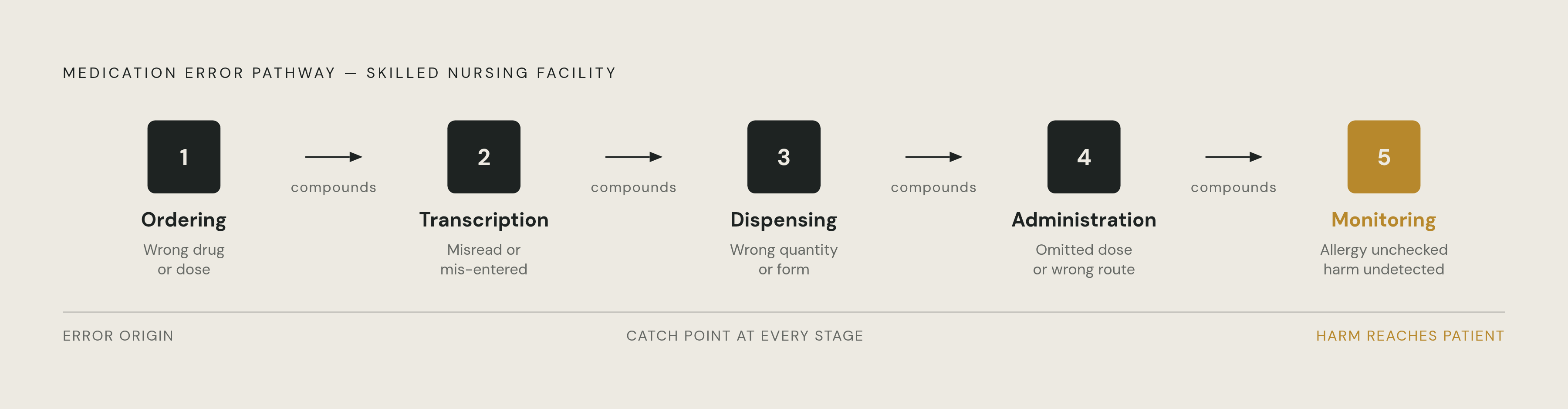
A medication error, by the standard clinical definition, is any error of commission or omission that occurs at any point between a prescriber's decision and the moment a resident actually receives the drug. That span breaks into five stages: ordering, transcription, dispensing, administration, and monitoring. Each stage has its own failure modes, its own staff roles, and, critically, its own opportunity to either catch a mistake made upstream or add a new one on top of it.
Two error types run through all five stages regardless of where they occur. A commission error means something was done and done wrong, involving the wrong drug, the wrong dose, or the wrong route into the body. An omission error means something that should have happened simply didn't happen, such as a dose never given, an allergy never checked, or a side effect noticed but never acted on. Both types appear at every stage, which is part of why root-cause work in this space resists simple fixes.
What makes this taxonomy especially relevant to skilled nursing, as opposed to a hospital ward, comes down to structure. SNFs routinely operate with multiple outside prescribers, pharmacy services contracted from off-site vendors, medication administration delegated to staff who are not licensed nurses, and electronic health record systems that do not talk to the hospital or physician-practice systems feeding them information. Acute care has its own error rates, but it tends to have one integrated chart and one pharmacy under one roof. SNFs frequently have neither. An error introduced at stage one doesn't just persist. It compounds as it moves through stages two, three, four, and five, each one adding its own layer of distortion to what the prescriber actually intended.
Ordering errors: how polypharmacy and multiple prescribers set the stage
Most SNF residents live with more than one chronic condition, and their medication regimens reflect that. Polypharmacy is the operating condition in long-term care, not the exception. It's the operating condition. The clinical concern isn't the number of drugs by itself but what's called inappropriate polypharmacy: medications prescribed that are no longer needed, that fail to accomplish their therapeutic goal, or that raise the resident's risk of an adverse drug reaction without a matching clinical benefit.
Multiple prescribers make this worse in a specific, mechanical way. An attending physician, one or more specialists, and a hospitalist writing discharge orders can all touch the same resident's chart without any of them holding the complete picture of what the others have ordered. Fragmented ordering is what happens structurally when no single person owns the whole medication list. It's what happens structurally when no single person owns the whole medication list.
The risk concentrates, too. A 2024 study examining 19 high-alert medication classes identified 101 observed or anticipated common-cause errors tied to those drugs, with a median of five distinct error types per class and an interquartile range of three to six. That's a meaningful finding: ordering risk in SNFs isn't spread evenly across every drug a resident takes. It clusters in a relatively narrow band of high-alert categories, the exact categories SNF residents are disproportionately prescribed.
Transcription errors: what happens between the prescriber's intent and the medication administration record
Transcription is the bridge between what a prescriber meant and what ends up on the medication administration record, and bridges are where things fall. A correctly written order can turn into a dangerous one through nothing more dramatic than a data-entry mistake, illegible handwriting in facilities still running paper-hybrid systems, or a missed allergy notation that never made it into the new record.
Electronic health records were supposed to close this gap, and in some ways they have. But SNF EHRs and hospital or physician-practice EHRs often don't integrate cleanly, and the discharge-related medication errors that persist despite growing EHR adoption trace directly to that silo. SNF staff can end up receiving an incomplete or simply inaccurate medication list and treating it as a verified order, because there's no mechanism forcing a second check against the source.
Once an inaccurate entry lands in the record, it tends to stay there. Therapeutic duplications, missed opportunities to deprescribe, dosage errors, medications that are no longer clinically indicated at all: these carry forward silently, often traceable to reconciliation and documentation failures that occurred at or before the resident was admitted. Incorrect transcription of an order is one of the more direct and well-documented causes of incorrect medication administration further down the line.
Transitions of care as the highest-density error window
Discharge from a hospital to a SNF is a convergence point where every upstream error shows up at once, not a single event with a single point of failure. Every upstream error appears at this convergence point at once: an incomplete pre-admission medication list, new drugs added at the last minute, existing drugs dropped without documentation, dosages changed with no note explaining why.
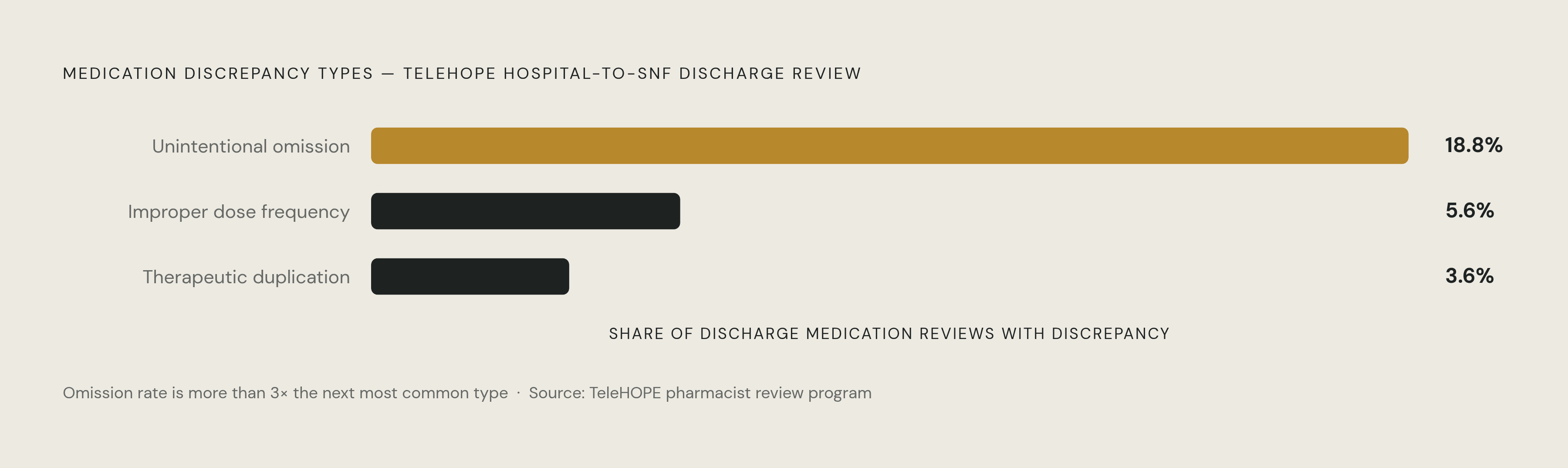
Data from the TeleHOPE pharmacist review program at hospital-to-SNF discharge makes the shape of this problem visible. The most common discrepancy identified was unintentional omission, at 18.8%, followed by improper dose frequency at 5.6% and therapeutic duplication at 3.6%. Omission dominates. It isn't close: omission dominates the other discrepancy types by a wide margin. Dose omissions are consistently the most common medication error during transitions into nursing home care, and the range of error types found in that data suggests no single fix, no one new form or checklist, is going to solve it on its own. Multifaceted intervention is the phrase the research points to, meaning several coordinated changes, not one.
One approach tested through an AHRQ-funded randomized controlled trial used pharmacy-integrated transitional care teams: structured handoffs between clinical teams paired with a pharmacist actively monitoring medications through the transition window. The approach is designed to cut down on transition-related medication problems by pairing structured handoffs with active pharmacist oversight, though standardizing it across an industry this fragmented is its own separate challenge.
Administration errors: the human and organizational conditions that produce them at the bedside
Administration errors get taught early in nursing education as the "five rights": right drug, right dose, right route, right time, right patient. Getting all five correct, every time, for every resident, sounds simple until you look at the conditions SNFs actually operate under.
Several conditions specific to skilled nursing make administration harder than the five-rights framework suggests. Drug administration may be delegated to staff who are not licensed nurses, a practice that concentrates risk at the exact point where the drug meets the resident. Abandonment of routine, plain carelessness or a deviation from established procedure under time pressure also occurs. So does a lack of knowledge: staff not fully understanding the particular handling requirements of a specific drug. Verbal communication breakdowns between colleagues, not just at shift change but within a single shift, contribute their own share. A lack of properly designed tools built without input from the people who use them daily compounds the rest.
Above the level of any single nurse's judgment sit organizational hazards: how well a facility controls delegation, what its education standards actually require, and how strong its safety culture is day to day. Staffing is the underlying factor that amplifies all of it, producing organizational hazards seen in how well a facility controls delegation, what its education standards actually require, and how strong its safety culture is day to day. Registered nurses in many facilities simply cannot get to every resident who needs assisted medication administration on a given day, and that coverage gap is a persistent, structural risk factor at the administration stage, not an occasional lapse.
Monitoring errors: the category that turns a recoverable mistake into a serious injury
Monitoring is the last gate. If a wrong drug or wrong dose has already reached a resident, timely monitoring is what stands between that mistake and a serious injury. When monitoring fails, a recoverable error becomes an adverse drug event, and whether that happens often comes down to whether anyone noticed in time.
Monitoring failures take a few recognizable forms: side effects that go unobserved, therapeutic failure that goes undetected, vital sign changes that go unacted on, behavioral changes that signal drug toxicity but never get escalated to anyone who could intervene. High-alert medications, anticoagulants, insulin, opioids, psychotropics, sit at the center of this concern because the margin between a therapeutic dose and a harmful one is narrow, and deterioration in a frail resident can happen fast.
CMS has taken direct aim at part of this problem for 2025. Updated guidance tightens monitoring requirements specifically for psychotropic medications, now requiring facilities to obtain resident consent for every psychotropic medication or dose change. That raises the documentation burden meaningfully at the monitoring stage, and it signals that regulators view oversight of this drug class as a compliance priority.
How unstructured clinical notes trap monitoring and early-warning data
Nurses already write down most of what monitoring is supposed to catch. Behavioral changes, pain complaints, a resident refusing a medication, a vital sign drifting out of range: this gets documented. The problem isn't that the observation never happened. The problem is where it gets written down.
Free-text clinical notes are not searchable in any systematic way, they don't aggregate across residents, and they are effectively invisible to a nursing manager trying to review ten or twenty residents at once during a shift. The intelligence exists inside the chart. It's just functionally inaccessible to anyone who isn't reading that specific note at that specific moment.
Electronic health record systems used across long-term care are where this documentation lives, and the gap is a data accessibility problem. It's a data accessibility problem. Early signals, a behavioral shift, the beginning of skin breakdown, a decline in hydration, get written down and then effectively lost inside a note nobody aggregates or searches. They tend to resurface only when a surveyor arrives, a family member complains, or a hospitalization forces a retrospective chart review, which is to say: after the harm has already occurred.
Capabilities of Predictive Risk Tools Beyond Retrospective Chart Review
Predictive risk stratification takes data that already exists, comorbidities, prior hospitalizations, functional status, polypharmacy burden, and uses it to flag high-risk residents within 24 to 48 hours of admission to a SNF. That timing matters. It moves the intervention point from after an adverse event to before one, which retrospective chart review, by definition, cannot do.
The goal is concrete: to identify which residents need closer monitoring, earlier visits from a physician or nurse practitioner, and a care plan built around their specific risk profile before their condition escalates. It's to identify which residents need closer monitoring, earlier visits from a physician or nurse practitioner, and a care plan built around their specific risk profile before their condition escalates into something harder to reverse. That's the proactive complement to the monitoring failure described above: catching the resident who's about to deteriorate instead of documenting that they already did.
The core components of proactive risk management in this space are medication management systems that track prescriptions, monitor dosing, and flag dangerous drug interactions, paired with predictive algorithms and continuous vital sign monitoring. Predictive, EHR-embedded AI has moved fast in acute care, with 71% of hospitals in one country reporting its use integrated with their EHR in 2024. hospitals reported using predictive AI integrated with their EHR in 2024. Skilled nursing has not kept pace with that adoption curve. The setting with arguably the highest daily medication-error burden is also the setting furthest behind on the tools built to catch it early.
The compliance stakes: how CMS 2025 updates connect directly to each root cause category
CMS revised Appendix PP for long-term care facilities across a series of updates issued in November 2024, January 2025, and March 2025, with implementation beginning April 28, 2025. The revisions touch staffing, infection control, psychotropic medication use, QAPI, and the MDS, and none of it sits apart from the five-stage error pathway described above. It maps onto it directly.
At the ordering stage, F605, which now consolidates what was formerly F758, tightens scrutiny of unnecessary psychotropic use, including sedation practices that regulators have flagged as a recurring source of harm. It's a regulatory response to a root cause that has been documented in ordering-stage error data for years, not a new concern invented for 2025: prescribing decisions made without full visibility into what else a resident is already taking. It's a regulatory response to a root cause that has been documented in ordering-stage error data for years: prescribing decisions that may lack full coordination across multiple prescribers managing the same resident.
The throughline across every stage in this piece, ordering, transcription, transitions, administration, and monitoring, is the same: errors cluster where information is fragmented and where no single actor holds the complete picture. CMS's 2025 updates don't fix that fragmentation by themselves. But they do put a regulatory floor under facilities that have been treating monitoring and documentation as a paperwork exercise rather than the last line of defense between a mistake and a preventable injury.
Sources
- Root Cause Analysis of Medical Errors and Prevention Strategies
- Errors linked to medication management in nursing homes: an interview study
- Errors linked to medication management in nursing homes: an interview study | BMC Nursing | Springer Nature Link
- Effects of skilled nursing facility structure and process factors on medication errors during nursing home admission. | PSNet
- cms.gov
- cms.gov
- psnet.ahrq.gov
- frontiersin.org