Time Audit for Nursing Managers in Skilled Nursing Facilities
Audit reveals administrative tasks consume time meant for resident oversight and staff supervision.
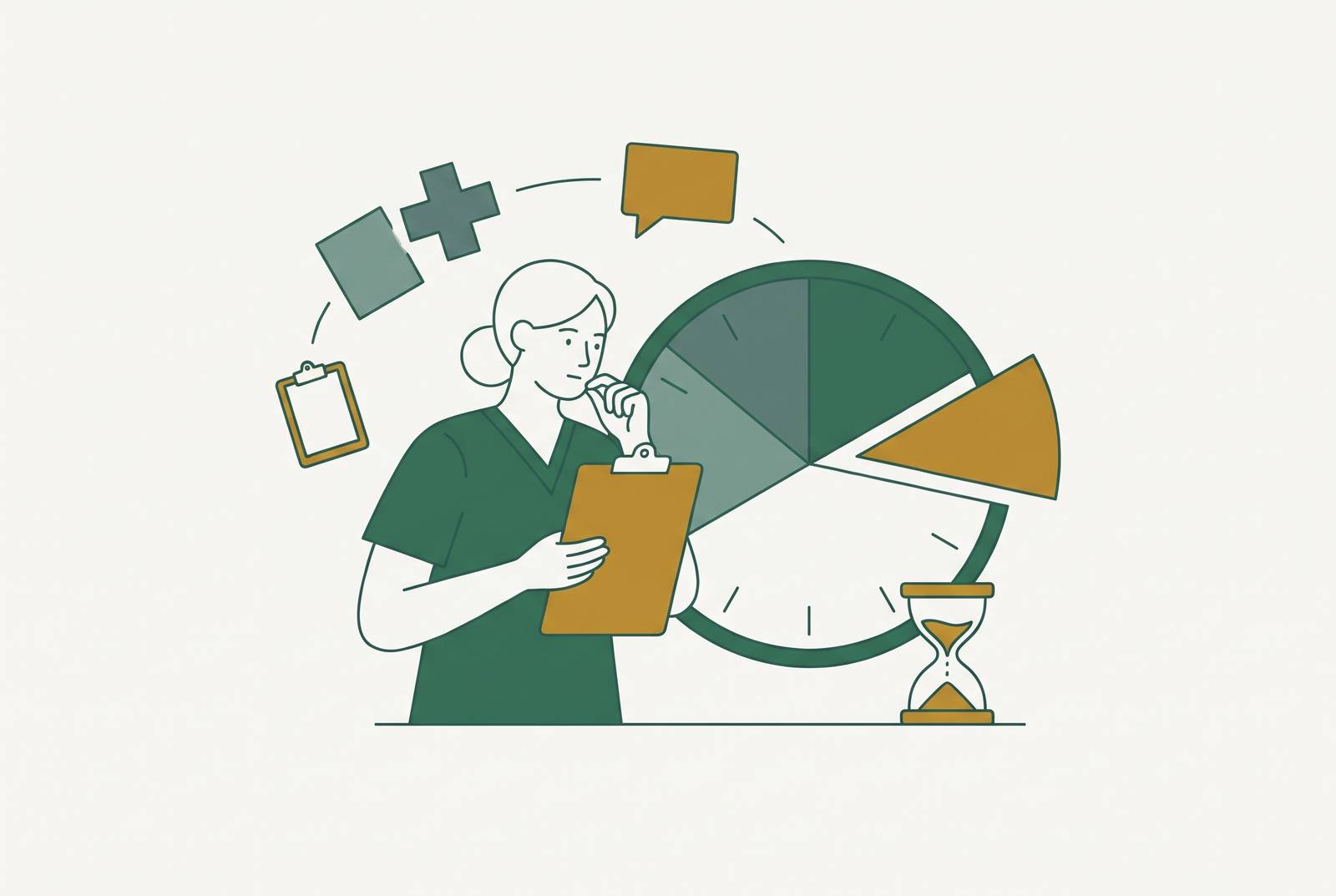
A time audit for nursing managers in skilled nursing facilities reveals a structural imbalance. Administrative and documentation tasks consume the majority of available hours, displacing clinical oversight, staff supervision, and resident-focused work. Mapping that imbalance shows where workflows create regulatory exposure and delay clinical attention. It is the first step toward reclaiming time without transferring the documentation burden to frontline nurses.
How nursing manager time actually splits across a typical SNF shift
Nursing managers are responsible for resident observation, clinical oversight, staff supervision, and the coordination of care. Their shifts, however, are dominated by administrative and documentation tasks. Charting, care plan updates, staffing records, and compliance work compete with rounding and supervisory responsibilities for the same available hours. Documentation alone consumes a substantial portion of a long-term care shift. The practical distribution of time therefore differs from the role’s clinical purpose before an incident or complaint adds another demand.
That imbalance reflects workflow design. Managers must meet obligations across clinical, staffing, billing, and regulatory functions, even when those obligations draw them away from residents. As documentation takes longer, observation and supervision have less room in the shift. These responsibilities remain part of the job, but the time available to perform them contracts. A time audit begins with that distinction between assigned responsibility and actual activity, rather than an assumption that the manager needs to work faster.
Why documentation keeps expanding even when facilities add technology
Documentation expands because new obligations accumulate faster than older tasks disappear. MDS accuracy, Section GG coding, PBJ hour tracking, and care plan updates each require distinct work, with their own formats and schedules. Adding EHR capabilities does not, on its own, remove any of those requirements. A manager may be working from the same clinical record while still having to prepare information separately for care coordination, reporting, and compliance.
The central difficulty is the form of the information. Nurses record clinically meaningful observations about behavior, mobility, skin changes, and hydration in free-text notes. Reporting tools and risk models that read structured fields do not necessarily make those observations visible. Managers must then extract, reconcile, or re-enter information that is already in the chart. The documentation exists, but its format prevents it from serving the next task without additional human effort.
Before a manager can assess a resident’s trend or reconcile a reporting discrepancy, the relevant observations must be located and brought together. Where added technology leaves this gap intact, it can expand the number of fields and reports without reducing the effort required to understand the resident’s condition.
What the current regulatory environment adds to an already overloaded schedule
CMS launched the SNF Validation Program in September 2025 to assess whether MDS-based quality measure data used in the Quality Reporting Program (QRP) and Value-Based Purchasing (VBP) Program matches the clinical record. Healthcare Management Solutions, LLC (HMS) manages the process. Under the 2025 Final Rule, beginning in FY 2027, CMS will randomly select a significant share of SNFs each year. Facilities that are selected must send up to 10 complete medical records within 45 days. Incomplete or late submission results in reduced Medicare Part A reimbursement for that fiscal year, with no partial credit.
This creates exposure across different parts of the chart. Section GG coding that records a resident as “independent” conflicts with a therapy discharge note recording “moderate assist.” Cross-verification makes that discrepancy visible even when the entries sit in different documentation workflows. The immediate submission requirement is completeness and timeliness. CMS has indicated that accuracy thresholds may be added through future rulemaking, so the submission penalty should not be confused with a current accuracy-based penalty.
CMS also requires PBJ hours to be categorized by job role and submitted quarterly. Its memo QSO-26-12-NH identifies the August 14, 2026, Fiscal Quarter 3 filing deadline as the last through the legacy QIES system, with submission moving to iQIES. The PBJ data specification changes to version 4.10.0 on April 1, 2026. These changes affect the same filing window.
OIG’s Nursing Facility Industry Segment-Specific Compliance Program Guidance, released in November 2024, identifies quality of care and quality of life as primary compliance risk areas. Together with its General Compliance Program Guidance, it provides voluntary guidance for identifying risks and maintaining an effective compliance program. OIG’s medical director audit also checks whether the PBJ time reported matches the duties that must be performed. That audit makes the logical scrutiny explicit because attributed time is defensible only when it corresponds to actual work.
What a time audit for a nursing manager actually measures and how to conduct one
To respond to that scrutiny, facilities should treat the time audit as a diagnostic. Its purpose is to map actual shift activity against the work the nursing manager role is designed to perform. The record must distinguish clinical attention from the administrative work that supports or displaces it. Total hours alone cannot show that distinction. Every hour in a shift may be accounted for even when too little time went to resident observation or staff supervision.
The audit should capture direct resident observation and rounding, clinical documentation and charting, and staff supervision and communication as distinct categories. Administrative tasks should include scheduling, payroll reconciliation, PBJ data verification, and audit response. The category for reactive triage should include incident response, complaint handling, and family calls. These categories make different demands visible without treating all desk-based work as interchangeable. They also allow the facility to connect reported supervisory or clinical time to the activity actually performed.
Within those categories, the audit should distinguish proactive work from reactive response. This is its most revealing comparison. A manager may spend substantial time outside documentation yet use most of it responding to incidents. The record should also expose manual reconciliation of existing EHR information, repeated entry from narrative notes into structured forms, and rounds shortened or deferred when documentation runs over. Those findings show both which task took up clinical time and which workflow caused that time to be lost.
Hours attributed to supervision or clinical oversight should be traceable to those functions, just as external scrutiny asks whether reported hours reflect actual work. The internal audit approaches that question from the workflow side. It shows whether the facility has allocated time to its obligations in practice, and where documentation or response demands prevent the manager from fulfilling them.
Where the audit consistently finds the biggest gaps in documentation, compliance prep, and reactive triage
Documentation duplication is the largest single driver of avoidable administrative work. Managers extract observations from narrative notes and put them into formats that reporting tools can use. This is the repeated processing of information already recorded, with each reconciliation taking time that could otherwise support oversight. An audit makes that repetition visible as a workflow cost rather than allowing it to disappear within a broad charting category.
Compliance preparation creates a different pattern of lost time. Work intensifies around surveys, when documents are uploaded, a Plan of Correction is written under deadline, and gaps are logged and assigned. Between surveys, the monitoring that would identify the same gaps earlier may be absent. The preparation spike then recurs before the next survey. This surge pattern is poorly aligned with cross-verification, because MDS submissions must agree with the supporting clinical record when audited.
Reactive triage can become the most time-consuming and clinically costly demand on the shift. Falls, medication errors, skin wounds, and behavioral incidents require attention after they escalate. At the same time, nursing notes may already show gradual mobility changes, hydration trends, and subtle behavioral changes. Where managers spend their available clinical hours responding to events, the audit exposes a timing gap: too little opportunity to review the signals that preceded them.
These patterns recur because they reinforce one another. Manual reconciliation leaves less time for proactive review, while incidents bring more work to respond and document what happened. Preparing for surveys adds another demand on time without giving managers an ongoing view of risk. The audit’s value lies in separating these mechanisms. A facility cannot address repeated data entry, episodic compliance work, and delayed clinical attention as though they were a single scheduling problem.
What the time audit reveals about clinical risk: the hours that aren't being spent on residents
Hours absorbed by administrative work are unavailable for observation, trend monitoring, and staff coaching. That displacement has a clinical consequence. Subtle behavioral changes, gradual mobility shifts, respiratory variations, and changes in hydration or skin integrity may be recorded without being brought together for managerial review. An individual note can describe a small change while a series of notes reveals deterioration. When the manager lacks time or visibility to recognize the pattern, the opportunity for earlier attention narrows.
Single-trigger alerts do not necessarily close that gap. A high temperature, a blood pressure reading, or a fall event can prompt a response after the clinical situation has escalated. Earlier signals may be left in narrative notes that structured-field systems cannot read. The resulting incident then requires additional documentation and coordination.
Signature Healthcare’s experience with fall prevention AI illustrates the importance of earlier signals. Machine learning monitored resident movement and provided earlier notification to staff, the reported mechanism behind the substantial decrease in falls that clinical teams saw in buildings where the system was implemented. Clinical information has greater preventive value when staff receive it before an event requires response.
NYU Langone researchers developed a model using natural language processing on physician notes to predict the need for skilled nursing care at discharge with high accuracy. The assessments that nurse case managers made on their own closely matched the model’s risk scores. This addresses discharge planning rather than fall prevention. Its relevance is that useful clinical information existed in narrative documentation and could support professional judgment when surfaced. For SNF managers, missed signals connect the allocation of time directly to quality-of-care exposure, including the risk of citations when clinical needs are not recognized and addressed.
How to use time audit findings to restructure nursing manager priorities
Facility operators should change the workflow identified by the audit. Where repeated entry consumes time, the response is to identify information already present in narrative nursing notes and eliminate or automate the re-entry step. The information does not need to be generated again. Any solution should use documentation already in place to give managers a clearer view of care while cutting administrative work and avoiding more charting.
Where compliance preparation comes in bursts, regular review should take the place of pre-survey sprints. Falls, skin integrity, medication patterns, hydration, and behavioral changes belong in the weekly management cadence. Where reactive triage dominates, a standing review of resident risk signals should shift supervisory attention earlier in the clinical timeline. Those signals should come from existing documentation. The objective is to restore time for clinical judgment.
OIG’s guidance supports routine auditing, monitoring, reassessment, and corrective action as continuous functions. CMS’s Risk-Based Survey process similarly directs more survey resources toward facilities where residents face greater health and safety risks while streamlining surveys for high-performing facilities. A time audit identifies whether management work supports the continuous oversight needed to address those risks, and where changes are required.
The governing constraint is that frontline nurses cannot absorb new documentation requirements as the price of recovering managerial time. A facility that knows where its nursing manager hours go can close the gap between the role’s clinical purpose and its daily demands. The audit provides the basis for a sustainable role and a defensible facility, with clinical intelligence drawn from documentation that already exists.