Resident Risk Stratification Models for Nursing Manager Rounding Priority
NLP can extract deterioration signals buried in nursing notes that traditional risk models miss.
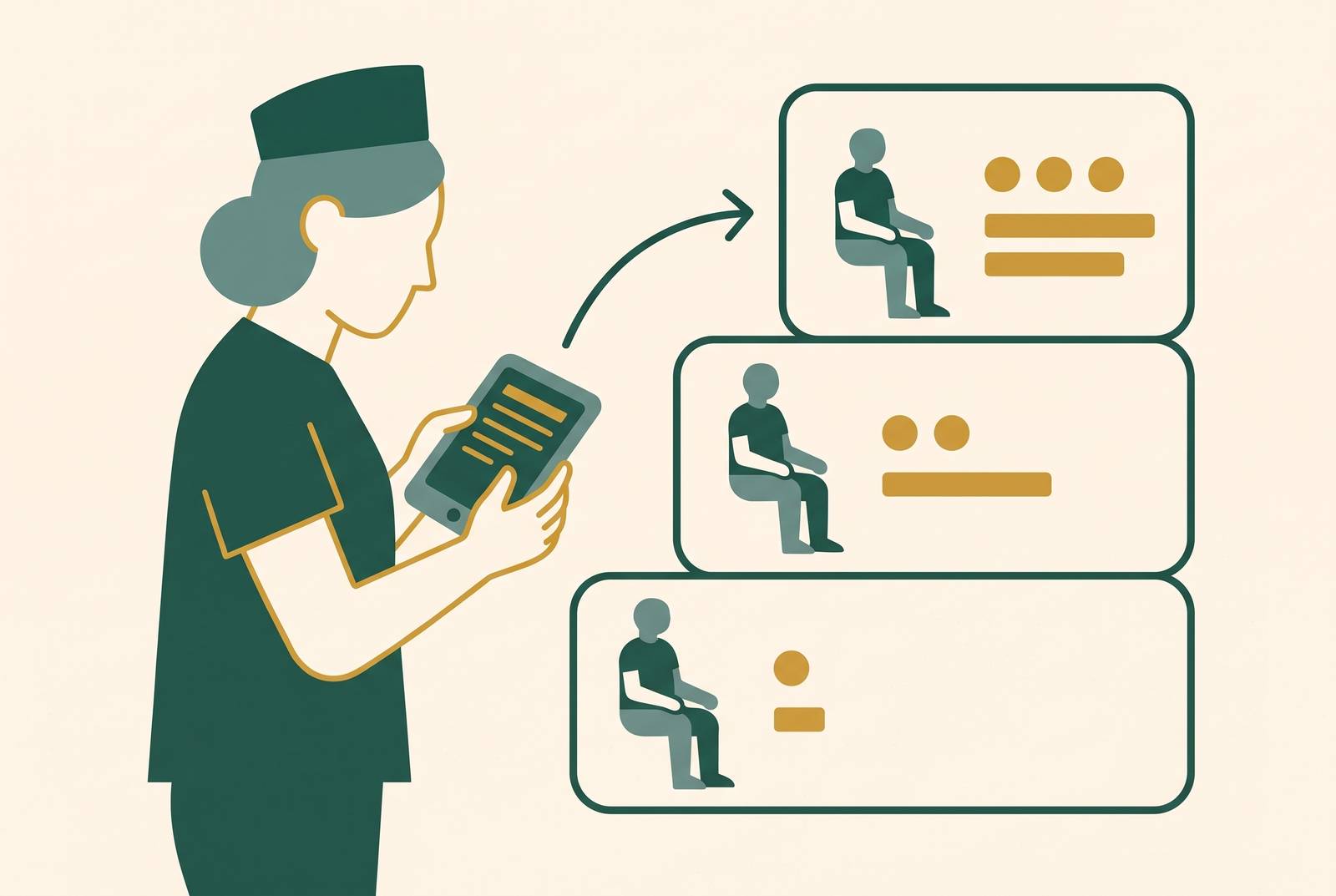
A nursing manager starting a shift in a skilled nursing facility typically has no ranked list of who needs attention first. The rounding order comes from habit, from floor layout, or from whichever resident's call light is on. That gap matters because the population a SNF serves is not stable in the way a fixed rounding schedule assumes. Most residents are frail, carry multiple chronic conditions, and can shift in condition between one scheduled MDS assessment and the next. In that interval, the manager's own rounding is the main thing standing between a resident and an unnoticed decline. Without a signal to tell the manager where to look first, the response becomes reactive: staff deal with the crisis once it has already announced itself, rather than catching the earlier signs that preceded it. That reactive posture is compounded by how SNF data actually lives day to day. Most teams work across disconnected charting systems, verbal handoffs, and shift changes, and every one of those transitions is a place where information can be delayed, dropped, or simply never passed along. A schedule built around convenience, not condition, cannot account for any of this, and the facilities most exposed are the ones that have never had a better option to compare it against.
The signal problem inside EHR data that makes resident risk genuinely stratifiable
You already have the data you need to prioritize residents by risk. Most of that data sits in a form current systems are not built to process at scale. A resident's decline rarely announces itself first in a structured field. It appears in free-text nurse's notes as a refusal to finish a meal, a new streak of agitation, a change in skin color a nurse mentions in passing, or an altered gait caught during a routine check, rather than being logged as a discrete data point on a flowsheet. Rounding-priority approaches built only from structured fields miss this layer entirely, but that is not because the data doesn't exist. It exists in a format those systems were never designed to read. A stratification model that only consumes structured inputs, no matter how complete those inputs are, is working from a partial picture of the resident, because the earliest and often most predictive signals of deterioration live in the narrative notes the structured fields were never built to capture.
The structured foundation: what MDS-derived variables contribute to a rounding-priority model
Any credible rounding-priority model has to start with the data that every Medicare- or Medicaid-certified nursing facility is already required to collect. The Long Term Care Minimum Data Set, known as the MDS, is a health status screening and assessment tool mandated for every resident in a certified facility, and it also determines Medicare SNF payment. It is not optional, and it is not proprietary to any one system, which makes it the one dataset a stratification model can assume is present for every resident, everywhere.
You can already see the value of building on MDS data tested outside the rounding-priority context. A 2025 peer-reviewed study published in Healthcare (MDPI) built a machine learning classification model to predict which SNFs would show high rates of catheter-associated urinary tract infections, using facility characteristics drawn from 94,877 SNF-year observations spanning 2019 to 2024, tested across Random Forest, XGBoost, and LightGBM algorithms. The study doesn't prove that any single rounding tool works. It shows that outcome-specific machine learning models built from SNF-level data can be developed, validated, and published in a peer-reviewed clinical journal, which gives the broader model class a credible foundation.
That foundation has a hard limit built into it. MDS assessments are periodic. They capture a resident's status at a fixed point in time, on a fixed schedule, and by design they cannot see what happens between those points. A resident can enter a dangerous decline the day after an assessment and remain, on paper, exactly as healthy as the MDS last recorded. The structured record gives a model its floor. It cannot give a model the ceiling the rest of this argument is built toward.
Weighting dynamic indicators differently from baseline risk factors
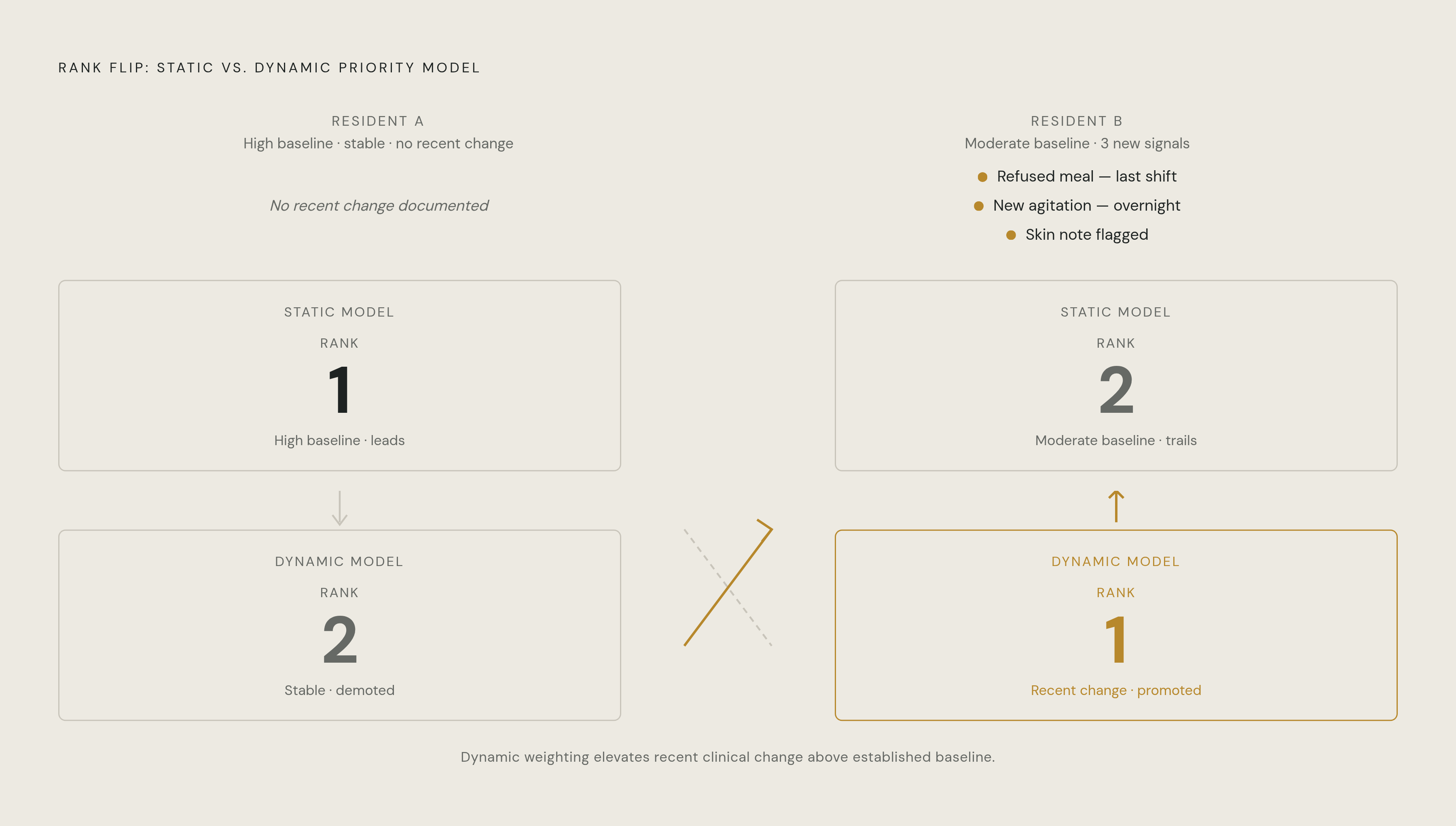
A rounding-priority model only becomes useful when it treats recent change as more predictive than an established baseline. That is the design decision separating a working rounding tool from a static report dressed up as one. Falls, medication errors, dehydration, skin wounds, and behavioral changes, the categories that drive the bulk of regulatory exposure in SNFs, are not fixed traits of a resident. They are incidents that build up out of compounding changes over a period of hours or days, and a model that scores residents only on long-term chronic burden will miss the moment those changes start compounding.
Consider two residents on the same floor. One carries a high baseline risk score but has been clinically stable, with documentation showing no change in days. The other has a moderate baseline score but just had a meal refused, a new bout of agitation logged by the overnight shift, and a skin note flagged for follow-up. So the second resident is the higher rounding priority that morning, even though the first resident's chart would rank higher on any model that weighs cumulative chronic conditions over recent change. Dynamic weighting is what corrects for this: recent documentation carries more predictive weight than a static chronic-condition flag, because the recent note reflects where the resident's condition is heading right now, while the chronic flag only reflects a burden that has already been priced into the resident's known baseline.
Urinary tract infections make the case. They are the most common healthcare-associated infection in SNFs, and they bring longer lengths of stay, higher levels of care, and higher mortality. The signals that precede a UTI, hydration notes, a behavioral shift, a change in output, typically appear in the chart well before the infection becomes a measurable clinical event. A model tuned to catch that early documentation, rather than one waiting for a confirmed diagnosis to update a resident's risk score, catches the problem early instead of treating it after it has already escalated.
At Ocean Healthcare, a tool built to analyze patient data and forecast potential health issues flagged early signs of a congestive heart failure episode before it became acute, so staff could catch a missed treatment and spot a developing pattern before it escalated. The value sits in catching the direction a resident's condition is moving, regardless of the specific condition caught.
Weighting dynamic signals this heavily does add complexity to a model, and it can make the underlying math harder to explain to a nursing manager reading the output. That tradeoff keeps the weights hidden from the manager. What the manager needs is a ranked list and a plain-language reason attached to each resident's position on it, something to act on immediately.
Closing the gap structured inputs leave open with NLP on existing clinical notes
When natural language processing works on the clinical notes nurses already write, it can turn a rounding-priority model from something updated in batches into something that reflects the floor in real time, and nurses don't have to document anything new. NLP techniques pull structure out of unstructured text, and applied to SNF nursing notes, they can parse free-text entries close to the moment they're written, surfacing residents whose notes carry a clinical or linguistic signal that a structured flowsheet would never capture on its own.
Combining unstructured notes with structured data produces a sharper risk picture than either source alone. Large language models have made it possible to work with complex unstructured clinical text in ways that weren't practical before: the embeddings these models generate capture meaning in a nurse's note that no structured field was built to hold, and research has found that text-based representations tend to generalize better across different institutions, a point that matters directly for any tool meant to run across more than one SNF facility.
The design constraint that governs all of this is simple: the model has to run on documentation nurses are already producing. The moment a tool asks staff to enter a new field, follow a new charting format, or double-check an output through a separate step, it becomes one more task layered onto people who are already stretched thin, and it gets sidelined or worked around within weeks. Reading the notes nurses already write satisfies both halves of the problem at once: it captures the dynamic, narrative signal the structured record misses, and it adds nothing to the nurse's workload to get there.
A nursing manager's ranked output at the start of a shift
The value of all this modeling comes due at one specific moment: when a nursing manager opens a ranked resident list at the start of a shift and can act on it without having to decode it first. The output that matters is a prioritized list carrying plain-language flags tied to each resident's position, something like "hydration documentation gap, 18 hours," "new agitation noted in last two shift notes," or "weight loss trend, three consecutive entries." A numeric score the manager has to interpret defeats the purpose. A flag the manager can read and act on in the time it takes to glance at a screen does not.
Because the risk domains behind the model map directly onto the categories that drive regulatory exposure, falls, medication management, hydration, skin integrity, behavioral change, the same ranked list doubles as a running view of where the facility stands on compliance before any surveyor arrives. So a manager working from that list starts the shift with a documented, defensible account of why certain residents were seen first, and that matters directly if a surveyor later asks about rounding decisions following an adverse event.
The ranked view also catches residents that a manager's habitual mental list tends to skip. The resident who is quiet, compliant, and easy to overlook, but who has a compound signal building across several notes, is exactly the resident intuition-based rounding is most likely to miss. And the time a manager would otherwise spend manually pulling together notes and incident logs to build that mental priority list gets returned directly as rounding capacity: more high-risk residents seen in a shift, without adding a single additional shift to the schedule.
The CMS Risk-Based Survey Process and Continuous Risk Stratification as a Compliance Asset
CMS's Risk-Based Survey process went into effect nationwide on September 8, 2026, and it ties a facility's internal risk management practices to a direct, quarterly-evaluated consequence for how closely, and how often, that facility gets surveyed. CMS Memorandum QSO-26-14-NH lays out the mechanics: facilities that qualify get a streamlined inspection, with fewer survey activities, a smaller resident sample, and roughly half the onsite time of a standard survey. The approach was piloted across 22 states and more than a hundred facilities starting in 2023 before this year's national rollout.
Qualifying isn't automatic, and the disqualifying conditions in the CMS memo point directly at the kind of internal monitoring this piece has been building toward. A facility is excluded if it carries any citation for Actual Harm, Immediate Jeopardy, or Substandard Quality of Care from its last survey cycle, if its staffing rating falls below three stars, if it fails an MDS resident assessment audit, or if its health inspection score lands above the 50th percentile in its state, among other conditions. Citation history and MDS audit accuracy are squarely within a facility's control: they reflect whether risk events were caught and documented before they escalated into something a surveyor would cite. But other conditions, like shifts tied to ownership changes, sit outside what any clinical monitoring tool can touch. The distinction matters because it tells a facility where better internal risk detection can actually move the needle.
Eligibility gets reevaluated every quarter, so a single bad cycle, one missed fall risk, one pressure injury that progressed without being caught, one UTI that went undetected until it became severe, is enough to pull a facility out of the qualified group and put it back under full survey scrutiny. The Long Term Care Community Coalition has pointed out that conditions inside a nursing home can shift quickly, driven by staffing changes, management turnover, or shifts in an owner's financial priorities, and that harm can take hold before any publicly reported rating reflects it. That observation supports the case for continuous, predictive monitoring built into daily operations, rather than a facility cleaning up its practices only when a survey is scheduled. A model that surfaces deterioration signals before they turn into adverse events functions as clinical infrastructure and as the compliance backbone that determines where a facility stands under the new survey framework.
Reducing friction in nurse leader readiness for implementing a risk stratification model
Every argument made so far assumes the tool gets used. Adoption depends on whether nursing managers feel it backs up their clinical judgment. A 2024 study found that just over a third of nurse leaders showed high readiness for integrating AI into their work, with readiness correlated to how much benefit they expected to see in care planning and day-to-day decision-making. The flip side of that number carries its own weight: most nurse leaders are not yet highly ready, and that's a real headwind facility operators have to plan around.
In that study, readiness tracked with age, educational background, and employment status, so it is not spread evenly across a facility's nursing management team. If rollout plans treat every nurse leader as equally prepared, they will run into resistance you could have predicted from the start. The single biggest driver of that resistance is added burden: a tool that asks nurses to enter new data, learn a new charting format, or double-check its outputs through some separate process will get pushed aside within weeks of launch, no matter how sound the underlying model is. Build a system to run on the notes nurses already write, producing a plain-language list a manager can read in seconds, and it is built to survive that test. One built on top of new workflow demands is not.